Praying with the Planets (Part One)

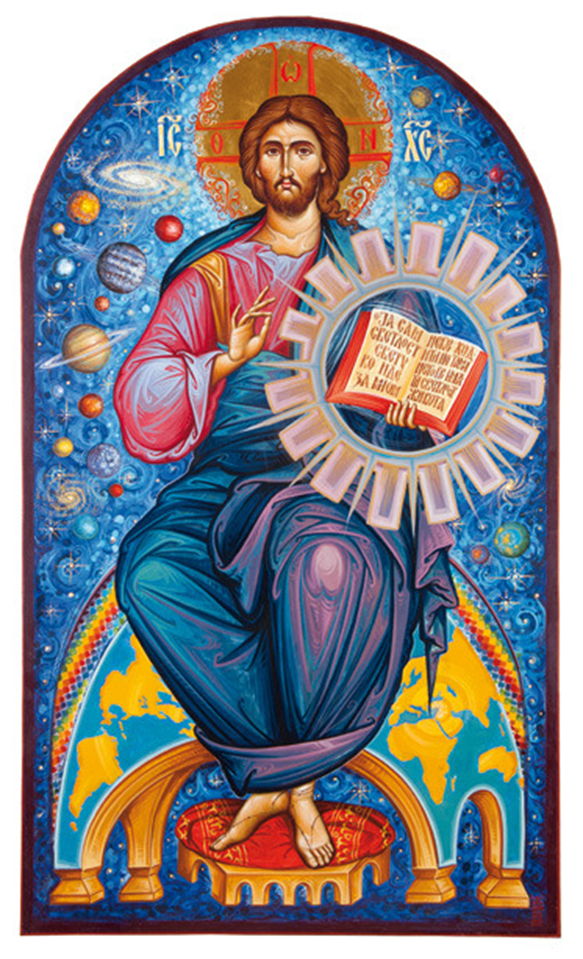
Jesus Christ Pantocrator, Vasilije Minić

For a long time now, a principal spiritual practice of mine has been the work of the Daily Office, a cycle of readings and prayers based on the time-sanctifying rhythms of monastic life in the Benedictine tradition.

Most spiritual traditions of the world have some way of weaving together prayer and time, and the Christian heritage is no different. Taking a cue from the practice of desert hermits and monks in the early centuries of the Christian movement, St Benedict of Nursia gave the West its characteristic form of the Divine Office, with attendant readings from scripture, refrains to be chanted, and prayers to be offered at set hours during the day, seven days a week, 365 days a year. The rhythms of the Daily Office become a trellis on which can grow the wild tendrils of a soul entering into the fullness of love.

I’ve been praying the Office in some form or another since 2010, and my preferred form these days is a simplified version of the order given in the Episcopal Church’s Book of Common Prayer. Toward the end of the order for Morning Prayer, the BCP gives two lists of suffrages, or petitionary prayers, that comprise several versicles and responses taken from the psalms:

Show us your mercy, O Lord;
And grant us your salvation

Clothe your ministers with righteousness;
let your people sing for joy.

Give peace, O Lord, in all the world;
for only in you can we live in safety.

Lord, keep this nation under your care;
and guide us in the way of justice and truth.

Let your way be known upon earth;
your saving health among all nations.

Let not the needy, O Lord, be forgotten;
nor the hope of the poor be taken away.

Create in us clean hearts, O God;
and sustain us with your Holy Spirit.

Unbidden, the thought struck me one morning as I made my way through them, chanting each versicle and response in my usual manner: these prayers make a maṇdala.

The thing about studying and practicing astrology is that it trains your brain to look for specific patterns as a means ordering our experience of the overwhelming quantity of sensory impressions we take in as we move through this world. In other words, it becomes difficult not to see two sets of seven without curiosity rearing its head. Given that seven is an archetypal number of cosmic perfection, and given the diurnal context of this set of prayers—after all, the seven days of the week take their name from the seven moving lights in a majority of cultures—I wonder: is the pattern here intentional?

I can’t say, and I don’t think that any such assertion could be proven directly. But what we can affirm is that the pattern of versicles and responses at the end of a prayed office is something with historical roots from a time when astrological consciousness was still shaping, in an overt way, the shape of private and communal prayer in liturgical Christian tradition.

The particular set of suffrages I have in mind (set A in both Rite One and Rite Two of the Order for Morning Prayer in the 1979 prayer book) is based on a set of suffrages contained in the liturgies of the Sarum use, an expression of Western Catholic ritual practice that developed around the traditions of Salisbury (Sarum) Cathedral in the late eleventh century and lasting until the English reformation, at which time Thomas Cranmer revised and condensed materials from the Sarum use into the first Book of Common Prayer.

According to Marion Hatchett’s commentary on the 1979 Prayer Book, the original set of suffrages on which these were based originate in the Sarum office of Prime, meant to be said in the first hour of the day. That said, Hatchett reveals that the version before us is a revision and expansion dating from 1979 (Hatchett, 124). So we cannot say that they are directly reflecting a historical reality.

However, I do think it is fair to say that the astrological consciousness present in pre-modern Europe—which is really nothing more complicated than an embodied awareness of the qualitative dimension of time, an awareness that we have lost in post-industrial modernity—is a through-line connecting the 1979 suffrages to their ancestors in Salisbury. This is, perhaps, an instance of what my teacher Cynthia Bourgeault would consider “imaginal causality, or the preeminence of archetypal pattern over historical facticity.” Bourgeault continues,

“According to this mode of seeing, the patterns that generate and organize the energy field of our visible world oringate beyond time (on a higher plane of reality and are transmitted largely through images (hence imaginal) impressed upon the still mirror of the contemplative imagination… In imaginal causality, the overarching pattern determines the field in which linear causality plays itself out. If a pattern can be shown to make sense of the data, to give energy and coherence to the field it is organizing, and to offer intelligent and useful directives for future action, then it is deemed to be true, whether or not it is, stricly speaking, historical” (Cynthia Bourgeault, The Holy Trinity and the Law of Three, 64).

Whether or not the suggestion of astrological line-up is intentional historically, the sevenfold alignment is enough of a cue to suggest that imaginal causality may have been at play in the contemplative imaginations of the compilers of the 1979 BCP (and only contemplatives could have written Prayer C, as far as I’m concerned). And so my curiosity remains: what might the planetary correspondences reveal about the inner meaning of the versicles? How might these versicles in turn help us to better understand the sevenfold structure of the reality in which we live and move and have our being?

Is there something here that helps us to pray these more effectively, with deeper feeling, with deeper attention, to help us route the wellspring of divine energies we experience as eros unto the transformation of the one praying and the relationships of causality that bind people and planets together?

And perhaps this this line of questioning goes beyond merely understanding the structure within which our life unfolds in time. I wonder whether, in praying these versicles, we might be offering an invitation to the reflections of the planetary archetypes which live within us to manifest in a way that reflects the spirit of wholeness in which the cosmos unfolds.

How do these prayers shape our subconscious, imaginal, and causal reality? In other words, can these prayers be the basis for upaye (“remedy” in Sanskrit), and therefore a tool for remediating adverse conditions and inclinations reflected in a person’s nativity?

My wager is that the answer is “yes.”

Astrologers reading this might ask, “Why weekday order and not Chaldean order?” One, my jyotish-pilled brain defaults to weekday order, and if you simply lay the two orders next to the suffrages as given you’ll see how the weekday order corresponds more closely to the themes, as you’ll see below.

But there’s also a deeper level to this choice (whether consciously editorial or not): because this is a prayer that is meant to be said at the same time every day as part of a daily rhythm, the structure of consciousness within which these prayers live and have their intended effect is the pattern of days as we experience them here on earth.

(And besides, the weekday order and the Chaldean order are tied to one another anyway by way of the planetary hours, which themselves gave shape to the pre-Reformation forms of the Daily Office in use in the British Isles, but that’s an article unto itself.)

So, what I endeavor to do in what will be a series of posts is this: I want to take each of these suffrages, and unpack them from the level of kāraka, a Sanskrit word meaning “signification.” Each of the prayers carries its own energetic reality that reflects its planetary position in weekday order, an energy that the kārakas present in each line hold.

Another intention of mine is a desire to expand these suffrages to a nine planet scheme to include the lunar nodes (Rāhu and Ketu), as would be even more appropriate for an astrologer in my own contexts. How might the selection represented here inform how we might go about identifying appropriate verses for them? That’s what I want to find out.

Here’s the set of prayers, presented with their astral correspondences and their source texts in the Psalms. Curiously, the one that aligns with Mercury is a prayer that does not have roots in the Psalter, but rather draws from another part of the BCP. If you’re not familiar with them, just read them as given and get a sense for their feel, both individually and as a planetary maṇdala.

SUN (Psalm 85.7)
Show us your mercy, O Lord;
And grant us your salvation

MOON (Psalm 132.9)
Clothe your ministers with righteousness;
let your people sing for joy.

MARS (Psalm 122.7 & Psalm 4.8)
Give peace, O Lord, in all the world;
for only in you can we live in safety.

MERCURY (Based on the collect For Peace Among the Nations, p. 816)
Lord, keep this nation under your care;
and guide us in the way of justice and truth.

JUPITER (Psalm 67.2)
Let your way be known upon earth;
your saving health among all nations.

VENUS (Psalm 9.18)
Let not the needy, O Lord, be forgotten;
nor the hope of the poor be taken away.

SATURN (Psalm 51.10a, 12b)
Create in us clean hearts, O God;
and sustain us with your Holy Spirit.

(Here I am, standing at the confluence of the Jordan and the Ganges (and I guess the Thames, too), trying to hold it all together in what will either be a fool’s errand or an offering of bhakti for the divine energies revealed in reality. We will see!)

If you’d like to practice with them and experiment with the wager yourself as we make our way through the maṇdala, nothing prevents you. If you’re not already a practitioner of the Daily Office, you can simply begin by finding a few quiet moments in the morning, lighting a candle, centering yourself. Say the Lord’s Prayer, then quietly repeat each of the suffrages, then a Hail Mary and a Glory Be. See how that feels, and let me know.

(I’ll be cross-posting this whole series over on my personal website, too.)

New Workshop Opportunity: You Can Always Call Mom!

YOU CAN ALWAYS CALL MOM: An Intro to Mary for Modern Seekers

Wednesday, March 13th, 2024, 6-8PM Eastern via Zoom

In this moment of planetary crisis, many of us are searching for a guiding star, a wellspring of comfort and strength, a vessel that can hold our deep grief and our deep longing. The good news is that you can always call Mom. In this introductory talk, I invite spiritual seekers from all backgrounds and faith traditions to discover the protecting presence of the Divine Mother as embodied in Mary, the mother of Jesus. 

Mary represents the universal figure of Mother—offering solace, understanding, and an unfathomable depth of love. But she is also a real human mother. She stands as a testament to the power of witness, courage, and inexhaustible love in the face of suffering—both personal and planetary. 

Mary’s role extends beyond her earthly existence; she is the gateway to embodying the divine qualities of mercy, justice, humility and love. She leads us in practicing these qualities in solidarity with all who are suffering. Together we’ll learn to connect with Mary’s spirit, drawing upon her strength and compassion to navigate the challenges of the modern world.

In this introductory talk, we’ll:

  • Reflect on the meaning of Mary as “divine mother” and as a historical woman
  • Consider the role Mary plays as an archetype, icon, and advocate in this moment in history
  • Lay the groundwork for deeper exploration of Mary’s images and titles
  • Learn a simple ritual to connect with Mary’s presence
  • Explore first steps in Marian devotional practice by diving into the Hail Mary prayer

“You Can Always Call Mom” is more than a one-off talk. My hope is that it serves as an invitation to a transformative relationship with Our Lady, a journey towards becoming a clear pane of glass through which love can illuminate the world. Whether you’re seeking healing, guidance, or a deeper sense of belonging, this class offers a welcoming space to explore the mysteries of Marian devotion and its potential to inspire change, both within and around us.

A suggested donation of $27 is recommended; a portion of the proceeds will go to the SHARE Center of Battle Creek, Michigan. All my classes and talks strive to be queer-affirming, antiracist, interspiritual settings.

Register here!

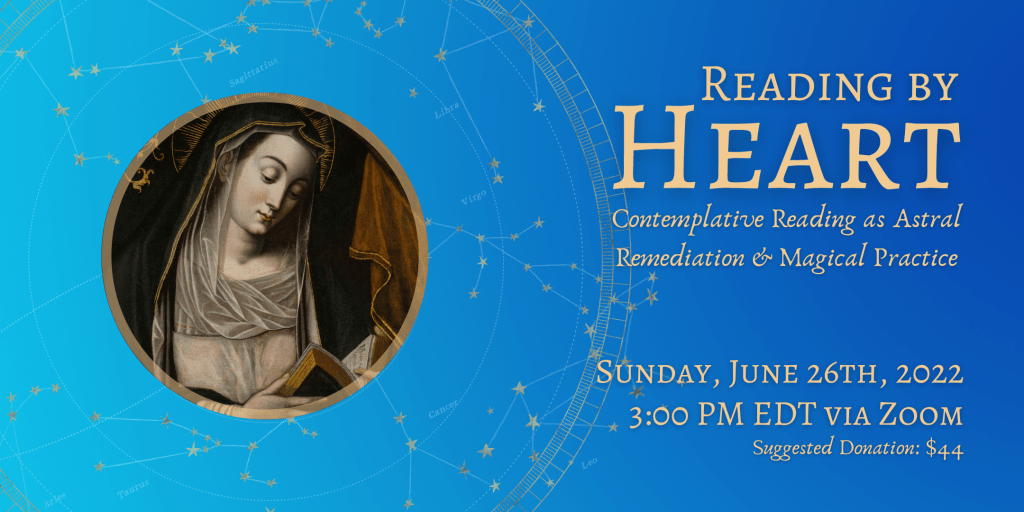
New Workshop Opportunity: Reading by Heart

I’m pleased to announce my next upcoming workshop, Reading by Heart!

Join me on June 26th at 3:00PM EDT to learn a centuries-old contemplative technique to unlock the subtle and transformative magic of any text that speaks to your heart.

The centuries-old Western meditative technique of Lectio Divina, or divine reading, has enjoyed newfound popularity in recent decades among spiritual seekers of all faiths. Long hailed as a tool for opening one’s innermost depths to divine presence, lectio divina has untapped potential as a tool for astrological remediation and as a magical practice in its own right.

Only recently did I realize the impact that this methodology of contemplative reading has had on my ability to read astrological charts and bring them to life in that subtle world of inner experience where the currents of my own being intersect with the imaginal. It’s been the single most important thing in helping me to break through plateaus and barriers in my astrological practice, and I suspect this can help you get unstuck, too.

I’ve had this intuition for a while, and I even sketched out the idea for a model of contemplative reading as a tool for bringing the chart to life in the last chapter of my book (which you can buy here!)

But it’s taken until now for me to have the necessary roadmaps, both Western and Eastern, to describe the why and how of contemplative reading: why it works, how it works, and how it changes the way we perceive reality.

It’s also taken me this long to distill the necessary personal experience in working with the technique, both in my own reading of my traditions’ sacred texts and in reading the arcana of astrological charts and texts.

Not only will this help you as a reader of charts, it’ll also help you crack Valens or Manilius or Lilly or Parāśara or the Orphic Hymns or whatever other text you’re working with. Whether you have a teacher or not. Whether you’ve been at this for three months or three decades. Any sacred text can be opened more deeply with lectio divina, and my definition of “sacred text” is fairly broad at that.

When I talk about contemplative reading, I’m talking reading for depth, but not just that. I’m talking reading from a Wisdom perspective, with the thinking, feeling, and sensing centers of knowing. It’s not just having a deep cognitive understanding of the text; it’s about allowing the text to become part of your imaginal being, part of your causal body, from which it shapes how you see and show up in the world. It’s about fully digesting the text, with all the impressions and archetypes it carries.

I guarantee that if you work with your chosen text in this way on a regular basis, it will shift your reality. I’d love the privilege of sharing what I know with you and giving you a powerful tool to see reality, both physical and imaginal, more clearly and intimately.

This workshop will introduce newcomers to the method and mechanics of lectio divina with emphasis on the experiential dimension of the technique. We will also explore the ways it can be applied to practical magic and to remediating adverse combinations in the natal chart. Lectio divina as a technology can be used by any person with any text to bring it to life in new ways that can reshape one’s reality, regardless of faith tradition or spiritual practice.

Recordings and handouts will be available to all participants. A donation of $44 is suggested; a portion of the proceeds will be given to VOCES of Battle Creek, Michigan.

Register here!

Why Sidereal Astrology?

I suppose the easiest way to start this is simply by saying that I’m doing sidereal astrology now.

Starting on the first of this year, I transitioned to using the sidereal zodiac exclusively for my work with natal charts and revolutions. (My teacher, if he’s reading this, can rest assured that I’m still using tropical for horary—and I think that there’s a solid rationale behind the apparent dichotomy, but that’s for a different article). The truth is that I initially started drafting this article in February of 2021, and I’m only now, in October, getting around to posting it.

Well, there it is. It feels a little bit like coming out; it’s certainly got the psychic feeling of “taking a stand,” even though I’m actively not taking a stand or identifying with the technique here.

Please note that I have not said, “I am now a sidereal astrologer.” There’s much to be said about the use of “I am” statements when describing our techniques of choice in the greater astrological project of deriving meaning from celestial data. I also want to be completely up front that a huge inspiration for me in following this path has been the work of Dayna Lynn Nuckols, a brilliant colleague and friend who has been bootstrapping sidereal astrology in a Western context through her unique, intersectional, liberation-oriented lens, and I am grateful for the work she’s done. Please go check out her work here.

So what am I trying to do here? Perhaps a better question to start with is what am I not trying to do here: I am not trying to prove anything. Nor am I at all interested in a debate over which zodiac is “right.” My only purpose is to share my reasoning and explore some of the lines of thought on which I ferried myself to this shore. I think telling the story is more interesting than proving a point, anyway. I’m simply choosing to use a different lens. And that’s really the point of this article, as a public update to my readers, and to my clients, that this is what you can expect when working with me now.

(Oh, by the way, I still do horary from a tropical, quadrant house perspective, since that is the lineage I was trained in.)

Tropical and Sidereal, Together at Last

For those who aren’t familiar with the tropical-sidereal distinction, many astrologers have treated that topic in sufficient measure such that to rehash the whole thing here will be a waste of everyone’s time. It would also be a waste of everyone’s time, I think, to go through all the reasons for why one is better than the other. We humans are pretty skilled at finding data that supports our biases, whatever they may be.

But, for the sake of context, the tropical zodiac sets 0° Aries as being the point where the ecliptic intersects the celestial equator as it is increasing in longitude, viz., the vernal equinox. The sidereal zodiac sets 0° Aries differently based on the fixed stars, at the beginning of the constellation of Aries (and there are a number of ways to determine this, too).

The difference between the vernal equinox and the beginning of Aries in the sidereal reference frame is called the “ayanamsa,” a compound word in Sanskrit roughly translated as “equinoctial difference.” This difference is generated by the earth’s slow wobble on its axis, a motion that is only perceptible over generations, such that every 72 years or so, the difference between the vernal equinox and the beginning of Aries increases by one degree of longitude.

The difference these days is about 24° degrees, and that “about” is important because there are different astronomical means of identifying the starting point for Aries.

Aries itself is much more than just a “constellation,” of course; the Sanskrit word rāśi, meaning “pile” or “heap” of something, describes not just the vanilla “sign” of Aries but everything it contains—individual degrees, Nakshatras (though that’s not quite accurate, as the nakshatras are properly a lunar zodiac, but… they get tossed in the pile with the others), harmonic divisions (which give us “divisional charts” in jyotisha, as well as the dodecatemoria of Hellenistic practice), particular fixed stars, even on down to individual degrees with different qualities like “bright,” “smoky,” “pitted,” and so on.

The problem with having begun my learning of astrology with a tropical framework is this: the fixed stars and the sky-as-it-is-observed have always been my primary muses, ever since the days of my youth. I learned constellations first, as a child; I knew where to find Leo, Virgo, Libra, Scorpio in the late twilight of spring and summer, as well as the constellations wheeling around the pole star. Those images and myths took root in my imagination. Even though I learned to work within the tropical framework as a dutiful student (and that framework is still immediately valid and descriptive of reality), the older way of simply seeing continued to exert a gravitational pull on my reasoning. My nascent training in astrology, at least from a contemporary Western perspective, had created a tendency in me to smooth out all the delicate intricacies and splendid variations to be found in each of the constellations into a kind of generic “sign.” But that wasn’t working for me; the “signs” had ceased to come alive for me in my imagination as I prepared charts.

And so I asked, and meditated, and journeyed, on questions that emerged out of this tension: for instance, why is the very heart of the Lion no longer tied to the imaginal gestalt that generated the mythos of Leo in the first place? For nowadays, the Lion’s Heart, Regulus, is within the sign of Mercury’s exaltation, not the Sun’s domicile. That’s just an example of the particular kinds of questions that this tension generates. I don’t believe the solution is necessarily to try to shoehorn one reality into the other, either.

Several things occurred in 2020 to move this further down the road, and the rest of this series of posts will speak to each of these experiences. Among them include my newfound love of Jyotisha, the tradition of astrology as a limb of Vedic knowledge, which I have been studying in the Sri Acyutanānda Parāmparā (lineage) since autumn of 2020 with Freedom Cole. I also spent time learning primary directions from Martin Gansten‘s work, adopting his framework as my own for the sake of learning and finding, to my chagrin, that primary directions of the hylegiacal points through the terms, using the sidereal zodiac (Lahiri ayanāṁśa), described moments of transition, turmoil, and transformation in my own life and the lives of my clients with a remarkable degree of precision and fidelity.

But what really sealed the deal was a series of mystical experiences that occurred to me while observing the fixed stars in an altered state of consciousness under the skies of rural Kentucky and on the shores of the Atlantic Ocean over a period of several years, each one calling me deeper to this expression. There is a gnosis, Wisdom, that can only be distilled from the crucible of direct encounter with a Living Presence making itself known to the Heart, that seat of spiritual perception, which is staggeringly difficult to put into linear arguments. But I will say it like this: when thinking sidereally and approaching the chart from a tuned-in, open-hearted posture, the rāśis and the planets come alive for me on the imaginal level of consciousness in a way that they never have in the tropical perspective, following these experiences. It is on this level of my being that these experiences have ground-truthed the “rightness for me” of a sidereal perspective.

On Living Images

I’d like to go a little more into some of the thought process that I’m working with as I navigate this sea change. The late Hellenistic astrologer Alan White, in his flip-chart lecture which Chris Brennan shared on his podcast last year, made a point of articulating something that I feel is lost when we’re discussing this today: the zoidia themselves, the living images themselves, are the ones who grant domicile to the planets—including the Sun, who is granted domicile by the living image of the Lion.

I do not actually believe that there is a great Lion out there that has given the Sun domicile. I mean, maybe there is, but if there is, it is not within the realm of physical manifestation; it is an imaginal process, even a causal one, that was part and parcel of the arising of consciousness here on this planet. Our ancestors looked to the stars themselves and saw there a beast, a bird, a hero, a harp, what have you; and it is those imaginal realities that take on a life of their own. Those images come to life, and specifically those images, for it is within them that the Sun, the seat of consciousness and the spark of life itself, spins his golden thread. They become zoidia. They become “living images.”

When I say “stellar images,” I literally mean the stars themselves as viewed and mythologized within human awareness. You cannot see tropical Scorpio. But, the gift of apophenia—a feature, not a bug, at least as far as the eye of the heart is concerned!—readily gives us a Scorpion, a Lion, and so forth.

The very word “zodiac” derives from the Greek term zodiakos kyklos, “the wheel of living images.” And the word “image” here is a rich one—it can certainly speak to the imaginal reality of, for instance, the tropical sign of Sagittarius, associated as it is with pre-Christmas prodigality. Yes, there is something there that is key to the psycho-social experience of embodied humans, something which I believe is tied directly to the Sun itself—archetypal image of consciousness though it may be—defining the beginning of this frame of reference.

So I keep returning to the idea of these images themselves. The great Lion. The Scorpion. The Bull. These stellar images seem to have an archetypal Realness within the human psyche that one cannot necessarily be separate from entirely no matter how far the vernal equinox has precessed. Stellar images such as these exist within the inherited ancestral and cultural stories of a great deal of the world. These same living stellar images have shaped not only Western culture but Eastern cultures as well as they have been carried along the Silk Road and inculturated in various forms throughout central and south Asia on through the Mediterranean basin.

These living stellar images that have taken on a life of their own within the human consciousness. (I happen to believe that conscious observation and interpretation of celestial phenomena is actually the mechanism through which astrology works, but that’s another article). When we remember that, in the cultures which gave us horoscopic astrology, the Sun is not just emblematic of life itself, but is also symbolically entangled with the concept of nous, with mind, with conscious awareness, the conversation really gets gravel under the tires.

I believe that the gestalt of these images have their own kind of archetypal force that functions differently from the divisions of that same golden line of sunlight when the Sun himself becomes their author and finisher. In other words, one might say that Pisces, for example, is oceanic, watery, benefic, sattvic, all of these things, in either zodiac, but the locus or dimension of reality in which those qualities take form might be different depending on the subtle lens through which the interpreter is viewing this one Reality.

My way of looking at it is like this: the frame-of-reference articulated by the Sun itself (0° Aries at the vernal equinox) will readily give us insight into localized issues of psychology and will, which gives the tropical framework remarkable utility in exploring the human person, especially the human person as understood through the cultural consciousness that has developed as the West has moved into the perspectival and mental structure of consciousness—a structure of consciousness which is now in the crisis of giving birth to aperspectival consciousness. (For more on this, please see Cynthia Bourgeault’s wonderful blog series accompanying a reading of Jeremy Johnson’s Seeing Through the World: Jean Gebser and Integral Consciousness.)

But the stars are the Sun’s peers—and, in many cases, his superiors, if we’re to mythologize the Sun’s exceeding ordinariness among all the stars of our local neighborhood—and I think that those Living Images themselves, which burst forth in the fecund ocean of human consciousness, after thousands of years of our species’ observing them and weaving our narrative experience around them over millennia of our common life, are part of the package when it comes to analyzing reality.

If you need me to say it this way, here you go: I believe the tropical and sidereal zodiacs function as two lenses upon the same reality, two lenses with which one may answer different questions. My opinion (and it’s exactly that!) is that the sidereal zodiac describes reality on the causal level of consciousness, and the tropical zodiac describes the realities we create for ourselves in our mind on the subtle level of consciousness—teasing those levels out is beyond the scope of this article, but I am working with a version of the gross-subtle-causal-nondual cosmologies of the Eastern traditions as articulated in large part by the work of G. I. Gurdjieff and described for the average reader in Cynthia Bourgeault’s wonderful book on the imaginal realm, The Eye of the Heart. 

Anyway! I’ve always wanted to use the fixed stars as my principal reference frame for astrological reasoning. And now I finally am.

But I don’t believe that’s actually the endgame of this process of developing aperspectival consciousness through astrological practice: ideally, the practitioner should be able to see through the world, through all perspectives. And when aperspectival consciousness has fully saturated the ordinary waking state of our awareness, the question of “which zodiac is the right one!?” (or the question of which house system is right, or any of these other dialectical entanglements we clothesline ourselves with) takes on a dimension of freedom and joy that our hungry ghosts of Western culture’s need to find the One True Perspective™ over the last 600 years continually threaten to take from us.

But that, my friends, is for another article.

By the way: I am in the final stages of completing my first year training with Freedom Cole in jyotisha, and I would like to do practice readings for you at a significantly discounted rate from my usual fee. If you’re interested in a jyotisha reading, you may schedule one here!

Featured image by Manouchehr Hejazi via Unsplash