My Favorite Psychopomp: Virgo, Mercury, and the BVM

I’m undergoing something of a spiritual key change.

I’m playing variations on the same material I always have, but as my understanding has deepened and broadened (and as Jupiter has been transiting my 9th house in Scorpio), I find that these days I’m playing this material at a new pitch level that’s requiring any number of adjustments to compensate for the untold variety of different harmonics and intonations that my life’s song is generating at this new pitch. In fact, it’s almost as though there needs to be a pause for re-instrumentation, because some instruments can’t play in A major as easily as they can play in B-flat major, if you’ll allow my overblowing of the metaphor.

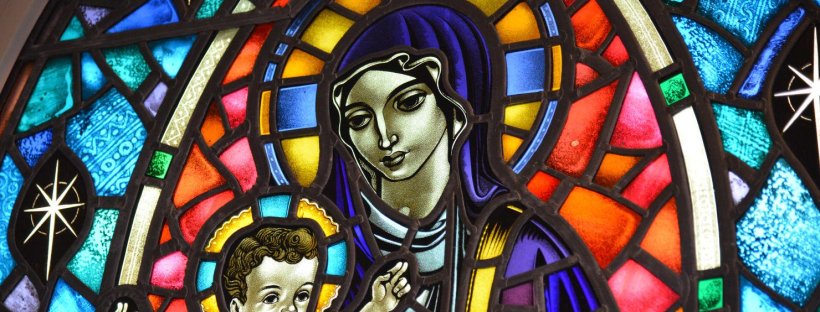
The Blessed Virgin has a hold on the scruff of my neck that doesn’t seem to let up, regardless of how my spiritual schemata continue to shift and grow and change under Jupiter’s enervating influence. She’s been in my corner for quite a while, as far as I can tell. Which is why this particular Virgo season has me thinking more deeply about the connection between the sign of the Virgin and the person of the Virgin, both as an archetypical reality and as a means of interpreting things going on in Mercury’s nocturnal home.

The association between Virgo and the BVM is a facile one, and I’m well aware that there are any number of myths undergirding both the sign and the constellation of the same name—most notably Astraea and her Eagle—but, for me, the connection to the BVM mythos is doubly strong because of my particular religio-cultural context. I’m also a Virgo Sun, so, I have lived the bulk of my life growing into an understanding that a fundamental ego purpose of my existence is to adapt and to perfect within the material realm.

While listening to commentary on Virgo placements during an episode of my friend Melanie’s podcast, I suddenly found myself thinking once again about this connection between Virgo and the BVM not because of any sacred baggage we might attach to “virginity” but rather because of the idea of “adapting to material learning” that Demetra George uses as a byword for Mercury’s purposes in Virgo.

Virgo is, when you’ve gotten down to the heart of its significations, primarily about making things real. This is why Jupiter struggles so hard here, and most Virgo Jupiters I know skew towards a particular kind of over-examined rigidity whether in faith or in skepticism. Mercury, however, rejoices to make things real, taking ethereal concepts like words and meaning and value and transmuting them into material things that we can pick up and share and carry around with us and distribute and hoard—things like money, or books, or words, or even ideas themselves. Mercury transforms the extraordinary things of our hopes and dreams and wildest imaginations into the ordinary stuff of everyday life, but in the most extraordinary of ways.

With this movement towards reality in mind, I want to look again at what I consider one of the peak moments of the story of Mary in the New Testament, namely, her song of exultation after having shared with her relative Elizabeth what has happened to her, viz., being told by the angel Gabriel that she is to give birth to a messiah:

My soul doth magnify the Lord,
And my spirit hath rejoiced in God my Saviour.
For he hath regarded the low estate of his handmaiden: for, behold, from henceforth all generations shall call me blessed.
For he that is mighty hath done to me great things; and holy is his name.
And his mercy is on them that fear him from generation to generation.
He hath shewed strength with his arm; he hath scattered the proud in the imagination of their hearts.
He hath put down the mighty from their seats, and exalted them of low degree.
He hath filled the hungry with good things; and the rich he hath sent empty away.
He hath helped his servant Israel, in remembrance of his mercy;
As he spake to our fathers, to Abraham, and to his seed for ever.
(Luke 1.46-55, KJV)

There is a lot that could be said here, but I want us to think about this: the story of Mary, a peasant girl from a nowhere town with no social prospects, who has become pregnant out of wedlock and has an unbelievable story about precisely how that happened, who is part of a people group who live under the thumb of oppression, has every reason to expect that her wildest dreams will never come to fruition and to linger in Piscean/Jovian dissolution. To wit, she is easily the first candidate for someone we would imagine would have no recourse in this world but to escape into flights of fancy.

But if we notice how the writer of Luke’s gospel has recorded Mary’s words, we notice one thing: nothing is in the subjunctive. All of her declarations are in the perfect tense; they have been accomplished, and there’s nothing left to wait for or to let remain the purview of dreams. Notice too that Mary’s Mercurial song of transmutation and magnification takes an easy potshot at everything Jupiterian or Piscean: “[God] hath scattered the proud in the imagination of their hearts.” After all, magnification is the very process by which the small becomes visible.

Mercury has transmuted what we would expect to be Piscean idealism and dissolution into the here and now, and not just the spiritual here and now, but the real socio-political right here, right now—what Mary sings of is not “salvation” as in being removed to some far away place, but rather the kind of salvation that manifests in corrupt governments being overthrown and the last and the least being given, at last, justice and equity in their plight. Adaptation to material knowledge, indeed.

Virgo scatters imaginations and flights of fancy to magnify the utterly real day-to-day stuff; Mary’s song draws the reader’s attention to that which is most on the minds of this oppressed and colonized people group and states, in no uncertain terms, that what was once the exclusive purview of dreams and prophecies has become as matter of fact as the sky’s being blue. That seems to be what it is that Virgo does, and likewise what the BVM does with all of us who have a connection with her ancient and archetypical image: she magnifies and realizes, leaving us unable to let that which is most important to us remain the exclusive purview of some far-off hope.

I’d also add briefly that Mary serves an important role as psychopomp and intercessor between humanity and the divine. Considering the overlapping function of Mercury within Greco-Roman mythology, this is not something to overlook. I surmise that this is one of the reasons that the BVM-as-Virgo archetypical notion serves to reinforce the idea of the priorities of Virgo being servile and helpful. If Mercury in Gemini is a fleet-footed go-between, Mercury in Virgo is much more strongly connected to the idea of advocacy and assistance—an “in” with the divine, so to speak, which is precisely the BVM’s function in non-Protestant religiosity.

Perhaps this is another one of the reasons that I have such a devotion to her. Because I was socialized believing that God is fundamentally “male” (even though that’s not a defensible position theologically) and, after all, I’m afraid to talk to men. But I can talk to Mary any time with the ease and facility of talking to an old friend’s mom at the dinner table. This ease and facility is another one of Virgo’s key significations, for Mercury here can adapt immediately to any incoming information or material and get it precisely to where it needs to go in order to be most effective, just as Mary and other such psychopomp figures can route incoming souls, prayers, magics, etc. to precisely where they will be most effective.

It’s with all this in mind that both my spirituality and my astrological practice continue to grow and reorganize as I draw close to my next solar return—which will ensconce the perfecting Mars/Uranus square as thematic of the next twelve months, and Mars rules my 9th. All that to say, what key this life-music will end up in by next September is anyone’s guess, but at the very least my Virgo sun will know what to do with all of that information when I get there.

Featured image by Jochen Rehm | Alamy Stock Photo

Spring Cleaning: the Virgo Lunation

Today on the Twitter™ a friend posted the following:

The Virgo moon asked me to discern. Asked me to purge. Asked me to focus. In a way, this is what i imagine Lent feels like…♍🌛🌕🌜

To which I said, immediately, “hey, yeah, that’s exactly what Lent is about.”

In my faith tradition there is a season that precedes the holiest days of the year, viz. Holy Week, which culminates with Easter. We call this season “Lent,” or in Latin, Quadragesima. The word “lent” is related to the French word lent, meaning “slow,” which is evocative of the journey our tradition takes us on: we spend the forty days (quadragesima) preceding Holy Week slowing down, “discerning,” “purging,” “focusing,” to use the words my friend used, so that we can better appreciate the promises, the gifts, and the joy that the Easter season brings.

In a felicitous calendrical accident, we have a Virgo full moon marking the midpoint of the season. It so happens that, because of the way the calendar works and because of the calculation of the dates for both the Jewish festival of Pesach and the Christian celebration of Pascha, we always have this Virgo full moon occurring every year during this season—and it is exactly the symbolism of this particular full moon that so richly captures the process of Lent and similar processes in other religious traditions that seem to happen this time of year (to say nothing of general “spring cleaning” as the Sun makes his transit through double-bodied Pisces as winter dissipates and we shake out the dust of our hibernation).

The symbolism of double-bodied, or mutable, signs is rooted in the change of seasons as one season falls away and yields to the next. Each of these signs (Pisces, Gemini, Virgo, and Sagittarius) has an obvious “double bodied” icon: the two fish, the twins Castor & Pollux, the virgin Astraea and her eagle (or the Virgin Mary with the Dove, pick your legend), and the two-bodied centaur Chiron, the tutor of Achilles. Each of these signs marks the time of the year where the story of the year bridges two seasons, and each calls for adaptation, adjustment, and yielding to change.

Virgo is the double-bodied sign of the earthy triplicity: indeed, a full moon lunation in this portion of the sky speaks to the need to re-order and re-structure our very surroundings. This manifests, as I said, as spring cleaning for most of us in the northern hemisphere: many of us will spend time over the next weeks purging and getting rid of stuff that’s been hanging around, changing our sheets (change them more than once every three months, please), selling old stuff on eBay, vacuuming out our cars and washing the crust of brine off of them, changing the filters in our HVAC system, doing our taxes, and so forth. Some of us will also spend time out-of-doors, tilling the ground, fertilizing, mulching, and making our gardens and flower beds ready for another season.

But the energy of this particular lunation also manifests as a call to engage with the process of spiritual “spring cleaning” as well. What is it that demands our energy? What takes up room in our soul? What do we need to let go of? How do we re-order, in Virgo fashion, our material and spiritual existence in order to make ready for the next cycle of life? Those are questions that I can’t answer for you, but the placements in your chart may give you some guidance. For instance, this lunation occurred in my natal 7th house, at the trine of my Part of Fortune, and I’m finding that I’ve spent quite a bit of time and energy in the last day or so attending to money management and my spiritual relationship with my “fortunes,” so to speak.

Moreover, the Virgo lunation serves as a counterpoint to the Pisces sun, which signifies deconstruction: we can’t remain in a state of deconstruction forever and expect to continue to thrive, so the contrapuntal play of the Virgo moon reminds us to adapt to what we have learned through the process of the deconstruction that is a function of growth as humans.

Indeed, this lunation can be read as the cosmos bidding us to make ready for the great greening and renewal of the entire planet which occurs as the Sun ingresses into Aries each year. It is a call for us to breathe along with the breath of the planet, which the stories of our faith traditions bear out in festivals around this time of year: Pascha/Easter for those of us who are Christians, Pesach for our Jewish friends, Ostara for others, and on and on. So many of us, especially those of us who are making preparations for our respective holy days, will experience the energy following this lunation as “tidying up” energy that, when employed skillfully, can enable us to Marie Kondo our physical environments as well as our spiritual environments in order to reorder and restructure for the best growth possible.

So I give you this prayer or affirmation to hold in mind as you work with this energy over the next two weeks: “may I reorder and make room in my life and my heart so that I may feast on the joy of the Earth’s restoration.”


Les Histoires Beoulviennes, or, How I Came To Astrology

As I’ve said elsewhere, I’ve always been a bit fascinated by spooky things, to use my friend Sonja’s terminology. At the same time, I’m a study in contradictions, to be sure; I am an openly gay man, a mental health professional, and an advocate for science—and at the same time, I’m a devout member of one of the traditional Abrahamic faiths (my day job, in fact!) and I’m not convinced that empiricism is the only legitimate means of knowing.

So in view of all that, what’s one more weird thing to add to my CV?

My first exposure to astrology was when my sisters brought home scented pens with their sun signs on them; I recognized the symbols from the horoscope section of the newspaper, which, in the Potomac News, were printed immediately opposite the first page of the comics in the Sunday edition and right above the crossword. I would glance through them every now and then but I could never square the vague Virgo aphorisms with the vicissitudes of my chubby nine-year-old life experience. But I knew I was a Virgo.

When my sisters brought the pens home, they told me, “if Mom asks why we chose these, just say we liked how they smelled.” So I went along with it—and I knew that there was something exciting, something to explore underneath these glyphs and colors and scents.

My mom (a Capricorn sun and a preacher’s wife) was an Anti-Harry Potter Mom™ who started each day with two cups of strong black coffee and an hour of Joyce Meyer while walking on the treadmill in our family basement. She forbad me from reading Harry Potter until she relented as I entered the eighth grade; little did she know that I had snuck home and read a copy of Chamber of Secrets which I had bought at a used book sale at my middle school. But I already knew about astrology at this point, because I also happened to be—and remain—a colossal Final Fantasy nerd.

Final_Fantasy_Tactics_LogoIn 1998, Squaresoft (now Square Enix) released a game called Final Fantasy Tactics, a turn-based strategy RPG set in a reimagining of late-medieval Europe called Ivalice. The hero, Ramza Beoulve, is by all accounts “on the wrong side of history,” as his journey to save his sister brings him into the darkest secrets of the powers that be—viz, the aristocracy, who is in bed with the Church (of Ajora Glabados, not of Jesus Christ, though the whole Glabados-as-a-critique-of-Christianity thing is another iteration of an overdone trope).

Unknown

Ramza Beoulve is a tiny precious angel baby

One of the primary game mechanics in this masterpiece of a game was a system of sun signs. I thought at first they were just flavor; you could, in fact, pick Ramza’s sun sign during the first moments of a new game. But I discovered as I played the game that sun signs mattered: on my first play through I had a magic-using character named Rivaldi, who was a Capricorn. I found that he managed to pull off spells with greater accuracy and power when targeted against units who were either Tauruses or Virgos; yet, his attempts to hit Aries or Libra units met with difficulty, and it was downright impossible to hit a Cancer unit if it was male—but spells cast on Cancer female units would, for some reason, always connect.

Fft-dycedarg-beoulve

Ramza’s eldest half-brother, Dycedarg Beoulve, though he ends up being a Bad Guy, could 500% still get it.

I had discovered synastry! Admittedly, it was an extremely stripped down version: spells and abilities worked well against units whose sun sign was a trine from the user, and faltered against squares and oppositions. Sextiles and conjunctions didn’t do anything, alas. There were sub-mechanics involving a character’s level of bravery and piety as well; a pious Aquarius would have better chances not only of blasting a unit off a parapet with Meteor, they’d also have a better shot at using Rhetoric to talk that enemy off the ledge and bring them to your team. The possibilities were endless.

As you progress through the game you encounter the Big Bads pulling the strings behind the scenes, a collection of twelve eldritch horrors in the image of each of the signs (and a thirteenth, if you do enough side quests). It happens that the final boss of the game is a Virgo—not just Virgo, but the Virgo, a twisted archetype of the original holy maiden whose constellation lent its name to the sign with which we’re familiar. Imagine what a relief for a Good Boy Like ME to find that Virgos could be bad guys, too. Needless to say I used my burgeoning astrological wisdom to sent Rivaldi into this fight in order to work some high-octane magicks, like a good Virgo.

Final Fantasy Tactics and its sister games, the remainder of the Tactics franchise and the main series title Final Fantasy XII, have continued to keep (to varying extents) their astrological symbolism as plot points of varying importance throughout the development of each game. All thirteen signs (gag me!) shaped environments, bosses, summons, and mythology for each of Ivalice’s incarnations and the stories that have woven together over these many years have given rise to one of the richest universes in Square Enix’s oeuvre.

FFT_Serpentarius

I REBUKE IT IN THE NAME-o’-JESUS

At the same time, the discerning reader should note that the inclusion of Ophiuchus in the tropical zodiac of Ivalician mythos is a side effect of Ophiuchus’ popularity in Japanese pop-astrology. There’s an Ophiuchus emoji, for Glabados’ sake! But somehow I managed to avoid becoming a sidereal astrologer in the midst of all of this. Perhaps we should leave working with Ophiuchus as an optional side-quest.

I carried the Ivalician zodiac with me for some time, always checking my sun sign column every now and then, even during my deepest plunge into the caverns of evangelicalism. When I went through a major life transition in 2012, leaving most of the comforts of evangelical surety that I had used as a ruse for hiding my insecurities in the process, I came back to astrology for lack of any other reason than “I need some kind of direction right now,” and I started reading Susan Miller’s Astrology Zone monthlies. What ho—there are more objects in the sky to note than just the sun on my birthday? And they move!? And I shouldn’t be reading the Virgo article as my main source!!?

I was hooked. To discover that Jupiter hanging out in my eighth house would correspond with growing up, to find that the progressed new moon lined up with my coming out—it worked. And let’s not even begin talking about Mercury transits during Mercury profection years.

It all worked. A little too well.

I read bit by bit, article by article, about different Venus and Mars placements; I pried for possible partners’ birth data so I could at least find out where their own Venus and Mars were; I got really excited when it worked easily and when I ran into difficulties I had to dig in a little bit. But I kept at it. And now I’m here.

I’m not a perfect astrologer, and indeed I’m still learning the ins and outs of the art—but nevertheless, I’m trying to hone my skills as best as I can. (Maybe you can help me practice.)

Astrology has made my experience of creation deeper and richer in ways that I never would have imagined at the outset; it’s not just about figuring out your chances for fame and fortune and sex—it’s about seeing more clearly the will of the fundamental goodness that drives the universe.