

There are many ways to be in partnership with someone.
I’m back from my trip to NORWAC, I’ve got both of the manuscripts I was working on done, and I’ve got plenty of thoughts about either I’ll share separately. For now, it’s time for us to return to our reflection on each of the twelve houses in astrology!
This week brings us to one of the houses that receives a lion’s share of the attention from astrologers who take questions from, and offer guidance to, those of us who are lusty, lovesick, or limerent. It’s time to talk about the seventh house in astrology, and how to interpret it.
Of course, it takes no time at all when you’re first whetting your astrological appetite to discover that, when it comes to love and romance, the seventh house is the sector of your chart with the most importance. However, to stop at that surface level delineation is to lose out on the depth of magic and myth that this part of the sky contains within its reaches. It’s about romance, sure, but it’s so much more than that.
Unlike most of the other houses we’ve explored, the seventh house does not derive its meanings from a planet which delights in being there, as is the case with the 5th and 6th houses. Instead, the seventh house, being an angular house, derives its meaning primarily from its visual features.
This is the part of the sky where planets sink beneath the horizon. Except in settings with few features on the horizon and clear visibility all the way to the heavens, setting planets quickly become obscured by atmosphere and environment. As they fall away in the west, they begin their journey through the realm of the dead, the foundations of the earth, as they wander through the unseen and the instinctual demesne of what lies hidden to the world. There they encounter deepest death and are turned, silently and subtly, back towards life at the imum coeli before beginning their ascent towards the eastern horizon once more.
The Greek name for this house is dysis, which simply means “sunset.” The word’s construction, however, suggests a process that embodies “difficulty, opposition, injuriousness or the like, and corresponding to our mis-, un-” (Thayer’s Greek-English Lexicon of the New Testament, 160). The day unfolds itself into night as that which rises in the ascendant falls into its undoing at the point of dysis. Things are undone here.
Because this house is an angular house, it is one of the pillars of the earth, or one of the tent pegs of the sky that gives it shape and structure. Planets here are actively playing a role in the unfolding narrative of the chart. However, they are playing that role relative to people who are not us. What is most important in understanding this house is its configuration to the ascendant: it opposes the ascendant, and therefore carries an essential understanding of the Other.
When I say Other here, I’m not referring to the Other in the sociological sense (viz., marginalized people who receive the scrutiny of the majority as a scapegoat population). What I mean is anyone with whom we are in a formal, public interaction who is not a subordinate, superior, friend, or blood relation. Any person with whom we can engage one-on-one as a partner, lover, or enemy is signified by the seventh house.
In the ancient world, the setting of planets underneath the horizon, especially the setting Sun, symbolized death. It’s a simple enough association: once the Sun is no longer visible, its light gradually vanishes from the sky until we’re left with naught but starlight. This point in the chart is the entry to the unseen, the mystical, the reunion of heaven and earth.
The Other is the ultimate unknowable; we may think we have a deep understanding of those with whom we are in formal relationships, but the reality is that, if it’s impossible to fully know even our own selves, it’s even less possible to come to a full understanding of another human being as a separate Subject.
The philosopher Martin Buber describes the Subject-Subject relationship in terms of “I and Thou,” which acknowledges the essential transcendence of the Subjects with whom we are in relationship—they are unknowable, inscrutable, and yet so tremendously present and active in our lives that to imagine a life without their presence giving our own experiences form and shape becomes impossible. Since the Other’s presence in our lives can give our own life increased understanding, so too does the other Subject become the Object of our pursuits. We’ll see how that plays out in the significations when we break it down further.
The antipodal I-Thou relationship baked into the seventh house in astrology is the point of departure for all its meanings: this place, its ruler, and its inhabitants all serve as peers, foils, and partners in our journey towards becoming ourselves. We might imagine that when we encounter a Thou to meet our I, our self-concept becomes as undone as the Sun does as it sets in the western sky to be raised again, transfigured. To love, to fight, and to collaborate requires that we make room for the Other, and in so doing, we ourselves are changed.
For this reason, we not only ascribe one-on-one romantic relationships to the seventh; we ascribe any individual with whom we are in an I-Thou arrangement. Those whom we pursue in love, war, and business, to be sure, are the main subjects of this part of the sky, but if we think about it, we might consider that other planets placed in the seventh house play out their meanings within the realm of the I-Thou dynamic as well. They become objects of pursuit, and our relationships will coalesce around the matters over which they have rulership. For instance, say the fifth house ruler is in the seventh; pursuit of creative endeavors expresses itself in collaborative work.
It’s also important to note that the element of pursuit lends itself to the seventh house’s use in classical horary astrology to symbolize thieves, fugitives, hunted targets, business contracts, and the opposing party within a lawsuit. Depending on the context of the question, the seventh house can also represent a desired location, for instance if the question is whether one would be better off staying put or moving to a different home. Imagine anything that lies in front of us as an object of our action or pursuit: that can be a seventh house factor, too.
How to interpret the seventh house in astrology
As with each of the houses we’ve explored to this point, we need to think about the questions that the seventh house raises. Examining these questions involves looking carefully at the planetary ruler of the seventh house, its placement and condition by sign and house, as well as the condition and house rulership of any planets placed within the seventh house. If there is a planet conjoined to the degree of the descendant (within five degrees), pay attention. This isn’t something you’ll want to miss in interpretation.
The questions we need to ask relative to the seventh house fall along the following lines:
- Which planet represents the partners with whom this person finds themself in relationship?
- What level of importance is placed on the person’s relational processes?
- What kind of people serve as the Thou to this person’s I?
- What slices of life best express themselves within the realm of one-to-one partnership as far as this person’s narrative is concerned?
- How well does this person’s ability to be in healthy, differentiated relationship with others express itself? Does it come with ease, or does it require careful cultivation and discipline?
I want you to notice very carefully which questions we are not asking here. We are not asking, “is this person doomed to a lifetime of singleness?” Because, remember, singleness isn’t a bad thing! We’re not asking, “does this person attract garbage people?” Because it’s not a person’s fault if their partners are garbage! The most we could surmise, if the person’s seventh house and its ruler are afflicted, is that relationships are troublesome for them, based on the nature of the affliction. (By the way, Western post-Evangelical culture doesn’t have a helpful container for the dynamics of singleness when it’s something you actually want.)
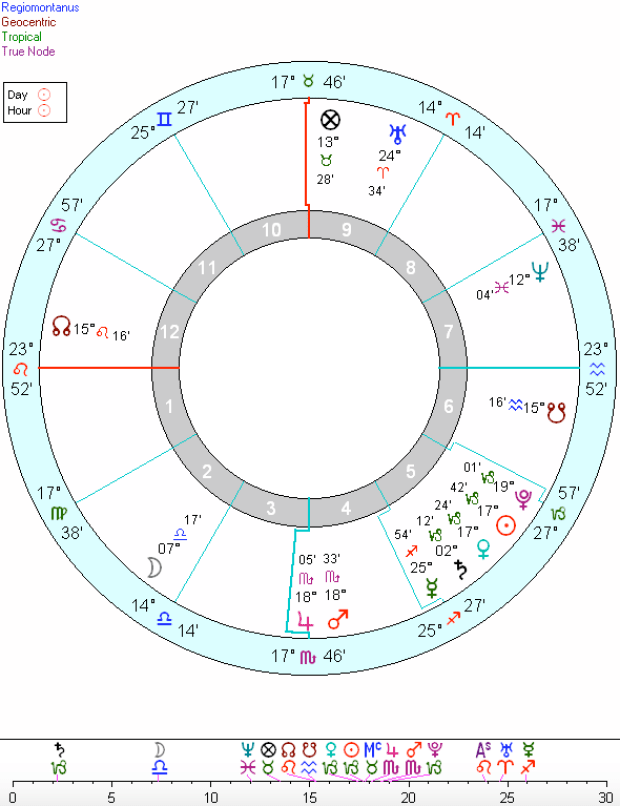
Suppose that someone has Aquarius rising, with Saturn in Leo in the seventh house, but their Sun is in Sagittarius in the 11th house (this would make it a daytime chart). Saturn is slowing down to station retrograde. Saturn in such a chart has several rejoicing conditions working for him, but it’s as though his story is written in boldface and he has quite a bit of say over the unfolding of the chart.
This is an individual who very likely desires one-on-one connections with people, but it might be a herculean effort for would-be suitors to win their affections, simply because Saturn in this placement acts as an impenetrable hedge. The one who would win this person will allow them plenty of space and autonomy. Given the Sun’s placement in Sagittarius in the 11th, this individual will likely need lots of freedom to maintain relationships with their community of friends, with the acknowledgment that these friend relationships and their local community is primary.
Meanwhile, consider the same rising and setting sign—Aquarius and Leo—but in this instance, instead of Saturn conjoined the descendant, it’s Venus, and she’s receiving a partile overcoming square from the Moon in Taurus, and the Sun is in Virgo in the eighth. In this instance, this person is the marrying type. Because Venus is probably the fourth house ruler as well as the ninth, there’s a spiritual dimension to the person’s desire to have a person to call home, as much as they need a place to call home to feel emotionally secure (Moon in the fourth sign). Yet, with their Sun as the seventh ruler in the eighth, there’s a perpetual fear that what they have attained, they will lose. In this instance it’s crucial for the individual to be willing to look their worst-case scenario in the eye; in so doing, it will lose its power.
Of all the houses, the seventh house is (I think) one of the hardest to interpret in cookbook style considering the varied narratives that it contains. To be honest, I don’t think it’ll actually be helpful to stick with these, but they can serve as an entrée: I’ll simply offer a general comment for each placement. In any case, we’ll need to pay very close attention to the configuration of the seventh ruler and any planets placed in the seventh to get the most useful information, a task for which this format is woefully inadequate.
We’re all just trying our best. (These are satirical but rooted in actual astrology. Take with lots of salt!)
- Seventh house ruler in the first house: your partners see you as a way of helping themselves out.
- Seventh house ruler in the second house: your partners either want to create abundance with you… or somebody’s digging for gold.
- Seventh house ruler in the third house: chances are you married your high school sweetheart (even moreso if your third ruler is in the seventh).
- Seventh house ruler in the fourth house: your first date was dinner, a movie, and a U-Haul. (Shoutout to West Ardere for this one.)
- Seventh house ruler in the fifth house: kids, creativity, and shared enjoyment is what keeps you bound to your beloved.
- Seventh house ruler in the sixth house: the couple that gets swole and/or unionizes together stays together.
- Seventh house ruler in the seventh house: well, at least one of you has it together.
- Seventh house ruler in the eighth house: your idea of a fun night in with your beloved is Netflix and Shared Existential Dread about the imminent threat of climate disaster and rising fascism in the West. So sweet!
- Seventh house ruler in the ninth house: you’ll either meet at Mass or you’ll move halfway across the planet to be together. It’s kind of cute, to be honest.
- Seventh house ruler in the tenth house: your partnerships are like unto that of a power couple with their own HGTV house-flipping series.
- Seventh house ruler in the eleventh house: just marry your best friend already, everybody thinks you’re dating anyway.
- Seventh house ruler in the twelfth house: if, by some twist, you don’t actually want to be single, you’ll probably meet your boo at an ashram.
If you want to untangle the richer stories that your seventh house contains, it’s best to look at the chart holistically. If you have questions about relationship, remember that you bring all of your manifold complexities and idiosyncrasies to partnership, as does your beloved (or potential beloved). Knowing thyself is the first step to being able to form functional, loving relationships; the second step is jettisoning all your expectations, because love will change you.
 Nate Craddock, Astrologian