
How to Interpret Houses in Astrology — Part 6: The Fifth House

I knew that as soon as we approached the subject of the fifth house I’d be wading into the treacherous waters of a slowly roiling controversy among astrologers, especially those on the Internet.

Somewhere in the development of the modern psychological approach to astrology, matters related to sex got assigned to the eighth house. There’s a strong case that can be made if we are approaching this from the Freudian framework that conceptually joins sex and death. Of course, the French euphemism la petite mort immediately comes to mind.

I’m one of the holdouts that insists on sexuality belonging to the fifth house. I wanted to rip that bandage off at the beginning, because I think there’s a solid reason for that peculiar topic to take its rightful place in the fifth along the other matters that fall within the gilded halls of the fifth house.

Remember that the houses either take the bulk of their meanings from their astronomical characteristics, as is the case with the four angles as well as the second and eighth houses, or from the significations of the planets that have their “joys” there. When a planet is in the house in which it rejoices, it’s a little bit happier. All other factors being equal, it at least gets to be involved in something it actually enjoys instead of being stuck managing something it has no interest in.

Deborah Houlding’s book Houses: Temples of the Sky (affiliate link ahoy) compiles and interprets historical sources on the origin and nature of planetary joys, which is a fabulous discussion of the subject in addition to being The Book on houses. Likewise, astrologer Chris Brennan wrote a wonderful article exploring the influence of the planetary joys in house rulership throughout the astrological tradition. I don’t want to go too far into the weeds here as to why planets rejoice to be in the houses that they do; just remember that this is where the bulk of house meanings get drawn from prior to 1900 AD. Those resources are the ones you want to have on hand if you decide to do a deep dive into this subject.

When we come to interpreting the fifth house in astrology, it’s best to know that we’re dealing with three primary elements that import their influence into the meaning of this house. These influences inform the questions that we need to ask here.

First off, this house is the joy of Venus. In fact, most of the meanings of the fifth house emerge from this influence alone. To get there, let’s consider the nature of the planet Venus to begin with.

Venus and Mars both represent interior, intuitive, nocturnal influences that cause us to move and to act in accordance with instinctual nature. This is because they’re part of the night team, the “nocturnal sect” of planets that operate on a subconscious level. Together, Venus and Mars form a polarity of energies that we see manifest in our behaviors and pursuits: while Mars’ function is to drive us (which we will explore more next week when we address the sixth house), Venus’ function is to draw us.

In her bid to join and harmonize us with one another and with the natural world, Venus inflames the hearts of humans with a desire to merge. Consider the last time that you’ve been absolutely captivated by something of tremendous natural beauty, whether a sunset, or a landscape, or a flower, or a birdsong, or a flavor, or perhaps even another human. The intoxicating factor here is the Venus principle at work.

Aesthetic beauty has the peculiar property of drawing us to it. Throughout history humans have made attempts to imitate and replicate this beauty with their own hands, skill, and intellect, crafting art to reflect reality in rarefied, idealized form. Aesthetic beauty isn’t the only thing that draws us; writ large, the principle here is pleasure. Anything that pleases our senses has the ability to draw us to it quite apart from our intentions or better judgment at times. Venus, then, has rulership over anything that brings sensory pleasure to us and draws us out of ourselves into richer engagement and union with the world of matter.

None of the senses are immune from her inexorable draw: sight, taste, touch, hearing, and smell all are susceptible to Venus’ indolent vacuum. The simplest reason for sex belonging to the fifth house is due to the sheer fact that it’s a pleasurable experience (or at least it’s supposed to be; I know this is tragically not the case for many). For the bulk of human history, sex was the sine qua non of having children, and so naturally children and pregnancy also belong to matters of the fifth house. Venus, of course, is conducive to life and is implicated in cycles of fertility—which reminds me, have you bought Nicola Smuts-Allsop’s game-changing book on fertility astrology yet? (It’s an affiliate link, Harry.)

But along with sex and sexuality come all the other sensory pleasures: flavors and aromas, colors and forms, harmonies and melodies that transfix us and give us a taste of the transcendent beauty of the world in material form (remember that the fifth house is also configured to the ninth house by trine as much as it is configured to the first). For that reason, any activity, person, or environment where these drawing elements are placed at the fore belongs to fifth house.

Second, the fifth house is referred to as the house of Good Fortune. There’s a reason that gambling is addictive: just as one can become addicted to any kind of sensory pleasure that draws us, one can also become addicted to the emotional thrill of inviting good fortune into our lives. “You have to play to win,” says the person who buys scratch-off tickets by the dozen. So the fifth house, then, rules games and any activity that joins us to Fortune, and any happy accidents that happen along the way.

(By the way, if you have the Moon applying to Jupiter in Cancer with the Part of Fortune all in the fifth house, playing the lottery might not be the worst decision for you—but your mileage may vary.)

Third, the fifth house is configured to the first house by trine. Astrologer Sam Reynolds explains this configuration makes the fifth house the house of “swagger.” The flowing partnership between the first and the fifth creates a space for the energies of the first house to express themselves.

Note too that this is a superior trine from the first: planets in the first have a direct impact on anything happening in the fifth and determine the outcomes here. Joined to the aesthetic sensibilities of Venus, there’s a strong case for this house and its ruler being implicated in a person’s style and self-expression through their aesthetic choices, dress, preferences, and performance. Child-bearing is also a natural part of this narrative: what’s more “expressing yourself” than making another human who looks like you?

How to interpret the fifth house in astrology

When it comes to interpreting the fifth house in astrology, we of course need to begin with the ruler of the fifth house to determine which area of life the person’s tastes and desirous factors work themselves out in. Likewise, we also need to determine how the planets placed within the fifth house express themselves.

SOAPBOX ALERT: I have, in my relatively brief time practicing professionally, encountered more than one client who has been told that they will not have children because they have no planets in the fifth house. This is patently wrong, and I will happily die on this hill. This approach to delineation ignores the fact that the fifth ruler might be wildly well-placed.

For example, say we have the fifth house cusp in Pisces in a day chart with nothing in the fifth, making Jupiter the ruler of the fifth (and very likely Venus as the almuten). Jupiter in this case is in Taurus in the seventh, with the Sun and Venus applying to Jupiter by sextile from Cancer in the 9th. If someone with a chart like this came into my practice and asked whether they would have kids, I’d have to ask them how many they already had.

That said, if Mars or Saturn were implicated somehow by hard aspect in this configuration, I’d expect there to be some difficulties depending on where they are afflicting Jupiter or any of the other planets involved from. Say Saturn were in an overcoming square to Venus from Aries in this same example, the issue might not be the native at all, but it might have to do with the fertility of their partner and we’d need to explore some medical interventions to help that out (since Saturn is in the sixth).

The most important thing to do in these instances, I’ve found, is not to pronounce an interpretation with finality one way or another but investigate all the factors that need to be considered and work with the client to discern solutions that they might not otherwise consider.

All that said, here’s a series of questions that we need to ask in analyzing the fifth house.

  • What is the individual’s relationship with pleasure, fun, and aesthetic sensibilities?
  • How can they bring more joie de vivre into their daily experience?
  • What is the impact of the native’s creations and creativity in this life?
  • How will the native’s creativity express itself naturally?

Taking the same example from above, we have Jupiter in Taurus in the seventh house as the fifth ruler, supported wonderfully by sextiles from the Sun and Venus in Cancer the ninth, not otherwise afflicted. In this instance, the native’s creative work will be wondrously fertile, their aesthetics are richly Venusian and tend towards the comfortable and classically elegant. Their creative priorities are pulled towards engagement one-on-one with other people. There’ll be a natural pull of this person to do creative work that renders physical objects that beautify their surroundings, and there’s a strong chance that this individual will become a parent, or otherwise have children as a significant part of their life if they choose not to have children of their own.

Since the fifth house is so multifaceted and expresses so much to do with style, attending to the sign in which the fifth ruler is placed is especially important. Signs determine the style in which planets express themselves. That said, by looking at the house position of the fifth ruler, we can determine what life priorities attune a person’s aesthetic compass. Is it a “beauty will save the world” situation? Or is someone’s draw the sensual allure of history? Of romance? Of death? Of their hometown?

Interpreting the fifth house ruler through the houses

  • Fifth house ruler in the first house: that which draws you is you, in the most basic way of phrasing it. Aesthetic sensibilities, pleasure, and creative output have their hand on the wheel in this case and form one of the guiding principles through which you live out your life narrative.
  • Fifth house ruler in the second house: pleasure-seeking activities and creative output are tied to your bank account and understanding the role they play in your life becomes important in improving your overall financial portfolio. These aspects of life function as a resource in your back pocket, if you nurture them well.
  • Fifth house ruler in the third house: the joy of gathering together with your local community and the beauty of everyday pleasures are important influences for you to nurture.
  • Fifth house ruler in the fourth house: the allure of history, legend, inheritance, and the land itself draws you to it and desires expression. Your tastes are likely strongly aligned with those of your family, for better or for worse.
  • Fifth house ruler in the fifth house: creation for its own sake is a crucial plotline in your life. If your fifth ruler is in its own sign, you can expect, in general, quite a bit of ease in enjoying anything to which you’re drawn.
  • Fifth house ruler in the sixth house: creativity is a labor for you, and chances are that your tastes are aggressively pragmatic. Anything requiring discipline and habitual effort becomes, in its own strange way, fun for you.
  • Fifth house ruler in the seventh house: there is a certain pleasure you derive from engaging one on one with other humans. If there’s any placement that signifies bids to win people over (or settle arguments) through an appeal to beauty—entrancing your beloved with art in their honor, or holding a stereo up outside their window—it’s probably this one.
  • Fifth house ruler in the eighth house: art must change you, if it doesn’t terrify you. Every opportunity to engage with a creative act has the opportunity to draw you into deeper engagement with the cycles of life and death. Sex can be a fearsome thing (in both the positive and negative connotations of that word). And, you might just really dislike being around children.
  • Fifth house ruler in the ninth house: creativity, performance, and pleasure for you are windows into the sacred and the transcendent, and the connection to Dostoyevsky’s position is stronger for you than most.
  • Fifth house ruler in the tenth house: aesthetics aren’t just an extracurricular activity for you. Creative work, pleasure, or any of the other fifth house factors are part and parcel of the impact you make in the world as you live your life, and can become a career story for you as well.
  • Fifth house ruler in the eleventh house: chances are if this is the case, your fifth ruler is in detriment, and you’ll be investing a lot of effort into drawing a community of friends around you to meet whichever sensual and social needs are going unmet throughout your life. Used well, this impulse can be tremendously beneficial for your friends and audiences.
  • Fifth house ruler in the twelfth house: the darkened glass of the unconscious and the forgotten areas of life become rich fodder for your bids at self-expression.

The final point on the fifth house I need to make is this: fun is not frivolous. The deeply utilitarian nature of most modern economic discourse is, in my humble opinion, a load of bullsh*t. I believe, body and soul, that aesthetic beauty and enjoyment of sensual pleasure, as well as the process of creativity, is wholly a holy end unto itself and does not need to be placed in the service of some “higher” priority.

Just because something belongs to the realm of “fun and games” does not mean it can be dispensed with; a soulful and purposeful life depends on nurturing the Venus principle within us. Understanding the matters she rejoices in are critical to the thriving of our souls.

Dostoyevsky was right: beauty will save the world.

(In related news, my fifth ruler Mercury is in the eighth house, ninth sign, in Libra.)

Where’s your fifth ruler at? How does your fifth house ruler influence your tastes and your approach to creativity, enjoyment, fun, sensuality, and the rest of it all? Let me know in the comments!

Featured image by Yutacar via Unsplash

How to Interpret Houses in Astrology – Part 5: The Fourth House

Where do we come from, and when all is said and done, where is it that we shall return? What is the source and summit of our sojourn through life? What is our center of gravity?

These weighty matters are the purview of the fourth house in astrology.

But before we get too far into the weeds, it’s time for a useless piece of information that I find delicious.

そっこんは、日本語をならいます.(I’m learning Japanese right now). In numerous east Asian cultures, Japan included, the number four is associated with death, partly because the number four (四, pronounced shi in Japanese, except when it’s pronounced yon) sounds like the word for die (死, also pronounced shi). Considering where we’re about to go with the meaning of the fourth house, you might want to keep this in your back pocket.

Unlike the third house, which derives its meanings from the planet that joys therein (namely the Moon), the fourth house in astrology derives its meaning from its astronomical features. No planet joys in an angle, save Mercury in the first, who strides across the realms of death and life with fleet feet, bridging the matter and spirit as a psychopomp.

The other three angular houses derive their meanings from the way in which planets encounter turns in their diurnal courses there. Remember that these angles are, to the ancient mind, the four stakes upon which the world is founded.

In quadrant-based house systems, the fourth house is centered around the lowest possible point in relation to the Zodiac, called the imum coeli, literally “the bottom of the sky.” This point marks the cusp of the fourth house. In sign-based systems, the fourth sign counter-clockwise from the ascendant fulfills this role.

This point is as far below the earth a planet can descend before it begins to ascend once more. If you’re standing in the middle latitudes of the northern hemisphere and facing south (i.e., facing the midheaven), the imum coeli, is under your feet and behind you a little. In middle and tropical latitudes, this point generally falls within the fourth sign from the ascendant as well.

The IC is as far out of your field of vision as it can possibly be. Planets at this point are hidden deep within the earth, but because they take their position at one of the celestial stakes, planets placed here have a subtly stunning impact on the unfolding of the narratives promised by a chart.

This point is a turning point. The transition that occurs here is one that is subtle, invisible to mortals on the surface, known only to those who understand that an uncanny transition from death to life begins at this point.

It’s worth noting that the Latin term “medium coeli,” which refers to this point’s opposite point in the visible sky, is not, as you might expect, called “cacumen coeli” or “apex coeli,” either of those meaning “top” or “highest point” of heaven. The ancients understood the place where planets reach their heights as primarily the middle of the sky, where planets were at their most visible and influential (beside the ascendant).

The base of heaven, then, is not just the lowest point—it is also the terminal point where the journey of a planet around the sky according to the diurnal march of the heavens around the celestial sphere end their journey and begin a new one. In this sense, the IC and the fourth house form the alpha and omega point, the beginning and the end.

The mythic power of the fourth house is floating right on the top of this soup of symbolism.

Dane Rudhyar, the 20th century astrologer and composer, evocatively described the fourth house as “the center of the globe,” that is, the center of gravity. Our center of gravity. The point draws our attention to the planet on which we stand, its gravity, its cycles, the raw material from which our experience emerges and unto which we will return. “Ashes to ashes.”

The fourth house symbolizes our center of gravity and everything upon which our experience of this lifetime stands; it is our point of deepest sustenance. Bernadette Brady, a British astrologer, describes planets and stars tied to the imum coeli as related to our “foundations,” fixtures that ground us and root our entire experience.

Because of its location, the meanings of the fourth house are shot through with the myths of the underworld. When I say “underworld” here, I don’t mean the fire-and-brimstone realm that is the darling of so many fundamentalist Christians. In fact, this version of “hell” is largely a medieval rhetorical invention that borrowed heavily on the description of a place called Tartarus which Vergil’s Aeneid described and which Dante Alighieri and those who followed in his footsteps so colorfully and horrendously describe in art and verse. What I mean, rather, is Hades, what the Hebrews called Sheol.

The early Christian conception of the underworld was much more in line with the Jewish view they inherited, itself influenced in large part the Greek understanding of Hades which was in the drinking water of the Mediterranean basin in the first century CE. In this view, the underworld is not a place of conscious torment, but rather a prison, a gravitational well.

That which laid in the grave was inert: “the grave cannot praise thee, Death cannot celebrate thee,” sang the psalmist. However, in the Easter mythos, the underworld is emptied of its dead as all its inhabitants are raised to new life at the resurrection of Christ, the great turning of the world—which unfolds at the cosmic imum coeli, the point where death pivots into life.

This myth has a similar flavor to other dying-and-rising myths found around the Mediterranean basin during astrology’s heyday. Because so many stories from around the world have subterranean dying-and-rising baked in, there’s a thread to pull here.

I’d go so far as to conjecture that every human narrative has some form of dying-and-rising experience. In that sense, the fourth house serves as the setting for the unfolding of that turn in our personal mythology. Keep in mind that the fourth house and the eighth house, which describes death, are configured to one another by a trine.

It is at the imum coeli that the roots of the world tree run their deepest; it is at the imum coeli that the waters under the earth gather as they flow from cloud to spring to mountain to ocean. It is in the bowels of the underworld that death is changed to life as all life flows there through its course. That which returns to the grave is transformed into the raw material of new life. The cosmic cycle begins anew.

The Astrological Meaning of the Fourth House

Ultimately, the fourth house in astrology describes the places we come from, and the place that we will return at the end of it all. It’s our source, our summit, our center of gravity. And for that reason, the fourth house picked up three primary significations:

The first is our roots, specifically our parents and the legacy that we inherited from them (and that we inherit from the living in general). Our parents are the closest humans to us, and we emerged from them, as humans emerged from the Earth (figuratively). The peculiar relationships we have with our parents are described by the nature and condition of planets involved with the fourth house, whether the house’s ruler or any planets placed therein.

The second is our home, both in the sense of the place that comes to mind when we think of “home” but also our daily dwelling place—so, our actual house or apartment. That’s because the home is our daily center of gravity; it’s where we depart in the morning to attend to our daily activities, it’s where we return to sleep in the evening, and it serves as the center of gravity around which our day-to-day activities revolve.

The third is the land, for all the reasons I cited above. We gain our sustenance from the land, our bodies transform material that is drawn out of the earth into our embodied life, and upon our death, we return to the land. Because of the connection to the land, we can also see how any matter related to the land is signified by the fourth house: material resources, real estate, speculative assets.

Sidebar: in horary astrology, there’s one additional signification that gets thrown around when the fourth house is highlighted in a chart. That signification is the “end of the matter.” Often folks want to go here to determine what the final outcome of a question is, but that’s not quite what this Jacobean turn of phrase means. Rather, this phrase signifies the legacy that a question will leave for the person who asks it, and the ripple effects that a given course of action will have for those who come after them.

How to interpret the fourth house in astrology

Given the three major significations I laid out, we’ll be looking at three primary questions when it comes to dealing with the matters of the fourth house:

  • What is this person’s relationship to their parents and ancestors, and what will they pass on to those who come after them? In other words, what psychic baggage did they inherit from their parents, and how will they adapt, transform, and heal that psychic baggage to hand it on to those who come after them?
  • What its this person’s relationship to home? Where is their center of gravity? Are they fixed in one place, or do they have a fire under their tail that drives them from one place to another? Are they given to settling or constant motion?
  • What is this person’s relationship with the land itself? Do they feel a connection to the land on which they walk, or do they travel through their unique geography as a sojourner?

Remember that the ruler of a house expresses its purposes among the affairs of the house that it is placed in and in accordance with the style and priorities of the sign in which it falls. How well or poorly a planet can do its job depends on its condition. (Do I sound like a broken record on this point yet?)

Meanwhile, planets placed in the fourth house have a direct impact on a person’s relationship to those three areas spelled out above.

Let’s look at an example. Say that a native has Virgo rising, with their IC falling in Sagittarius in the fourth sign (keeping it easy here). In this case, their fourth house ruler is Jupiter. Suppose their natal Jupiter is in Virgo, right in the first house. This suggests that their connection to their parents is deeply influential to them, sitting right on the steering wheel of their chart. This ensures that they live up to the expansively scrutinizing standards of their parents becomes a major theme throughout their life, and something which they as a parent will pass on to their children.

Likewise their relationship to their physical house and dwelling place is of the nature of Jupiter in Virgo: they have a deep, abiding desire to have a house to call home but it may be that other factors in their life, possibly their marriage partner’s job (since Jupiter is also the 7th ruler, as well as the turned 10th ruler) prevents them from being able to own a home and put down roots in the way that they would truly prefer. Finding a place to settle down will require a herculean effort and it’s likely that having to pack up and move every so often will simply be part of their life narrative. When it comes to maintaining their home, only perfection suffices: they have an overblown standard of cleanliness, and heaven forfend anyone leave their crap laying around.

The ruler of the fourth house through the houses

  • Fourth house ruler in the first house: your parent’s desires and expectations, your relationship to your dwelling place, and your level of engagement with the land all have an unyielding influence on your personality and your attempts to create the best circumstances for yourself. It might be difficult for you to differentiate from your parents if your fourth ruler is afflicted, but if it’s in good condition, this may suggest that you enjoyed a wonderfully supportive upbringing that has carried you into adulthood.
  • Fourth house ruler in the second house: your relationship to parents, home, and the land is as a resource to you that you can access to support overall outcomes in your life. If this planet is well-placed it can indicate that you’ve got access to estate; if poorly-placed, home can become a money pit.
  • Fourth house ruler in the third house: you’ve likely never strayed far from home, and your old stomping grounds are probably still your current stomping grounds. You find a sense of family identity especially among your siblings and lateral contemporaries.
  • Fourth house ruler in the fourth house: you’ve got roots that run deep and you know precisely who you are and where you came from. You don’t need the Disney musical to tell you who you are, and carrying on that legacy to the next generation is a major part of your sense of identity and purpose.
  • Fourth house ruler in the fifth house: home is a source of fun and creative drive for you. Your relationship you’re your parents was likely pleasant and supportive, depending on how well the planet that rules the fourth is doing here.
  • Fourth house ruler in the sixth house: home, family, and the land are areas where you feel a certain sense of drudgery and responsibility. This may manifest as being asked to return home to care for an ailing parent when your fourth ruler is activated by timing techniques, or it may signify that you work within the family business.
  • Fourth house ruler in the seventh house: your sense of home and center of gravity is tied up in forward motion and it’s very unlikely that you’re one to stay in a single place for a long time. One of the reasons for this is that, in relocation horary questions, the 4th house is “stay” and the 7th house is “go.” This could also mean that you are more likely to follow your partner’s career and call wherever they land “home,” because for you, there’s a good chance that “home” is where your partner is if this is the case. (This is my 4th ruler placement, by the way.)
  • Fourth house ruler in the eighth house: you have a strong sense of what it is that you inherited from your family, and it is a present possibility that there is some element of fear or loss connected to the story of your upbringing. Interpreting that story in life-giving ways then becomes part of your own dying-and-rising myth.
  • Fourth house ruler in the ninth house: home is far away, either far away from where you grew up or far away from where you are now. The land you tread serves as a teacher and a spiritual nexus for you as well.
  • Fourth house ruler in the tenth house: your family and land story plays out in the actions you take for which you are most remembered, whether within the context of your career or the ways in which the legacy you inherited from your parents drives your public actions.
  • Fourth house ruler in the eleventh house: home and lineage is a source of good fortune for you, and you find yourself among friends when people know who your parents were (or among enemies, if the fourth ruler is afflicted here). Pay attention to the way that stories from your upbringing play out anew among your friends, groups, and chosen family.
  • Fourth house ruler in the twelfth house: distance. Distance between you and your roots, you and your parents, you and the land on which you tread. Bridging that gap of isolation requires long, thoughtful, considered effort, and can be wildly fruitful if the condition of the planet so promises. The other niche interpretation is a strong connection to livestock and animal husbandry, but that’s going to be fairly unusual.
  • Where’s your fourth house ruler? What’s its condition? How do you see the story of your fourth house playing out in the overall arc of your story? Let me know in the comments!

    Featured image by Jared Rice via Unsplash

How to Interpret Houses in Astrology: Part 2 — The First House

This week, we’re the first house in astrology.

The first encounter with the first house is that fabulous point that causes every newbie astrologer to marvel. They realize that reading the sun sign horoscopes they had been forcing themselves into, like square pegs into to-o-small round holes from the perspective of the first house often causes those mass-marketed promises to land in a way they hadn’t before—at least if they’re written by an astrologer that knows what they’re doing.

They begin to learn that this is the point that makes the most sense when they view their spirit, identity, motion through the world, and fundamental personality through its lens. This turn is especially fabulous for the nascent astrology enthusiast, because, when we encounter the first house, we encounter the most important point within an astrological chart.

But what is the first house? Let’s turn our house music back on and take a deep dive.

Astronomically speaking, the first house is the part of the sky that is ascending over the eastern horizon at the astrological moment. It is that point where things are set into motion, the point of the sky that has the strongest bearing on the overall outcomes of what comes into being at that very moment. The first house is determined by the ascendant degree, the point where the ecliptic hits the horizon.

The ascendant degree represents the meeting point of the sky and the earth, where everything that was held in promise underneath the earth enters onto the scene. Here, matter and spirit join and create something new, like water in stone becoming wine. This is the point of incarnation, where the soul enters the body, according to tellings of cosmic myths. Indeed, I could wax poetic at length about the magic and myth of this point.

In the Hellenistic tradition, an astrological chart was likened to a boat containing the life of a native (or of an event, if they were looking at an inception chart). Remember that the Mediterranean lifestyle depended in no small part upon the ability of competent helmsmen to steer boats containing cargo and people safely to their destination, so the metaphor is an apt one. In modern life, we might consider this as the pilot of an aircraft, or really, any vehicle.

Essentially, if the chart is a boat, a boat has a rudder, and a place on the boat where one stands to turn that rudder to steer the boat safely to its destination. The planet that rules the ascendant degree is the captain of the boat, or the pilot of the plane, or the driver of the bus… pick your metaphor. That planet’s condition describes how well it will be able to manifest the best outcomes for a person’s life.

Demetra George explores this more richly in her books Astrology for the Authentic Self and Ancient Astrology in Theory and Practice (affiliate links ahoy). Tolle, lege.

The helm of the ship, or the cockpit of a plane, or the driver’s seat, is the ascendant, which we refer to as the first house. Regardless of the house system you’re using (I discussed that a little bit in the last entry in this series), the first house is always related to the ascendant degree.

But when it comes down to it, this degree and the house that contains it, the first house, are the most important point in a chart and the starting place for reading anything.

To wit, if I don’t know at least your rising sign, I’m kind of at a loss for where to begin with a reading of your nativity. That doesn’t mean I can’t, it just makes it harder to frame any judgments I might derive relative to you specifically.

But what does it mean, Nate?

Every house has multiple layers of meaning. Throughout this series, I’m going to distinguish between the internal meanings of a house, namely what you carry in your subjective experience and personality, and the external meanings of a house, being the way in which a house physically manifests in the material world. In every case, there are important “meta” significations that impact both internal and external experiences.

In fact, let’s start with the “meta” significations of the first astrological house.

From a 30,000-foot view, the first house, together with its ruler, describes the overall circumstances and general positive or negative outcomes of a person’s life. We might say that the narrative being played out by the ruler of the first house and any planets contained within the first house point to a person’s plotline. This house describes how a person both bears the story being told about them and how they tell their own story.

Internally, the first house describes a person’s underlying motivation and baseline personality. What drives them unconsciously? What patterns their life? What is their way of being in the world?

Externally, the ascendant degree and the first house describe a person’s appearance, their preferred style of dress, how their internal experiences join to outward style to create a peculiar behavioral style. In either case, this expression is conditioned by the sign on the ascendant degree in their chart.

For example, someone with Aquarius on the ascendant will have an underlying motivation and baseline personality keyed to maintaining intellectual security and bearing the wisdom that they accumulate over a lifetime within the context of a community. They move through groups knowing precisely it is what they believe and remain committed to their peculiar why in such a way that it gives them a set-apart-ness that causes them to appear aloof to others. Put Saturn in an earth sign and you wind up with someone who manifests this with ruthless practicality and resistance to trends (all my Capricorn rising babies with Saturn in Cap, I see you).

But, put that Saturn in a water sign such as Pisces, and you will see much more commitment to matters of emotional knowledge and a personal style that is much more open to the suggestions of trends and passing dreams (barring, of course, other influences).

Meanwhile, an individual with the first house falling in Virgo will find their life plotline conditioned to matters of applying knowledge in material fashion, improving their own physical circumstances and those of the people who journey alongside them, and regarding any situation wherein knowledge may be applied with scrutiny. They’ll tend towards caution, skepticism, precision, and anxiety.

You may notice that I’m deriving these sign interpretations more from the planets that rule them, which is the natural order of determining meanings in the classical astrological model. That’s because the expression of a person’s first house primarily determined by the ruler of the first house, with its expression modified by its own placement by sign and house, as well as other conditions.

(Did you buy Demetra’s book yet? DO IT NOW)

There is, however, one important consideration here: this way of interpreting presumes that there are no other planets in the first house. If we have another planet in the first house, especially one very close to the rising degree, that planet is sitting in the driver’s seat, and its nature and condition will impact the behavior, style, and circumstances of a person in much more flagrant colors than the ruler of the first house alone.

For example, consider someone with Virgo rising, as I described above, but who has Jupiter in Virgo conjoined the ascendant (someone dear to me has this configuration). This means a couple of things: one, the person’s baseline operating personality will be ruthlessly committed to perfection in their search for truth, and that can take them in the direction of a cheery, winsome fundamentalism (which can go either towards belief or skepticism). Their behaviors may have a peculiar doctrinaire flavor, but what prevents them from becoming the lovechild of Pat Robertson and Richard Dawkins is the fact that Virgo is mutable, and Jupiter is naturally adaptable given its warm and moist nature.

Meanwhile, this person has their natal Mercury, their ascendant ruler, in Capricorn in the 5th, configured to the trine of Jupiter (which is a beneficial configuration for Jupiter’s positive expression). This means that their baseline operating priorities are weighted towards matters of the fifth: toward their children, and especially toward their children’s success. They want to know that their kids are alive, employed, and financially solvent.

We can summarize this interpretive principle for the first house like so:

The placement of the ascendant ruler by house describes the overall priorities and plotline of a person’s life. The ascendant ruler in the 7th gives us either a romantic comedy or a heist film. The ascendant ruler in the 4th gives us a nostalgia piece. The ascendant ruler in the 12th gives us a psychological thriller, and so forth.

Meanwhile, planets placed in the first house act like competing voices that focus a person’s peculiar narrative.

These rules don’t just work for natal astrology; they work for all branches! For example, in a horary with the ascendant ruler (or the Moon) in the 10th, I might surmise that there’s a heavy emphasis on career, vocation, or public image in the person’s query, even if the question isn’t about a career matter at all.

Interpreting the First House Ruler through the Houses

Here’s the fun part. What I want you to try on, especially if you’re just learning astrology, is to use this formula to learn how this interpretation feels:

My first house ruler is in the [nth] house. That means in my life, the pilot is steering my life in the direction of [nth] house matters.

And if you have planets in your first house:

The ruler of [nth] house is in my first house. That means in my life, priorities of the [nth] house compete with my first house priorities and influence my daily life and actions.

Here we go!

Ruler of the first house in the first house: the pilot of my chart steers my life in the direction of my own circumstances, priorities, and self-development. My priorities are aligned closely with improving my own circumstances and understanding of myself. I desire to know who I am.

NB: when you use quadrant houses, it’s important to note that sometimes the first house ruler in the first house can fall in a sign that’s not the rising sign. This creates a situation called an aversion, where the pilot can’t see the control stick. In this instance, manifesting the best outcomes for yourself requires more focused effort and remediations.

Ruler of the first house in the second house: the pilot of my chart steers my life, motivation, and behaviors in the direction of material and immaterial resources, financial security, and ensuring that I have enough to support myself. I desire to have enough.

Ruler of the first house in the third house: the pilot of my life steers my life, motivation, and behaviors in the direction of my local community (my zip code), communication, exchange of words and ideas, my siblings if I have them, relatives, regular folk, functional learning, “street smarts,” and being a neighbor. I desire to belong.

Ruler of the first house in the fourth house: the pilot of my life steers my life, motivation, and behaviors in the direction of my home, the land, my parents, my traditions, and that which I inherited from the living. It also draws my focus to the legacy that I will leave for those who come after me. I desire a legacy.

Ruler of the first house in the fifth house: the pilot of my chart steers my life, motivation, and behaviors in the direction of self-expression vis-à-vis creative work, sensuality, procreation, nurture, children, enjoyment, and having a good time. I desire to create.

Ruler of the first house in the sixth house: the pilot of my chart steers my life, motivation, and behaviors in the direction of disciplined action, physical rigor, service to others, and being responsible for the needs of those who depend upon me. I desire a project.

Ruler of the first house in the seventh house: the pilot of my chart steers my life, motivation, and behaviors in the direction of the other: to relationships, to partnerships, to coalitions and collaboration, and possibly to open enmity and strife with others, toward pursuit of the other for good or for ill. I desire an equal.

Ruler of the first house in the eighth house: the pilot of my chart steers my life, motivation, and behaviors in the direction of life’s unavoidables: fear, death, and debt. I desire gravitas.

NB: this does not mean that you are morbid or have something wrong with you; the gift of this placement is your ability to walk where others fear to tread, and that’s a blessing in a culture who has no tools to engage well with the beauty of death. More on that when I write on the eighth house.

Ruler of the first house in the ninth house: the pilot of my chart steers my life, motivation, and behaviors in the direction of philosophy, higher learning, theory, understanding, matters of faith and belief, and deepening my engagement with all matters of ultimate concern. I desire faith, hope, and love.

Ruler of the first house in the tenth house: the pilot of my chart steers my life, motivation, and behaviors in the direction of career, vocation, and the visible impact that my actions have in the world. I desire to make a name for myself.

Ruler of the first house in the eleventh house: the pilot of my chart steers my life, motivation, and behaviors in the direction of friends, groups, community, chosen family, and fidelity to others and their fidelity to me. I desire a community.

Ruler of the first house in the twelfth house: the pilot of my chart steers my life, motivation, and behaviors in the direction of retreat, hidden matters, sorrow, and succor. I desire to be apart to be myself.

Wondering how to interpret the ruler of the first house in your own chart with all other factors considered? There’s no better way to do so than to get a second set of eyes on your chart. Pop over and book an astrology session with me and we’ll see exactly where your pilot’s steering your plane—and how we can help them out, if they need it!

Book an Astrology Reading Today!

Featured image by Roberto Delgado Webb via Unsplash

How to Interpret Aspects in Astrology

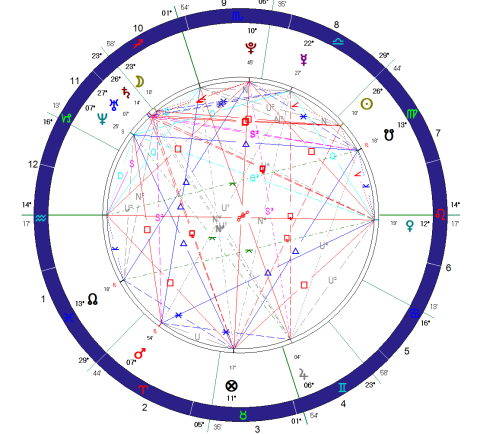
One of the places I got completely stuck when I was first learning astrology was the issue of aspects. Probably because when I first drew my chart it looked something like this:

Screenshot 2019-02-25 12.23

To which I said,

via GIPHY

That’s quite the knot to untangle, even for a visual-spatial learner like yours truly. I had an inkling of what to do with a planet in a given sign and was even starting to get into issues related to houses—but when it came to getting my head around the aspects in my birth chart, I was up the creek. I wasn’t going to give up that easily though.

The astrology bug bites hard.

In this post, I’m not only going to explain how to interpret aspects, but I’m also going to give you a starting place into understanding the “why” of astrological aspects so you can begin to get your head around the “how!”

What is an Aspect in astrology, anyway

To put it as simply as possible, aspects are how we describe the relationship between planets. Understanding aspects in your chart gives you a window into the dynamic stories that are playing out in your life.

An aspect in astrology occurs when a planet is at a certain number of degrees away from another planet or point in the chart. For example, when two planets are around 90° from one another, we say that they’re in a “square” aspect (a square has four 90° angles).

What that means is this: those two planets are in a relationship with the character of a “square.” Think of the language we use in English that describes squares: “squaring up” before a fight. “Squaring off.” “Square peg in a round hole.” That should tell us that there’s something adversarial about a square: something tense, a real “can I speak to the manager” situation.

If you’re like me, you want to know where this concept comes from; keep reading. If you’re not like me and you just want to know what aspects signify what kinds of relationships… well, scroll on down 😉

To give aspects in astrology their due, we must take a detour into classical optical theory, because the word “aspect” literally means “look at” (Latin ad, “at, to” + spectō, “I look”). I just heard half of you slam your head on the desk. “I just wanna know when I’ll meet my soulmate!” I see you, I hear you, but stay with me!

It’s important to remember that the ancients conceived of the planets as active agents, not as passive on a cosmic timepiece. We start off with the idea that, in the astrological ball of wax, planets interact with each other by casting glances at one another. Kind of like this:

via GIPHY

If we’re looking at something, what we are doing is bearing “witness” to that which we are observing, and many of the ways traditional texts talk about aspects include descriptions of planets “witnessing” each other. The astrologer Chris Brennan discusses this at length in his game-changing book, Hellenistic Astrology: The Study of Fate and Fortune, beginning on page 292 (that’s an affiliate link; I get a kickback if you purchase a copy). If you’re serious about astrology at all, that’s a book to have on your shelf.

These glances in the ancient world were conceived of as an exchange of energy. The short version is that people imagined that the human eye was emitting ethereal light called “lumen,” which was invisible but illuminated anything it fell on. Anything that this lumen hit was “illuminated,” and returned visible light, called “lux,” to the beholder.

We see this reflected in literature of the day, including the New Testament (Matthew 6.22-23, NRSV):

“The eye is the lamp of the body. So, if your eye is healthy, your whole body will be full of light; but if your eye is unhealthy, your whole body will be full of darkness. If then the light in you is darkness, how great is the darkness!”

Lux. Lumen. Lewks. They make aspects work. Got it?

In modern astrology, we’ve lost the connection to optical theory and now it’s more to do with vibrations, from the ways I’ve heard it explained. It’s as though the planets “resonate” with each other at certain angles, creating consonant or dissonant harmonies. This vibes well with the way many new age folks talk about vibrational frequencies. But even that has some ancient roots!

Aspects and Musical Harmony

There are five main aspects described by Ptolemy and agreed upon in general by the astrologers of the ancient world up through the renaissance and early modern era.

These five aspects are as follows: the conjunction (0º), the opposition (180º), the trine (120º), the square (90º), and the sextile (60º).

Ptolemy explains that these divisions of a circle are important precisely because they represent the primary divisions of the octave in music (cf. Tetrabiblos I.13). Each division correlates to a harmonic interval: correlate to the unison (conjunction), the octave (opposition), the fifth (trine), and the major third (sextile).

You’ll notice that I skipped over the square.

If you play the note exactly halfway between the top and bottom notes of an octave, the interval that results is actually the most dissonant interval in music, the tritone (also known as a diminished fifth or augmented fourth). This musical interval corresponds to the astrological square: halfway between the conjunction and the opposition.

This is whence the language of “harmonious trine” and “tense square” emerges historically, but I don’t think this is commonly known (although I can’t imagine astrologer-musicians throughout history Rudhyar or Ficino would have overlooked this, but I haven’t read enough of them to have the sources on hand).

For those keeping score at home, the modern equally tempered octave has twelve notes in it—but, the zodiac preceded the chromatic scale. Greek music used tetrachords: 4-note scales!

Okay, so what? How do I actually interpret aspects in my chart?

To interpret an aspect in your birth chart, you’ve got to take the aspect apart first by asking yourself several questions:

  • Which planets are involved?
  • What aspect is involved
  • Which planet is faster?
  • What houses do the planets rule?
  • What houses are the planets in?

It gets complicated quickly, but if you get used to doing this over and over, it becomes second-nature! It’s like learning your scales and arpeggios, to continue the musical metaphor. Let’s break this down!

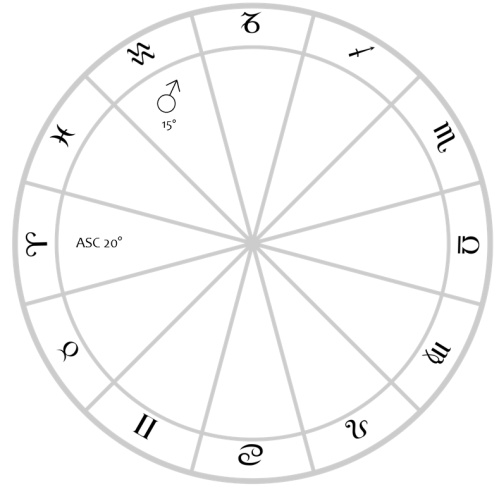
Suppose you’ve got Mars sextile Jupiter in your birth chart, and say that you’ve got Aries rising, and that you were born at night. If you were to look at the sky at the moment of your birth (and it was nighttime) you’d see Mars rising bright over the eastern horizon. Drawn on a chart, it looks like this:

aspects mars in chart 1

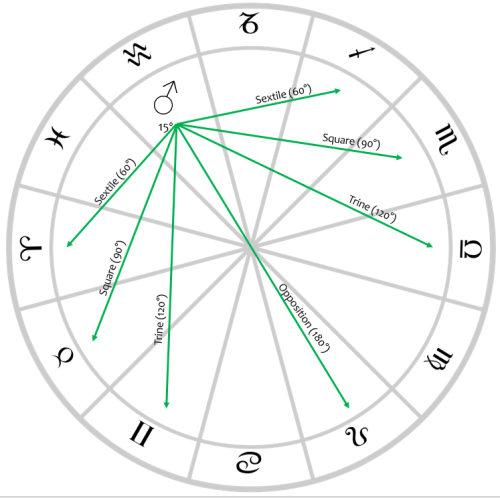
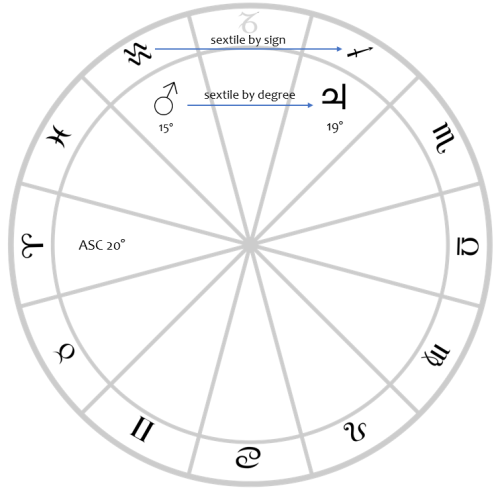
As a rule, planets in astrology can see things in the sign where they’re at. Planets also emit seven “rays” of lumen to the degrees that they can see by the aspects we talked about above. So, Mars is hitting a certain collection of signs with his lewks, and so we say he can behold those signs. From Aquarius, Mars can behold Aries, Taurus, Gemini, Leo, Libra, Scorpio, and Sagittarius. Really, anything in Aquarius can see anything in those other seven signs—there can be an aspect there.

aspects mars with lines

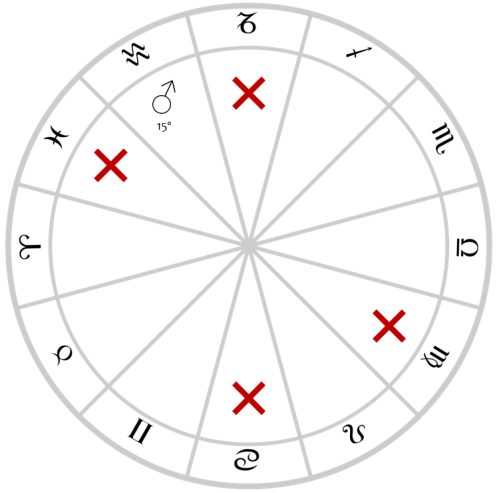
Now, Mars cannot behold anything in Pisces, Cancer, Virgo, or Capricorn from where he sits in Aquarius. So, we say that anything in those signs is “averse” or “in aversion” to Mars, and likewise we can say that Aquarius is “averse” or “in aversion” to those signs. We can spend a lot of time on that, but here’s a visual reminder:

aspects mars aversions

Say that a planet is in any of the signs that Mars can behold from where he sits in Aquarius, so, let’s say it’s Jupiter in Sagittarius. That means Mars and Jupiter are in aspect by sign. So, right now, Mars and Jupiter can see each other because they are in signs that can behold one another. We call this a “sign-based aspect.”

aspects mars jupiter sextile

If two planets are in sign-based aspects, they can interact with one another. The nature of their interaction, whether friendly or hostile, is determined by the nature of aspect. Here’s the juice:

  • Conjunction: two planets are working together according to their natures (e.g., Venus helps, Mars hurts, etc.)
  • Sextile: gently supportive and easy, but not very dynamic
  • Square: tense and combative, but sometimes passive aggressive
  • Trine: flowing, makes things happen, but not necessarily always “good” in a strict sense
  • Opposition: well, it’s in the name. Overt fighting, explosive, a blow-out!

Sign-based aspects describe the overall tenor of planets’ relationships with each other. But planets don’t interact directly with one another until they come to a degree-based aspect within a sign. That would mean that when Mars advances to a later degree of Aquarius, to meet the square that Jupiter is casting there, which activates whatever this relationship signifies.

Let’s put the story together!

Mars moves faster than Jupiter (usually, unless Mars is retrograde), so Mars will be the one who is approaching Jupiter here. Because it’s a sextile aspect, Mars and Jupiter are in a supportive relationship with one another. Think of it like this: Mars is approaching Jupiter as a friendly acquaintance and asking him for help with something. Since Jupiter is, by nature, a friendly guy, and since he’s in his own sign of Sagittarius and has access to his own resources, Jupiter’s happy to share out of his abundance with Mars.

Good so far?

The last step is to figure out what parts of life the aspect is describing, and you figure this out by looking at which houses the planets involved rule. So in this example, with Aries rising, Mars rules the first house of your basic personality, body, health, vitality, appearance, and overall circumstances, as well as the eighth house of the unavoidables: fear, death, and taxes. Jupiter, meanwhile, rules the ninth house of education, spirituality, and travel, as well as the twelfth house of limitations, sorrow, and the unconscious. Mars is placed in the eleventh house of friends and groups, and Jupiter is placed in the ninth house, which I already described.

Let’s plug everything into this formula:

[Faster planet] representing [material of houses ruled by faster planet] approaches [slower planet] who rules [material of houses ruled by slower planet] in a [character of aspect] way and this creates [positive/negative based on the nature of the aspects and the planets involved] impacts in the area of [house where the faster planet is].

That gives us:

Mars, representing the native’s body, health, appearance, basic personality, approaches Jupiter, who rules philosophy, religion, travel, and education, in a gently supportive way and this creates positive impacts involving the native’s friends and associations.

Then you see where that takes you. In this example, we can see how the native’s personal circumstances can be improved by making efforts to connect with people who share their beliefs, philosophies, and values. Doing so serves them quite well and has the ability to improve their social standing. That’s just a very basic interpretation, but we can dive deeper into how this aspect plays out within the life of the native by looking at their unique context. That’s what we’d do within an astrological consultation.

I’m still lost!

It takes quite a bit of time to learn how to interpret aspects in this way, and I didn’t even get into the difference between applying and separating aspects! But if you take the time to get this rhythm into your bones, you’ll be able to interpret aspects in your birth chart with more ease.

Remember that astrology is a long apprenticeship, too! It’s always helpful to get another set of eyes on your chart, and I’d love to be able to help you out with that.

Get your aspects untangled—book now!

If you want to practice interpreting aspects on your own, great! I’ve made an aspects worksheet PDF for you that has all the information on aspects and houses you need to get used to the rhythm of interpreting aspects (plus some extra stuff on applying and separating aspects). To get your copy, all I need you to do is to sign up for my email list here.

Was this helpful to you? What questions do you still have? Let me know in the comments!

How to Maximize Missing Elements in your Birth Chart

It’s finally happened—you’ve gotten your birth chart calculated on astro.com, you’ve learned which signs are what element, you’ve gone through and read where each of your planets are, and you’re finally getting a handle on this whole astrology thing.

Then it hits you.

You don’t have any planets in water signs.

You start frantically Googling: “missing element in birth chart!” “No planets in water!” “Am I emotionally handicapped!?” You start to spiral. You start to second guess your career in helping professions. You bring it up to your therapist!

Step one: hit the brakes.

This is exactly what happened to me when I first got into astrology. Besides Pluto and my North Node, I have zero visible planets in water signs in my birth chart.

It happens to the best of us, you know. Because of the way the clockwork of our solar system works, many people are missing an element in their birth chart.

Many modern approaches to astrology look at elemental deficiencies, as they’re called, as areas where we have more work to do in our lives. That’s a valid interpretation, but I want to offer another way to look at it.

This is something I learned from the inimitable Dr. Jenn Zahrt in a late night conversation at this past fall’s SOTA Astrology conference in Buffalo.

Amid all the campy dance parties and late night soul conversations, I learned a little bit of astrology, and this is one of the things I have seen flip a switch in my clients whenever I bring it up to them.

You can see their eyes light up when they get this insight!

What Dr. JZ explained to me was something she got from another astrologer a few years earlier at another conference (and I bring that up because lineage and citing your sources is important in doing good astrology).

This is the idea of elemental mastery.

It’s an absurdly simple idea in essence: if you’re missing an element in your birth chart, the stuff signified by that element is not something that you need to work on in this lifetime.

Easy, right? Almost a little too easy.

Missing water in your birth chart? Great. Water stuff is easy for you in this lifetime.

But I’ve played around with this idea both with my own chart and with the charts of my loved ones and clients, and it bears out in practice.

Are you an elemental master? Let’s find out?

See, every zodiac sign has an element, right? Elements in the birth chart are like four different teams, or Hogwarts houses. A planet has to deal with the stuff related to the team that a given zodiac sign is in.

Just to remind you:

The fire team includes Aries, Leo, and Sagittarius. This team deals with the self in matters of ego security and identity: obtaining it (Aries), expressing it (Leo), adapting and expanding it (Sagittarius).

The earth team includes Capricorn, Taurus, and Virgo. This team deals with the physical world through matters of material security: obtaining and storing it (Capricorn), maintaining it (Taurus), and applying it to concrete situations to improve circumstances (Virgo).

The air team includes Libra, Aquarius, and Gemini. This team deals with intellectual security, social connections, and ideas: creating them through social structures (Libra), maintaining them through social responsibility (Aquarius), and adapting them through gathering incoming information (Gemini).

Lastly, the water team includes Cancer, Scorpio, and Pisces. This team deals with emotional security and bonding with others, and again, the pattern is obtaining emotional security and nurture (Cancer), sustaining and defending those bonds (Scorpio), and expanding and releasing our bonds with others as we grow (Pisces).

Step two: what element is your birth chart missing?

If you’ve already figured this out, you’re a step ahead.

But if not, here’s a great exercise in getting familiar with your birth chart. Maybe it’s not something you’ve given any thought to! By the way, this approach works best when you’re working only with visible planets, and maybe the North Node.

Go get your chart wheel from astro.com and look at each of the visible planets in your birth chart: Saturn, Jupiter, Mars, the Sun, Venus, Mercury, and the Moon. Note which signs each planet is in. See if there are any missing elements. Got it figured out? Perfect!

Step three: what does that missing element mean?

Now that we know what that missing element in your birth chart is, we know what to do with this information. It’s simple: whichever team, or element, is missing, is an area of life that you don’t need to spend time working on during this lifetime, because it comes easily to you. Remember, all of these are just starting places—different factors can make these statements more or less true for you!

If you’re missing fire in your birth chart, you’ve got a strong sense of who you are and don’t need to spend a gap year in the Maldives finding yourself.

If you’re missing earth in your birth chart, you’ve got financial and material security down pat, and don’t need to overthink how you’ll get money or take care of your bills. You just do it.

If you’re missing air in your birth chart, your mental and social powers are something that don’t require thought; you know what you know, what you don’t know, and where to get the connections and data you need.

If you’re missing water in your birth chart, your emotional powers are dialed up, and you are skilled at riding the waves of human emotions. Showing up for people with empathy and vulnerability comes easily to you.

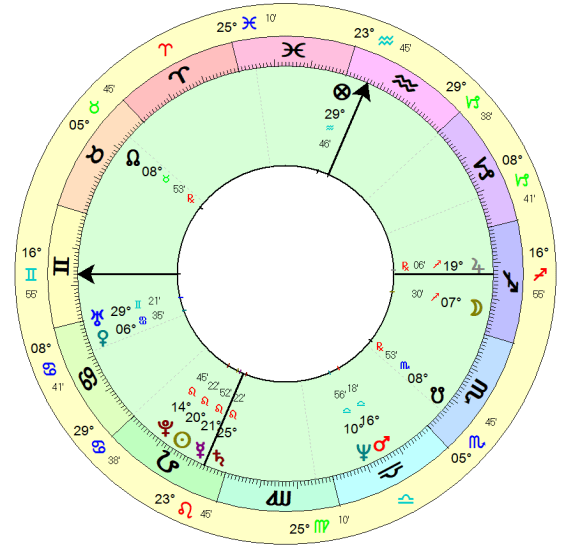
Here’s an example: the chart of the famous opera singer, Kathleen Battle.

Screenshot 2019-02-19 10.16

As we look around the zodiac wheel in her birth chart, we see that there are exactly zero visible planets in Earth signs here.

We can spend a lot of time talking about how the huge amount of fire planets in her chart made her live up to her last name—she was a legendary diva in every sense of the word. But Miss Battle does not want for anything, at least as far as money or financial security was concerned.

Step four: now what?

Relax! Just because you’re missing an element in your chart doesn’t mean your life is going to fall apart at that particular seam.

It does mean that your temperament is skewed away from whatever element is missing. But temperament is a more complicated beast; it impacts your personality and your physical health, too.

What you can focus on now is where most of your planets are stacked. If there is more of an element than others in your chart, that’s where your attention should be! It’s what will require more work, since more of your planets have to express through the parts of life governed by that team.

Looking back at Miss Battle’s birth chart, her chart is stacked heavily towards fire: five visible planets in fire signs! So she will need to spend time working on knowing who she is and balancing how she goes about expressing it in healthy ways.

The good news is that you’re not alone in this. As an astrologer, I can help you identify where the elements in your birth chart lie and help you develop strategies to deal with them, as well as the other important factors in astrology, in a birth chart consultation. I’d absolutely love to work with you on this, and I’m excited to jailbreak your stars with you!

Book a Consultation Now!