
How to Interpret Houses in Astrology: Part 1

When you’re first learning about astrology, there comes a time—and it usually happens when you encounter your first quality sun sign horoscope— that you’ll come across the idea of “houses.” Houses in astrology are one of the crucial components of understanding your birth chart, and if you want your understanding of astrology to level up quickly, learning how the houses work and what they mean, both in general and for you, will be one of the quickest ways to understand how this kooky cosmic clock times trends in your life and in the world.

“Sure, but what are they?”

First, let’s put some vapor house on to get in the mood…

Imagine a department store.

Within a department store you have, well, departments, and you’re probably thinking of the sales floor: there’s housewares, men’s clothing, women’s clothing, automotive, sporting goods, automotive, and electronics (in most, anyway). The sales floor has quite a bit to do with how the store interacts with you, the customer.

But there are also parts of the store that you don’t see, too; things like the cash office, human resources, the loading dock, the employee lounge, and the warehouse area in the back. Sometimes there’s a concessions area with a Starbucks in front. Then there’s the checkout area, which is where the magic happens for the store.

Each of these areas serves a different function in the overall shopping experience. So, we might think of them as “functional areas.” And each of these areas has a middle manager who oversees the day-to-day operations of each department, while everyone in the store and all its functions, as well as its overall success, is under the purview of the general manager.

In astrology, each house in a chart is like one of these functional areas within a store. Each of the houses has a way in which it relates to you as an individual, and each house interfaces with an aspect of the outside world around you (just like each area in the store, sales floor or not, relates to the customer experience overall).

The Ascendant and its ruler represents the General Manager of the store, and every other department has its own manager, or what we call a “house ruler.”

So if each house represents a domain of your life, how do you figure out which domain goes where? Let’s look at a chart example.
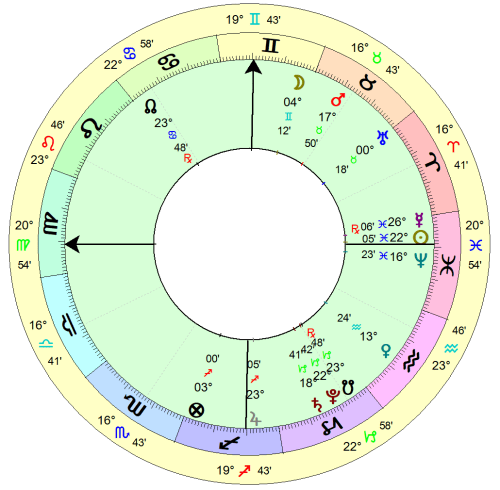
Screenshot 2019-04-08 13.06

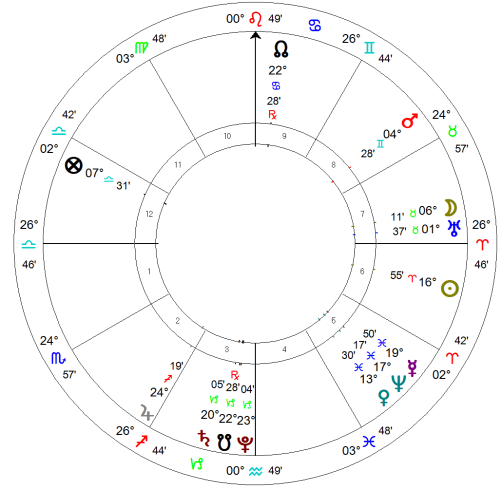
If you’re looking at your circular birth chart, you’ll see it divided into twelve pizza slices. Starting with the point on the circle furthest over the left-hand side (the nine o’clock position), you will then count forward counter-clockwise to number them off. See where the Ascendant degree is in that graphic? Everything in a counter-clockwise direction, to the next line or “cusp,” is the first house.

So, the first house in that chart is the pie piece that starts at 26 Libra 46 and goes to 24 Scorpio 57.

However! A tricky bit quickly arises: when using quadrant houses, if a planet is within 5 degrees of the next house cusp moving in a counter-clockwise direction, we read that planet as being in the next house. Looking at that same chart, we see that Jupiter is at 24 Sagittarius 19, but the 3rd house line falls at 26 Sagittarius 44. Since that Jupiter is within 5 degrees, we know that this Jupiter is a 3rd house Jupiter.

That five-degree “buffer” until the dividing line is what we call the “cusp” of a house, which doesn’t mean boundary; it means point or apex, like the points on your canine teeth: it’s why those teeth are called “cuspids.” It’s the seat of power related to that house, and planets on the cusp have a big impact in the affairs of that house.

For example, we might think of the second house in your birth chart as your stock room: it’s where all your inventory and resources are stored. A planet sitting right on the 2nd house cusp is in the middle of your stock room, doing whatever it is that planet does: if it’s Jupiter, he’s making money for you, but if it’s Mars, he’s probably spending money. “You gotta spend money to make money, honey,” he says.

But, he’s not in charge of the stockroom. He’s just right in the middle of it doing his Mars thing.

Who’s actually in charge of the 2nd house? Well, whose turf does that cusp fall in? To figure this out, we look at the sign wherein the cusp falls, and see what planet rules it.

So, if the 2nd cusp falls in the sign of Leo, the ruler of Leo is then in charge of the 2nd cusp. In this case, the Sun rules the 2nd cusp and will describe your relationship to money in some way.

How do I figure out how to divide the houses in my birth chart? I heard something about whole sign/Placidus/Koch/&c. houses… what’s all that about?

Technical Ramble Alert!

What you’re thinking about is the issue of house division, which has been a logistical problem within the astrological community for centuries and has engendered more than one loud argument in restaurants at conferences throughout the years.

Conceptually, houses are divisions of local space using astronomical considerations. There are… more than a handful of different criteria around which you could divide this space. You could use time to divide space. You could use… space to divide space (how’s your spherical trigonometry?) You could just use the Zodiac itself to divide space. It’s like cutting a pizza into 12 pieces. We generally want the result to have nice, even pieces.

But different astronomical criteria (yes, astronomical, meaning things that we are observing about the sky) determine how those pieces are divided. Broadly speaking, most systems of house division use either a reference to a point in the Zodiac, usually the ascendant, and then project houses from there on a sign-by-sign basis (whole sign houses and equal sign houses do this), while others, like Placidus, bring the degree of the midheaven into the equation, creating some complicated math.

My friend Ryhan Butler did a series of Twitter threads on the rationale for the way most of the popular house systems are divided, and if you want to do a deep dive, head over there!

BUT HOW DO I PICK ONE

Just pick one and stick with it long enough to learn how it functions and why it functions. In my practice, I waffle between whole sign houses and Placidus houses for natal astrology (although I gave up whole sign houses for Lent this year to build some consistency of interpretation…), but I use Placidus exclusively for horary.

The point, especially if you’re new to learning astrology, is not to win an argument; the point is to have results that help lead you to richer understanding of your own chart and the charts that come into your life. So!

How do I actually interpret the houses in my birth chart?

Let’s start off with the idea of angular triads. There are four angles in your birth chart. As each day goes by, if you’re looking south, the sky appears to rotate in a clockwise direction. We call this direction “primary motion.” Planets rise at the ascendant, culminate at the midheaven, set at the descendant, and come to their lowest point at the imum coeli, AKA the cusp of the 4th house.

Those four turning points are called “angles,” and initially were described with a word that also meant “tent pegs.” Those four points are the most significant points in your chart, and anything placed within those houses has more to say about your overall life and experiences. So start off by looking to see if you have any planets in the 1st, 10th, 7th, or 4th houses.

Planets in the houses that come before the angular houses in primary direction (remember, clockwise is primary) are called “succedent.” If we think of each of the big four angle house cusps as a throne, planets the succedent houses (2nd, 11th, 8th, and 5th) will, as the day goes on, succeed to those thrones. Conversely, planets in the houses that come after the angular houses in primary direction are called “cadent.” They were on the throne, but now they’ve lost their opportunity and have fallen out of power (which is what “cadent” means).

We can then divvy out the houses into three categories: succedent, angular, and cadent. Planets in angular houses have all the opportunity in the world to manifest what they promise; planets in cadent houses have lost that opportunity and are regrouping. Planets in succedent houses are movin’ on up but aren’t quite there.

Now, just because a planet is in an angular house doesn’t mean that it’s doing its job well, which is why understanding planetary condition is crucial—but that’s for another blog post!

Let’s get to the overall meaning of the houses, then. I won’t go into the rationale for why these meanings are what they are; that’s been treated at length by lots of fantastic astrologers. What I do want to point out is that there’s disagreement on the meanings of some of these, for sure.

Modern astrology understands the meanings of houses that Dane Rudhyar articulated in his lovely book “The Astrological Houses,” where each of the houses is viewed as a part of an unfolding life cycle. That’s not what I’m presenting here.

What I’m presenting here represents the consensus of the classical astrological tradition as found as common threads through the astrological texts of the middle ages, renaissance, and baroque era. Try these out, see if you like them, and if you get stuck on the meaning of a house or if it doesn’t land, let it marinate until it clicks. Many of these are drawn from the “joys” of the planets: if a planet delights to be in a house, it impacts the overall meaning of that house.

    • The first house is the joy of Mercury and it relates to you: your baseline personality, underlying motivations, style, appearance, and vitality.
    • The second house relates to money, especially your money, and resources that you have access to which enable you to support yourself.
    • The third house is the joy of the Moon and relates to communication in general, but more specifically to communication with people who are in your local space. There’s a “your zip code” element to the third; it represents your peers, siblings, neighbors, and really anywhere within commuting distance. It also relates to matters of the mind, gathering knowledge, primary education, news, rumors, and reports.
    • The fourth house relates to matters of ancestry, parents, family, and your sense of “home;” it also relates to matters of the land, and the legacies that you leave.
    • The fifth house is the joy of Venus and relates to matters of sensual pleasure, fun, recreation, procreation, and creativity. Sam Reynolds calls this the house of swagger; where you go to express yourself and put more of yourself in the world.
    • The sixth house is the joy of Mars and relates to matters of disease and illness. It also relates to drudgery, hard work, labors, servitude, and people who work for you. It also represents pets and small animals!
    • The seventh house relates to one-on-one interactions, most commonly marriage or romantic relationships, but it also has signification of anyone with whom we are engaged, such as the opposing party in a lawsuit, the business partner we would sign a contract with, or our enemies.
    • The eighth house is the house of unavoidables: death, debt, and taxes. Since it opposes the 2nd house, it has significations of other people’s money. It also represents inheritances you might receive from the dead, as well as your relationship with fear.
    • The ninth house is the joy of the Sun and relates to matters that enlighten and elevate our perspective: religion, philosophy, higher education, and travel to far-off lands. It’s everything that the 3rd house isn’t; if the 3rd is focused on here and now, the 9th is focused on everything else. Publishing and mass communication is part of the story here; 3rd is generating content, 9th is getting it out there.
    • The tenth house, called “Acts” in Greek, is what you’re known for, the way you appear within public perception, career, vocation, and accomplishments.
    • The eleventh house is the joy of Jupiter and relates to the people whose company you keep: friends, groups, affiliations, associations. It also describes the positive boons and opportunities which come your way and your aspirational longings.
    • The twelfth house is the joy of Saturn and relates to matters of sorrow, isolation, separation, and imprisonment. Kelly Surtees describes it as a “Pandora’s Box” of all the stuff that you’d rather forget about that can be brought to the surface by transit.

Now, the key to interpreting how houses function is to figure out which planet rules the house and to look at the condition and placement of that planet in your birth chart. We can use this extremely basic formula to get us rolling:

My [nth] house cusp falls in [sign]. [Sign] is ruled by [planet]. [Planet] is in [good/bad/eh] condition in [x] house. My relationship to [nth] house affairs manifests in a [planet] style using [matters of the house the sign ruler is placed in]. This leads to [positive/negative/mixed] outcomes relative to matters of the [nth] house.

Since I’m a Sagittarius midheaven, I’ll use my own chart as an example.

In my chart, the cusp of the 9th house falls in Scorpio. Scorpio is ruled by Mars. Mars is in overall good condition in my chart in the 2nd house. My relationship to 9th house affairs manifests in a Mars style using matters of the 2nd house. This leads to generally positive outcomes relative to matters of the 9th house.

I’m an impulse spender when something resonates with a goal or ideal that I have. In fact, I spend a lot of money, but I try to spend it in accordance with my ethics around money!

Let’s try another one!

Say you have the 7th house cusp in Libra with Venus in Capricorn in the 10th in a night chart, applying to the conjunction of Mars, with the Moon applying to trine Venus from Taurus. That’s a strong Venus, helped by Mars and supported by the Moon. So it would look like this:

In your chart, the cusp of the 7th house falls in Libra. Libra is ruled by Venus. Libra is in overall good condition in the 10th house. Your relationship to 7th house affairs (relationships) manifests in a Venus in Capricorn style (strong, determined, suffers no fools) within the realm of your 10th house. This leads to positive outcomes relative to matters of the 7th house; you might meet your partner in a work setting, or you and your partner might join together to found a company (since in this instance, Mars would be your ascendant ruler as the ASC would fall in Aries).

Remember what I said especially about planets in an angular house (both Mars and Venus are in an angular house, the 10th here): this part of your chart will have a lot to say about your overall life story! It’s turned up to 11, so to speak. This synergy between Mars and Venus in your chart makes your professional achievements a major factor in the stories people tell about you.

What if I have empty houses in my chart?

That’s not anything you need to worry about. I’ve heard of people told that they won’t have kids because their 5th house is empty… that’s bunk, sorry. Even if a house is empty, it still has a ruler, and that ruler is still placed somewhere and doing something. If your 2nd house is empty, you’re not going to be broke because of that; look to the ruler of your 2nd and see what’s happening with it! Use the formula, tell the story!

That said, understanding the condition of a planet is crucial to getting accurate interpretations for each placement. I’ve not yet written a lot on understanding planetary condition, but if you want to do a deep dive, Demetra George’s new book is the text you want to get to start getting the mechanics in your head (affiliate link ahoy!): get it here!

Meanwhile, over the next twelve weeks, I’m going to be offering one post for each of the houses going through its ruler being placed in any of the other houses! That’ll cover every possible combination.

In the meantime, if you really want to do a deep dive into understanding your house placements, there’s no better way to do that than by working one on one with me in an astrology consultation. Your chart will come alive in ways you didn’t expect just by getting another set of experienced eyes on it, and I absolutely can’t wait to work with you!

get your houses in order: book a session with me today!

Featured Image by Jakob Owens via Unsplash

How I Found My Husband’s Wallet Using Astrology

Lots of folks don’t realize that astrology isn’t only a handy tool for personality analysis. It can also be employed for real-world problem solving!

One of the ways I do this regularly for myself and for my clients is through the practice of horary astrology. I’ve written about horary at length on my blog here, and I use it day in and day out for myself and for my clients to derive answers to sticky situations and determine courses of action whenever life throws us a curve ball.

If you don’t know what horary astrology is, it’s the practice of drawing an astrological chart for the time a question is posed and using the data provided in the chart to determine an answer. Simple, right? Mine and my clients’ results with horary astrology create a pretty strong case for its utility, but my husband, God love him, remains skeptical.

When his wallet went missing yesterday and he asked me to help find it, I of course leapt into action and immediately drew a chart.

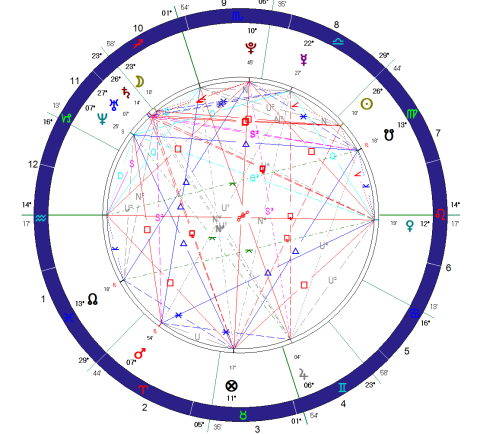
Missing Wallet Chart

Horary Chart: 12 March 2019, 7:32pm, Lexington, KY, USA

If you’ve never encountered a horary chart before, there are some standard steps in approaching the question, especially in questions like this where we’re dealing with lost objects.

Before we get into where the wallet is, though, we need to look to see if we’ll actually be able to find the wallet. In astro-speak we would call these factors “testimonies of recovery.” In a lost object chart it’s helpful to do this before jumping ahead and trying to figure out where the item is. Ultimately, we want to see good stuff happening on the angles of the chart (first, tenth, seventh, and fourth houses), as well as with the Moon itself.

If we look at those four houses, the first thing I see is that we’ve got Mercury and the Sun mutually applying right on the descendant, but as it happens, both planets are applying to Jupiter in this pileup called a “collection of light.” Jupiter is the slowest planet in this mix. The Sun and Mercury are both moving towards 23 degrees of Pisces, forming a square to Jupiter at 23 Sagittarius—you may be thinking that this is a square so it’s not as good of a sign, but remember that Jupiter in Sagittarius is no villain, and on the 4th house cusp he’s in a position where he can make a final call.

Let’s also look at what the Moon is doing: her last aspect was the sextile to retrograde Mercury in Pisces while she was transiting the last few degrees of Taurus. She’s in the 9th house, which is a cadent house, in Gemini. The Moon’s next application is the trine to Venus, a benefic, who isn’t in the best shape she can be in, but it’s not awful. But it’s still a benefic, so I’ll take it!

So we’ve got Jupiter at a power point bundling together the light of the Sun and Mercury, and we’ve got the Moon applying to Venus. This makes for a great situation! At this point I’m confident the wallet will be recovered.

Now, let’s figure out where to look!

We need to determine what happened first, though. We’ll take the ruler of the ascendant to signify my husband, since he’s the one asking the question. That gives us Mercury in Pisces in rotten shape: detriment, fall, retrograde, and combust. Michael’s not going to be the one to find the wallet. Fair enough reasoning, right?

We can look to the ascendant ruler’s last aspect and the Moon’s last aspect to tell us how this situation came to pass, and it happens that the Moon’s last aspect was the sextile to Mercury. This tells me that Michael’s wallet fell (Moon in a cadent house) when he wasn’t paying attention to it (Moon’s separation from combust/retrograde/peregrine/detriment/fall Mercury). The story’s writing itself.

We’ll also take Venus as one of the significators of the missing wallet, since Venus is the ruler of the 2nd house (the 2nd house cusp is at 16 Libra). Because we see that Venus is in a Saturn ruled sign, this confirms the description of what we’re looking for: Michael’s wallet is old-ish, worn, and leather, as he’s had it since before we met. Old, worn, leather, and valuable: that’s the symbolism of Saturn and Venus mixed together, so we know we’re on the right track. So where is it?

In lost object charts I’ve found it a little more helpful to start with the Moon for figuring out the location of the object if the placement of the 2nd ruler doesn’t make sense right off the bat. Venus in Aquarius in 5 isn’t telling me anything, and the last contact the 1st ruler had was to the Moon, so it makes more sense to start there anyway.

The Moon is placed in the 9th. But Michael hasn’t been on any distant trips or in any places of worship recently, and we knew he had the wallet on his person that day—we had gone to lunch and to the pet supply store to get flea treatment for our dog, and Michael gave me his debit card to buy it.

Naturally we thought the wallet was somewhere in my car, but he had already looked and didn’t find it, nor did he find it near the mailbox; he had gotten out of the car to get the mail on the way into our apartment complex. At this point, he was thinking it was gone completely.

This is calling for extra insight. Enter turning the chart.

If you turn the chart to read it to read where the Moon is relative to me (since I’m the 7th house/ruler here), the Moon is placed in my 3rd house. Based on that alone I was convinced that the wallet had disappeared somewhere between the pet supply store and our parking lot, but for added measure, look at the planet right on the 9th cusp: Mars in Taurus.

Mars naturally rules anything with a combustion engine, and the 3rd is related to short trips or means of transportation. For added flavor, I drive a bright red Scion XB, which is shaped like a box. Taurus = boxy, Mars = red, 3rd house = car, it’s all lining up.

So then, where was the wallet? The Moon is in a mutable air sign. Air signs indicate places off the ground, so it was unlikely that the wallet had fallen to the ground and was picked up by someone else. Mutable signs (Gemini especially) indicate spaces within spaces, or places where two things join, like the eaves of a house (wall meets roof).

Based on this I was almost positive that the wallet would be stuck down somewhere and hard to find in my car, and because of Jupiter being the 7th ruler here and collecting the light of the Sun and Mercury, I knew I would be the one to find it.

I threw on my flip-flops, went down to the parking lot, opened the passenger side door of my car and shoved my hand down into the bottomless abyss between my center console and the passenger’s seat. My hand fell right on the wallet.

I then texted Michael, who is patiently skeptical of this nonsense, that I had just found his wallet using astrology. He thanked me but withheld further comment.

¯\_(ツ)_/¯

Need help finding something or making a decision? Horary astrology can deliver results, today!

Ask a Horary Question

How to Interpret Aspects in Astrology

One of the places I got completely stuck when I was first learning astrology was the issue of aspects. Probably because when I first drew my chart it looked something like this:

Screenshot 2019-02-25 12.23

To which I said,

via GIPHY

That’s quite the knot to untangle, even for a visual-spatial learner like yours truly. I had an inkling of what to do with a planet in a given sign and was even starting to get into issues related to houses—but when it came to getting my head around the aspects in my birth chart, I was up the creek. I wasn’t going to give up that easily though.

The astrology bug bites hard.

In this post, I’m not only going to explain how to interpret aspects, but I’m also going to give you a starting place into understanding the “why” of astrological aspects so you can begin to get your head around the “how!”

What is an Aspect in astrology, anyway

To put it as simply as possible, aspects are how we describe the relationship between planets. Understanding aspects in your chart gives you a window into the dynamic stories that are playing out in your life.

An aspect in astrology occurs when a planet is at a certain number of degrees away from another planet or point in the chart. For example, when two planets are around 90° from one another, we say that they’re in a “square” aspect (a square has four 90° angles).

What that means is this: those two planets are in a relationship with the character of a “square.” Think of the language we use in English that describes squares: “squaring up” before a fight. “Squaring off.” “Square peg in a round hole.” That should tell us that there’s something adversarial about a square: something tense, a real “can I speak to the manager” situation.

If you’re like me, you want to know where this concept comes from; keep reading. If you’re not like me and you just want to know what aspects signify what kinds of relationships… well, scroll on down 😉

To give aspects in astrology their due, we must take a detour into classical optical theory, because the word “aspect” literally means “look at” (Latin ad, “at, to” + spectō, “I look”). I just heard half of you slam your head on the desk. “I just wanna know when I’ll meet my soulmate!” I see you, I hear you, but stay with me!

It’s important to remember that the ancients conceived of the planets as active agents, not as passive on a cosmic timepiece. We start off with the idea that, in the astrological ball of wax, planets interact with each other by casting glances at one another. Kind of like this:

via GIPHY

If we’re looking at something, what we are doing is bearing “witness” to that which we are observing, and many of the ways traditional texts talk about aspects include descriptions of planets “witnessing” each other. The astrologer Chris Brennan discusses this at length in his game-changing book, Hellenistic Astrology: The Study of Fate and Fortune, beginning on page 292 (that’s an affiliate link; I get a kickback if you purchase a copy). If you’re serious about astrology at all, that’s a book to have on your shelf.

These glances in the ancient world were conceived of as an exchange of energy. The short version is that people imagined that the human eye was emitting ethereal light called “lumen,” which was invisible but illuminated anything it fell on. Anything that this lumen hit was “illuminated,” and returned visible light, called “lux,” to the beholder.

We see this reflected in literature of the day, including the New Testament (Matthew 6.22-23, NRSV):

“The eye is the lamp of the body. So, if your eye is healthy, your whole body will be full of light; but if your eye is unhealthy, your whole body will be full of darkness. If then the light in you is darkness, how great is the darkness!”

Lux. Lumen. Lewks. They make aspects work. Got it?

In modern astrology, we’ve lost the connection to optical theory and now it’s more to do with vibrations, from the ways I’ve heard it explained. It’s as though the planets “resonate” with each other at certain angles, creating consonant or dissonant harmonies. This vibes well with the way many new age folks talk about vibrational frequencies. But even that has some ancient roots!

Aspects and Musical Harmony

There are five main aspects described by Ptolemy and agreed upon in general by the astrologers of the ancient world up through the renaissance and early modern era.

These five aspects are as follows: the conjunction (0º), the opposition (180º), the trine (120º), the square (90º), and the sextile (60º).

Ptolemy explains that these divisions of a circle are important precisely because they represent the primary divisions of the octave in music (cf. Tetrabiblos I.13). Each division correlates to a harmonic interval: correlate to the unison (conjunction), the octave (opposition), the fifth (trine), and the major third (sextile).

You’ll notice that I skipped over the square.

If you play the note exactly halfway between the top and bottom notes of an octave, the interval that results is actually the most dissonant interval in music, the tritone (also known as a diminished fifth or augmented fourth). This musical interval corresponds to the astrological square: halfway between the conjunction and the opposition.

This is whence the language of “harmonious trine” and “tense square” emerges historically, but I don’t think this is commonly known (although I can’t imagine astrologer-musicians throughout history Rudhyar or Ficino would have overlooked this, but I haven’t read enough of them to have the sources on hand).

For those keeping score at home, the modern equally tempered octave has twelve notes in it—but, the zodiac preceded the chromatic scale. Greek music used tetrachords: 4-note scales!

Okay, so what? How do I actually interpret aspects in my chart?

To interpret an aspect in your birth chart, you’ve got to take the aspect apart first by asking yourself several questions:

  • Which planets are involved?
  • What aspect is involved
  • Which planet is faster?
  • What houses do the planets rule?
  • What houses are the planets in?

It gets complicated quickly, but if you get used to doing this over and over, it becomes second-nature! It’s like learning your scales and arpeggios, to continue the musical metaphor. Let’s break this down!

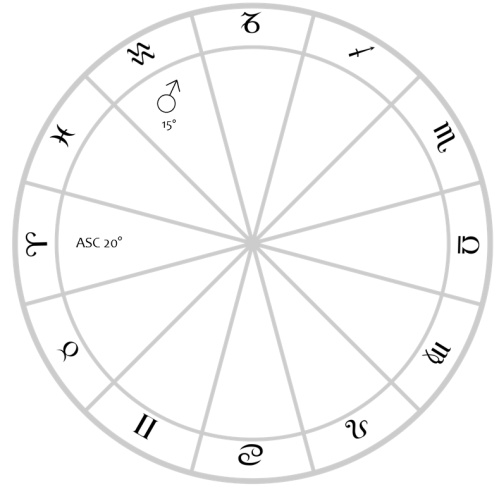
Suppose you’ve got Mars sextile Jupiter in your birth chart, and say that you’ve got Aries rising, and that you were born at night. If you were to look at the sky at the moment of your birth (and it was nighttime) you’d see Mars rising bright over the eastern horizon. Drawn on a chart, it looks like this:

aspects mars in chart 1

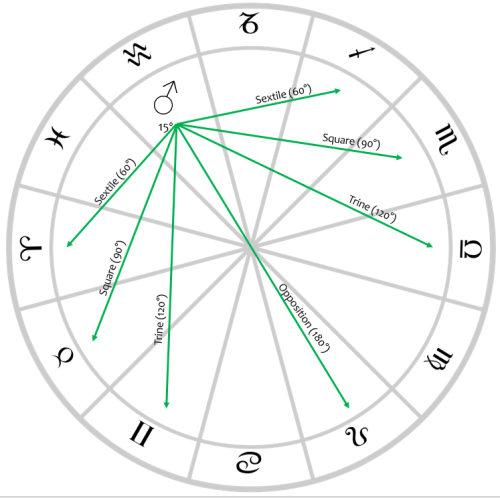
As a rule, planets in astrology can see things in the sign where they’re at. Planets also emit seven “rays” of lumen to the degrees that they can see by the aspects we talked about above. So, Mars is hitting a certain collection of signs with his lewks, and so we say he can behold those signs. From Aquarius, Mars can behold Aries, Taurus, Gemini, Leo, Libra, Scorpio, and Sagittarius. Really, anything in Aquarius can see anything in those other seven signs—there can be an aspect there.

aspects mars with lines

Now, Mars cannot behold anything in Pisces, Cancer, Virgo, or Capricorn from where he sits in Aquarius. So, we say that anything in those signs is “averse” or “in aversion” to Mars, and likewise we can say that Aquarius is “averse” or “in aversion” to those signs. We can spend a lot of time on that, but here’s a visual reminder:

aspects mars aversions

Say that a planet is in any of the signs that Mars can behold from where he sits in Aquarius, so, let’s say it’s Jupiter in Sagittarius. That means Mars and Jupiter are in aspect by sign. So, right now, Mars and Jupiter can see each other because they are in signs that can behold one another. We call this a “sign-based aspect.”

aspects mars jupiter sextile

If two planets are in sign-based aspects, they can interact with one another. The nature of their interaction, whether friendly or hostile, is determined by the nature of aspect. Here’s the juice:

  • Conjunction: two planets are working together according to their natures (e.g., Venus helps, Mars hurts, etc.)
  • Sextile: gently supportive and easy, but not very dynamic
  • Square: tense and combative, but sometimes passive aggressive
  • Trine: flowing, makes things happen, but not necessarily always “good” in a strict sense
  • Opposition: well, it’s in the name. Overt fighting, explosive, a blow-out!

Sign-based aspects describe the overall tenor of planets’ relationships with each other. But planets don’t interact directly with one another until they come to a degree-based aspect within a sign. That would mean that when Mars advances to a later degree of Aquarius, to meet the square that Jupiter is casting there, which activates whatever this relationship signifies.

Let’s put the story together!

Mars moves faster than Jupiter (usually, unless Mars is retrograde), so Mars will be the one who is approaching Jupiter here. Because it’s a sextile aspect, Mars and Jupiter are in a supportive relationship with one another. Think of it like this: Mars is approaching Jupiter as a friendly acquaintance and asking him for help with something. Since Jupiter is, by nature, a friendly guy, and since he’s in his own sign of Sagittarius and has access to his own resources, Jupiter’s happy to share out of his abundance with Mars.

Good so far?

The last step is to figure out what parts of life the aspect is describing, and you figure this out by looking at which houses the planets involved rule. So in this example, with Aries rising, Mars rules the first house of your basic personality, body, health, vitality, appearance, and overall circumstances, as well as the eighth house of the unavoidables: fear, death, and taxes. Jupiter, meanwhile, rules the ninth house of education, spirituality, and travel, as well as the twelfth house of limitations, sorrow, and the unconscious. Mars is placed in the eleventh house of friends and groups, and Jupiter is placed in the ninth house, which I already described.

Let’s plug everything into this formula:

[Faster planet] representing [material of houses ruled by faster planet] approaches [slower planet] who rules [material of houses ruled by slower planet] in a [character of aspect] way and this creates [positive/negative based on the nature of the aspects and the planets involved] impacts in the area of [house where the faster planet is].

That gives us:

Mars, representing the native’s body, health, appearance, basic personality, approaches Jupiter, who rules philosophy, religion, travel, and education, in a gently supportive way and this creates positive impacts involving the native’s friends and associations.

Then you see where that takes you. In this example, we can see how the native’s personal circumstances can be improved by making efforts to connect with people who share their beliefs, philosophies, and values. Doing so serves them quite well and has the ability to improve their social standing. That’s just a very basic interpretation, but we can dive deeper into how this aspect plays out within the life of the native by looking at their unique context. That’s what we’d do within an astrological consultation.

I’m still lost!

It takes quite a bit of time to learn how to interpret aspects in this way, and I didn’t even get into the difference between applying and separating aspects! But if you take the time to get this rhythm into your bones, you’ll be able to interpret aspects in your birth chart with more ease.

Remember that astrology is a long apprenticeship, too! It’s always helpful to get another set of eyes on your chart, and I’d love to be able to help you out with that.

Get your aspects untangled—book now!

If you want to practice interpreting aspects on your own, great! I’ve made an aspects worksheet PDF for you that has all the information on aspects and houses you need to get used to the rhythm of interpreting aspects (plus some extra stuff on applying and separating aspects). To get your copy, all I need you to do is to sign up for my email list here.

Was this helpful to you? What questions do you still have? Let me know in the comments!

Three Ways to Work with Saturn

There comes a time when you first start learning astrology that you learn about Saturn. Nobody really likes to deal with him, if we’re being perfectly honest; we would much rather spend our time cozying up with Venus and partying with Jupiter. They’re better company.

But the reality is that everyone must deal with Saturn. We can’t escape it. But, we can learn to become friends with Saturn—well, maybe not BFFs, but we can get on better terms with him.

And the truth is that I honestly love Saturn. But that hasn’t always been the case!

In our birth charts, Saturn represents the places that box us in. We all have a pinch point in our life where we seem to get stuck, an area which demands discipline, diligence, and structure. In those spots, he says “no” to something in our birth chart. He says to us, “this is where your hardest work will be.”

A part of our life that challenges us to learn how to say “no”—sometimes it even challenges us to learn how to say “no” to ourselves. Even with that being the case, we can embrace the hard work that Saturn demands. Saturn stands ready to give us what we need to thrive when we make that hard choice.

Some of us have Saturn in our eleventh house, where he makes it harder for us to find community and kindred spirits. Some of us have Saturn in our fourth house, where he can make our home life feel like a prison. Some of us even have Saturn in our first house, where he demands that we learn how to say “no” to ourselves.

Saying “no” to yourself isn’t necessarily a fun Saturday activity.

Let me put a pin in that real quick, though: think about the gift of Saturday. Each of the days of the week has a planetary ruler, and Saturday is no different. Naturally, the day is Saturn’s own.

But in other languages, especially those deeply connected to the Jewish diaspora, Saturday is still called “the Sabbath.” Sabado. Samedi. In Russian, Subbota.

The ancient stories of the Jewish tradition suggest that it was on Saturday that the Divine said “no” to further creation so that the Divine could rest.

And likewise, for millions of people throughout history, Saturday has been the day where Jewish people have learned to say “no” to work and to fear in order to say “yes” to the richer things of life that neither labor nor money can procure. Things like family, community, rest, relaxation, feasting—aspects of life that empower us to live with soulfulness and depth.

These aspects of life need a container. And what Saturn does is that he hollows out a space in our lives through teaching us to say “no” so that we can contain a life that’s rich with fullness and depth.

Wherever Saturn is in your birth chart, there is an opportunity for you to experience the boon of “sabbath.” You have the chance to say “no” to something to make space for what can grow there.

So how do I work with Saturn?

One: Know What You’re Up Against

The first step is knowing which house Saturn falls in, which is easy to do if you know how to run your birth chart on astro.com or another service. Whichever house Saturn falls in is the area that demands that hard work of hollowing out space by saying “no” in order to say “yes.”

For a brief refresher, here are the life domains that each house represents:

  • First house: the self, the body, physical appearance, physical health & vitality, circumstances
  • Second house: our own resources, whether financial or energetic
  • Third house: our siblings, our local communities & neighborhoods, short trips, commonplace things, communication
  • Fourth house: our upbringing, our parents, our home, and the things that we inherit
  • Fifth house: fun, creativity, enjoyment, pleasure, children, and anything we do to create more of ourselves
  • Sixth house: hard work, duty, responsibility, and the people and creatures for which we are responsible (employees and pets)
  • Seventh house: partners in love and conflict, coalitions
  • Eighth house: other people’s resources, whether financial or energetic; other fearful things, like death and debt
  • Ninth house: expansion of perspective & knowledge, teachers, mentors, religion, spirituality, philosophy, long voyages
  • Tenth house: the legacy we leave, our career and public status, what we are remembered for
  • Eleventh house: our friends, associations, and fidelity to others
  • Twelfth house: that which imprisons us and limits us, isolation, retreat, sorrow, the unconscious

For example, let’s look at the chart of the famous choreographer and dancer, Martha Graham.

martha graham birth chart

We see that Saturn is in Libra in her fifth house. So, in her life, Saturn demanded her to apply diligence, structure, and shape to her artistic pursuits. If you’re familiar with Martha Graham’s choreography, you know that diligence, structure, and shape are perfect descriptors for her approach! By doing so, her artistic vision radically influenced dance in the 20th century (notice also that her midheaven degree is in Aquarius, which is traditionally ruled by Saturn!)

Oh, by the way, a fun astrology history fact: the important 20th-century astrologer Dane Rudhyar was, for a time, Martha Graham’s rehearsal pianist!

Whichever house Saturn occupies in your birth chart is the area of life that Saturn is asking you to structure, organize, and say “no” to certain factors so that you can say “yes” to the gifts that will be planted there.

Ask yourself these questions, and spend time answering them honestly:

“What part of this area do I need to say no to? What does it look like for me to put some sweat into tilling this earth? What can I cultivate here after I do that?”

Two: Look Inward with Compassion

The problem with Saturn work is that, if you haven’t given it a lot of thought before, it can be a rude awakening. You might feel like you’re being read for filth. You’re not filth. But Saturn is reading you for sure; it’s what he does.

Gentle reminder: you’re not alone.

If the process of looking at the Saturn part of your life raises some difficult questions for you, it’s crucial that you give yourself the gift of looking at that area with compassion. If you can’t learn to look at that area of your life and see it with the same eyes that those who love you most see you, then you’ll stay stuck on this Saturn piece. It’ll make dealing with your Saturn return even harder, too.

But Saturn thoughts don’t have to be the destructive emotions that we so often make them out to be. (I hope I’ve hammered this point home!)

One of the most helpful resources in my journey with learning to look at myself with compassion was a book given to me by my therapist, The Mindful Path to Self-Compassion by Dr. Christopher Germer. This work is a fabulous introduction to the basics of mindfulness meditation. But it’s not only that. You’re learning how to do mindfulness meditation with techniques and visualizations specifically geared to learn how compassion feels in your body. I return to his “soften, allow, heal” technique all the time.

If you’ve got any interest in meditation practice at all, it’s a fantastic starting place, and his accompanying website has free tutorial recordings that you can access. Do yourself a favor and get a copy (this is an affiliate link, full disclosure).

Get Your Copy of The Mindful Path to Self Compassion

Real talk? As long as looking at this Saturn-filled part of your life causes you to cringe and run away, you won’t be able to do the necessary work of softening it, allowing it to be, and letting it heal. It’s a necessary step on the journey.

Three: Attune Yourself with Saturn’s Spirit

Here’s where we get a little bit woo, but I’m trying not to go too hard here. Stay with me!

The idea is that each of us have a little bit of Saturn in us, and we can attune ourselves to that piece of the sky that’s lodged in our souls through prayer and mediation on its principles and properties.

This is what some astrologers call a “remediation,” and essentially it’s a way of balancing out a planet that’s too active or not active enough by making that planet more a part of our conscious experience. So how do you go about this?

In the Vedic tradition, there are mantras for each planet, and you can easily find a Saturn mantra to utilize in this way. Kelly Surtees features a wonderful write-up on this practice on her site that serves as fantastic angle of approach. We can dip into other traditions, too. Here’s one that I especially like for Saturn from the Greek Orthodox tradition:

“O Lord and Master of my life, grant me not a spirit of sloth, meddling, love of power, and idle talk, but give to me, your servant, a spirit of prudence, humility, patience, and love. Yes, O Lord and King, grant me to see my own faults and not to judge my brother, since you are blessed to eternity.”

Any prayer or affirmation that focuses on themes like prudence, humility, patience, and self-assessment is great for Saturn. If you can’t find one that you like, you can even write your own in words that feel right for you! There’s not a wrong way to do this.

Essentially, you take whichever mantra you want to use that encapsulates a planet’s principles, and you pray with it repeatedly until it sinks into your bones. Over and over again, breathing the prayer in and out as you go. There’s a reason that the earth’s major spiritual traditions each have some sort of prayer beads: this meditative repetition entrains your subconscious to the wisdom contained in the prayer.

It’s basically like reprogramming your brain’s circuitry so that it runs more harmoniously with the planets within!

For extra oomph, try doing this on a Saturday just after sunrise, or on a Tuesday night just after sunset.

What else can I do?

Even if you know what you’re working with, you’ve learned how to look at it compassionately, and you’re working on attuning yourself with Saturn, that doesn’t magically make everything go easier. (Well, it might. A little.)

The reality is that there’s a lot that you can do. It’s not a one-size-fits-all approach, though; if you’re interested in how to manage and nurture your unique Saturn situation, the best thing you can do is reach out to an astrologer who’s on good terms with Saturn and let them help you develop a strategy for working with Saturn that is tailored to you!

(I happen to know a guy.)

Help me figure out my Saturn stuff!

Lastly, if you’re dealing with Saturn stuff it’s important that you have people around who can help you carry the load he puts across your shoulders. And if you’re engaging in this process, I want to hear about it! Shoot me a note to let me know how your Saturn story is going. We’re in this together!

Disclaimer: this post contains an affiliate link. If you buy a copy of Dr. Germer’s book through the link above, I receive a small commission at no extra cost to you.

How to Maximize Missing Elements in your Birth Chart

It’s finally happened—you’ve gotten your birth chart calculated on astro.com, you’ve learned which signs are what element, you’ve gone through and read where each of your planets are, and you’re finally getting a handle on this whole astrology thing.

Then it hits you.

You don’t have any planets in water signs.

You start frantically Googling: “missing element in birth chart!” “No planets in water!” “Am I emotionally handicapped!?” You start to spiral. You start to second guess your career in helping professions. You bring it up to your therapist!

Step one: hit the brakes.

This is exactly what happened to me when I first got into astrology. Besides Pluto and my North Node, I have zero visible planets in water signs in my birth chart.

It happens to the best of us, you know. Because of the way the clockwork of our solar system works, many people are missing an element in their birth chart.

Many modern approaches to astrology look at elemental deficiencies, as they’re called, as areas where we have more work to do in our lives. That’s a valid interpretation, but I want to offer another way to look at it.

This is something I learned from the inimitable Dr. Jenn Zahrt in a late night conversation at this past fall’s SOTA Astrology conference in Buffalo.

Amid all the campy dance parties and late night soul conversations, I learned a little bit of astrology, and this is one of the things I have seen flip a switch in my clients whenever I bring it up to them.

You can see their eyes light up when they get this insight!

What Dr. JZ explained to me was something she got from another astrologer a few years earlier at another conference (and I bring that up because lineage and citing your sources is important in doing good astrology).

This is the idea of elemental mastery.

It’s an absurdly simple idea in essence: if you’re missing an element in your birth chart, the stuff signified by that element is not something that you need to work on in this lifetime.

Easy, right? Almost a little too easy.

Missing water in your birth chart? Great. Water stuff is easy for you in this lifetime.

But I’ve played around with this idea both with my own chart and with the charts of my loved ones and clients, and it bears out in practice.

Are you an elemental master? Let’s find out?

See, every zodiac sign has an element, right? Elements in the birth chart are like four different teams, or Hogwarts houses. A planet has to deal with the stuff related to the team that a given zodiac sign is in.

Just to remind you:

The fire team includes Aries, Leo, and Sagittarius. This team deals with the self in matters of ego security and identity: obtaining it (Aries), expressing it (Leo), adapting and expanding it (Sagittarius).

The earth team includes Capricorn, Taurus, and Virgo. This team deals with the physical world through matters of material security: obtaining and storing it (Capricorn), maintaining it (Taurus), and applying it to concrete situations to improve circumstances (Virgo).

The air team includes Libra, Aquarius, and Gemini. This team deals with intellectual security, social connections, and ideas: creating them through social structures (Libra), maintaining them through social responsibility (Aquarius), and adapting them through gathering incoming information (Gemini).

Lastly, the water team includes Cancer, Scorpio, and Pisces. This team deals with emotional security and bonding with others, and again, the pattern is obtaining emotional security and nurture (Cancer), sustaining and defending those bonds (Scorpio), and expanding and releasing our bonds with others as we grow (Pisces).

Step two: what element is your birth chart missing?

If you’ve already figured this out, you’re a step ahead.

But if not, here’s a great exercise in getting familiar with your birth chart. Maybe it’s not something you’ve given any thought to! By the way, this approach works best when you’re working only with visible planets, and maybe the North Node.

Go get your chart wheel from astro.com and look at each of the visible planets in your birth chart: Saturn, Jupiter, Mars, the Sun, Venus, Mercury, and the Moon. Note which signs each planet is in. See if there are any missing elements. Got it figured out? Perfect!

Step three: what does that missing element mean?

Now that we know what that missing element in your birth chart is, we know what to do with this information. It’s simple: whichever team, or element, is missing, is an area of life that you don’t need to spend time working on during this lifetime, because it comes easily to you. Remember, all of these are just starting places—different factors can make these statements more or less true for you!

If you’re missing fire in your birth chart, you’ve got a strong sense of who you are and don’t need to spend a gap year in the Maldives finding yourself.

If you’re missing earth in your birth chart, you’ve got financial and material security down pat, and don’t need to overthink how you’ll get money or take care of your bills. You just do it.

If you’re missing air in your birth chart, your mental and social powers are something that don’t require thought; you know what you know, what you don’t know, and where to get the connections and data you need.

If you’re missing water in your birth chart, your emotional powers are dialed up, and you are skilled at riding the waves of human emotions. Showing up for people with empathy and vulnerability comes easily to you.

Here’s an example: the chart of the famous opera singer, Kathleen Battle.

Screenshot 2019-02-19 10.16

As we look around the zodiac wheel in her birth chart, we see that there are exactly zero visible planets in Earth signs here.

We can spend a lot of time talking about how the huge amount of fire planets in her chart made her live up to her last name—she was a legendary diva in every sense of the word. But Miss Battle does not want for anything, at least as far as money or financial security was concerned.

Step four: now what?

Relax! Just because you’re missing an element in your chart doesn’t mean your life is going to fall apart at that particular seam.

It does mean that your temperament is skewed away from whatever element is missing. But temperament is a more complicated beast; it impacts your personality and your physical health, too.

What you can focus on now is where most of your planets are stacked. If there is more of an element than others in your chart, that’s where your attention should be! It’s what will require more work, since more of your planets have to express through the parts of life governed by that team.

Looking back at Miss Battle’s birth chart, her chart is stacked heavily towards fire: five visible planets in fire signs! So she will need to spend time working on knowing who she is and balancing how she goes about expressing it in healthy ways.

The good news is that you’re not alone in this. As an astrologer, I can help you identify where the elements in your birth chart lie and help you develop strategies to deal with them, as well as the other important factors in astrology, in a birth chart consultation. I’d absolutely love to work with you on this, and I’m excited to jailbreak your stars with you!

Book a Consultation Now!