Praying with the Planets (Part One)

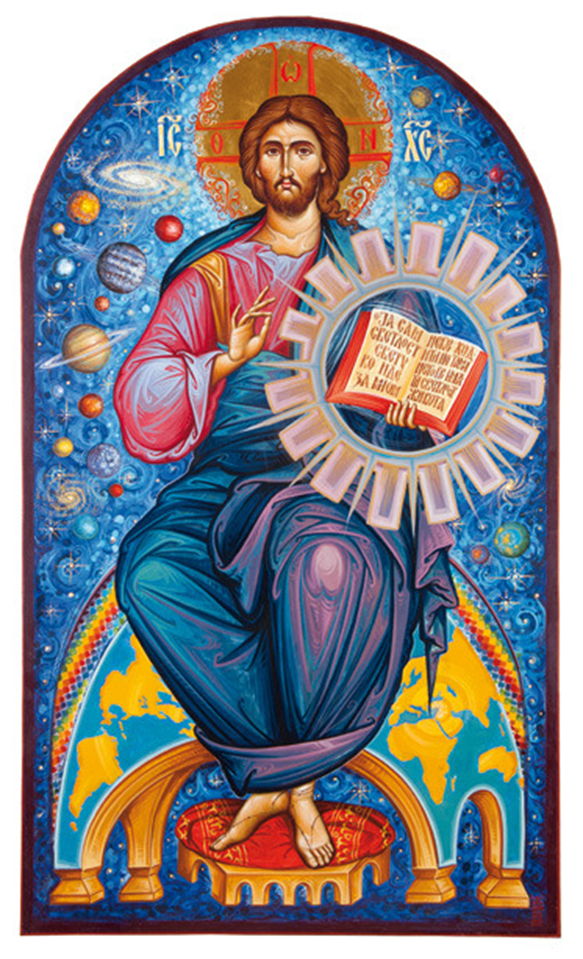
Jesus Christ Pantocrator, Vasilije Minić

For a long time now, a principal spiritual practice of mine has been the work of the Daily Office, a cycle of readings and prayers based on the time-sanctifying rhythms of monastic life in the Benedictine tradition.

Most spiritual traditions of the world have some way of weaving together prayer and time, and the Christian heritage is no different. Taking a cue from the practice of desert hermits and monks in the early centuries of the Christian movement, St Benedict of Nursia gave the West its characteristic form of the Divine Office, with attendant readings from scripture, refrains to be chanted, and prayers to be offered at set hours during the day, seven days a week, 365 days a year. The rhythms of the Daily Office become a trellis on which can grow the wild tendrils of a soul entering into the fullness of love.

I’ve been praying the Office in some form or another since 2010, and my preferred form these days is a simplified version of the order given in the Episcopal Church’s Book of Common Prayer. Toward the end of the order for Morning Prayer, the BCP gives two lists of suffrages, or petitionary prayers, that comprise several versicles and responses taken from the psalms:

Show us your mercy, O Lord;
And grant us your salvation

Clothe your ministers with righteousness;
let your people sing for joy.

Give peace, O Lord, in all the world;
for only in you can we live in safety.

Lord, keep this nation under your care;
and guide us in the way of justice and truth.

Let your way be known upon earth;
your saving health among all nations.

Let not the needy, O Lord, be forgotten;
nor the hope of the poor be taken away.

Create in us clean hearts, O God;
and sustain us with your Holy Spirit.

Unbidden, the thought struck me one morning as I made my way through them, chanting each versicle and response in my usual manner: these prayers make a maṇdala.

The thing about studying and practicing astrology is that it trains your brain to look for specific patterns as a means ordering our experience of the overwhelming quantity of sensory impressions we take in as we move through this world. In other words, it becomes difficult not to see two sets of seven without curiosity rearing its head. Given that seven is an archetypal number of cosmic perfection, and given the diurnal context of this set of prayers—after all, the seven days of the week take their name from the seven moving lights in a majority of cultures—I wonder: is the pattern here intentional?

I can’t say, and I don’t think that any such assertion could be proven directly. But what we can affirm is that the pattern of versicles and responses at the end of a prayed office is something with historical roots from a time when astrological consciousness was still shaping, in an overt way, the shape of private and communal prayer in liturgical Christian tradition.

The particular set of suffrages I have in mind (set A in both Rite One and Rite Two of the Order for Morning Prayer in the 1979 prayer book) is based on a set of suffrages contained in the liturgies of the Sarum use, an expression of Western Catholic ritual practice that developed around the traditions of Salisbury (Sarum) Cathedral in the late eleventh century and lasting until the English reformation, at which time Thomas Cranmer revised and condensed materials from the Sarum use into the first Book of Common Prayer.

According to Marion Hatchett’s commentary on the 1979 Prayer Book, the original set of suffrages on which these were based originate in the Sarum office of Prime, meant to be said in the first hour of the day. That said, Hatchett reveals that the version before us is a revision and expansion dating from 1979 (Hatchett, 124). So we cannot say that they are directly reflecting a historical reality.

However, I do think it is fair to say that the astrological consciousness present in pre-modern Europe—which is really nothing more complicated than an embodied awareness of the qualitative dimension of time, an awareness that we have lost in post-industrial modernity—is a through-line connecting the 1979 suffrages to their ancestors in Salisbury. This is, perhaps, an instance of what my teacher Cynthia Bourgeault would consider “imaginal causality, or the preeminence of archetypal pattern over historical facticity.” Bourgeault continues,

“According to this mode of seeing, the patterns that generate and organize the energy field of our visible world oringate beyond time (on a higher plane of reality and are transmitted largely through images (hence imaginal) impressed upon the still mirror of the contemplative imagination… In imaginal causality, the overarching pattern determines the field in which linear causality plays itself out. If a pattern can be shown to make sense of the data, to give energy and coherence to the field it is organizing, and to offer intelligent and useful directives for future action, then it is deemed to be true, whether or not it is, stricly speaking, historical” (Cynthia Bourgeault, The Holy Trinity and the Law of Three, 64).

Whether or not the suggestion of astrological line-up is intentional historically, the sevenfold alignment is enough of a cue to suggest that imaginal causality may have been at play in the contemplative imaginations of the compilers of the 1979 BCP (and only contemplatives could have written Prayer C, as far as I’m concerned). And so my curiosity remains: what might the planetary correspondences reveal about the inner meaning of the versicles? How might these versicles in turn help us to better understand the sevenfold structure of the reality in which we live and move and have our being?

Is there something here that helps us to pray these more effectively, with deeper feeling, with deeper attention, to help us route the wellspring of divine energies we experience as eros unto the transformation of the one praying and the relationships of causality that bind people and planets together?

And perhaps this this line of questioning goes beyond merely understanding the structure within which our life unfolds in time. I wonder whether, in praying these versicles, we might be offering an invitation to the reflections of the planetary archetypes which live within us to manifest in a way that reflects the spirit of wholeness in which the cosmos unfolds.

How do these prayers shape our subconscious, imaginal, and causal reality? In other words, can these prayers be the basis for upaye (“remedy” in Sanskrit), and therefore a tool for remediating adverse conditions and inclinations reflected in a person’s nativity?

My wager is that the answer is “yes.”

Astrologers reading this might ask, “Why weekday order and not Chaldean order?” One, my jyotish-pilled brain defaults to weekday order, and if you simply lay the two orders next to the suffrages as given you’ll see how the weekday order corresponds more closely to the themes, as you’ll see below.

But there’s also a deeper level to this choice (whether consciously editorial or not): because this is a prayer that is meant to be said at the same time every day as part of a daily rhythm, the structure of consciousness within which these prayers live and have their intended effect is the pattern of days as we experience them here on earth.

(And besides, the weekday order and the Chaldean order are tied to one another anyway by way of the planetary hours, which themselves gave shape to the pre-Reformation forms of the Daily Office in use in the British Isles, but that’s an article unto itself.)

So, what I endeavor to do in what will be a series of posts is this: I want to take each of these suffrages, and unpack them from the level of kāraka, a Sanskrit word meaning “signification.” Each of the prayers carries its own energetic reality that reflects its planetary position in weekday order, an energy that the kārakas present in each line hold.

Another intention of mine is a desire to expand these suffrages to a nine planet scheme to include the lunar nodes (Rāhu and Ketu), as would be even more appropriate for an astrologer in my own contexts. How might the selection represented here inform how we might go about identifying appropriate verses for them? That’s what I want to find out.

Here’s the set of prayers, presented with their astral correspondences and their source texts in the Psalms. Curiously, the one that aligns with Mercury is a prayer that does not have roots in the Psalter, but rather draws from another part of the BCP. If you’re not familiar with them, just read them as given and get a sense for their feel, both individually and as a planetary maṇdala.

SUN (Psalm 85.7)
Show us your mercy, O Lord;
And grant us your salvation

MOON (Psalm 132.9)
Clothe your ministers with righteousness;
let your people sing for joy.

MARS (Psalm 122.7 & Psalm 4.8)
Give peace, O Lord, in all the world;
for only in you can we live in safety.

MERCURY (Based on the collect For Peace Among the Nations, p. 816)
Lord, keep this nation under your care;
and guide us in the way of justice and truth.

JUPITER (Psalm 67.2)
Let your way be known upon earth;
your saving health among all nations.

VENUS (Psalm 9.18)
Let not the needy, O Lord, be forgotten;
nor the hope of the poor be taken away.

SATURN (Psalm 51.10a, 12b)
Create in us clean hearts, O God;
and sustain us with your Holy Spirit.

(Here I am, standing at the confluence of the Jordan and the Ganges (and I guess the Thames, too), trying to hold it all together in what will either be a fool’s errand or an offering of bhakti for the divine energies revealed in reality. We will see!)

If you’d like to practice with them and experiment with the wager yourself as we make our way through the maṇdala, nothing prevents you. If you’re not already a practitioner of the Daily Office, you can simply begin by finding a few quiet moments in the morning, lighting a candle, centering yourself. Say the Lord’s Prayer, then quietly repeat each of the suffrages, then a Hail Mary and a Glory Be. See how that feels, and let me know.

(I’ll be cross-posting this whole series over on my personal website, too.)
How to Understand the Planets in Astrology, Part 1

Time for a new series of posts! This time around, we’re going to be taking a look at the planets in astrology.



Each of the posts in this series is excerpted from my 2019 book, Charted Territory, and reflects my understanding of the planets at that time. The reality (as any student of astrology will be quick to affirm) is that you never stop learning about the planets. So, the posts in this series represent where I stood in 2019, and as part of the series, I’ll be gleefully correcting myself the whole time just to show how these understandings shift and change over time.

The first thing to keep in mind when lifting the hood on the astrological engine is this: planets are the most important part of astrology. Without planets, there is no astrology.

So, what is a planet, anyway?

Yes, they’re the “wandering stars” that accompany our Sun and our fragile planet through our voyage through the cosmos. Symbolically, they’re the entities whose connection to space and time gets baked into our stories. Their principles and purposes craft our plot beats and come into manifestation through the way we live our lives.

Planetary natures, desires, preferences, and power get impressed on the slices of the zodiac that they rule, and their ability to carry out their role is where the meat of this language of symbols lies. Their interactions with one another in time and space correspond with (notice I did not say cause)* the unfolding of events here in our earth-bound layer of existence.

*[In 2021, I have the language to distinguish between layers of causality now, thanks to Integral Theory and my deepening engagement with Vedic philosophy, so… yeah, some salt needed here.]

Without planets, astrology falls apart; there are ways of doing astrology without signs, houses, or even aspects, but there’s no astrologer that I’m aware of today that omits planets from the equation. Planets are the most important part of astrology.

Each planet is more than just a data point in the chart: it’s like a data nexus. A bundle of energies touching different aspects of life. Including the outer, invisible planets, we have ten centers of narrative gravity to keep track of, each with their own personalities and predilections. Each of them carries layers of myth and magic, accrued like sediment over millennia.

Meanwhile, skeptics holler from the sidelines that planets cannot possibly influence human existence—much less have natures, desires, wants, needs, personalities, and so on.

But they do. Too bad.

Planets imbue the signs that they rule with their meaning, not the other way around.** If someone is born in early December, their Sun is in Sagittarius. As a result, there’s a solid chance that they have a taste for adventure and love to accrue insider information wherever they go. That’s not because Sagittarius the sign is essentially about adventure and fun. In this example, Sagittarius receives its significations (the astrology jargon for “meanings”) from its ruling planet, which is Jupiter.

[**I actually believe that each individual sign is its own living causal entity on the highest levels of manifest reality, or to put it in the language of the tradition of Jyotisha I am studying right now, a “jyotir-linga” delineated by the coming-together of the Sun and the Moon as Shiva and Shakti, but… that’s for another series.]

The popular American astrologer Christopher Renstrom uses the evocative turn of phrase “a child of…” to describe the nature of a person with a peculiar tie to a sign, vis-à-vis the Sun. So, a person with a Sagittarius Sun is a “child of Jupiter.” The Sun, which represents conscious purpose and essential desire—that is, what one wants out of life—inherits its expression from Jupiter’s rulership of Sagittarius.

In the traditional astrological literature, each sign was described as being one of the planet’s “homes” or “domiciles.” A planet manages that pocket of celestial real estate and has final say over everything that happens within. Mars’ signs are decorated in leather and rivets with heavy metal blasting from towering speaker racks that shake your very bones. Jupiter’s signs are rich with feasting and frankincense. They fly upward from a banquet hall in soaring arches and towering statuary to draw your attention to what lies beyond the mortal coil. The Sun’s sign is gilt and mirrored from ceiling to floor so that wherever he goes he can see and be seen in his royal splendor.

A Leo is not performative or ego-centric simply because they are a Leo, but because they are a child of the Sun, and the Sun is at home in his palace in Leo (which looks an awful lot like Versailles, built by the Sun King himself—who, ironically, was actually a Virgo.***)

***[Another big difference between my practice in 2019 and my practice as it is today is that I’m now using the sidereal zodiac for natal astrology almost exclusively, which is the subject of a forthcoming essay. That said, Louis XIV, the Sun King, was definitely a sidereal Leo.]

Coming back to our example of the Sun in Sagittarius, the Sun finds himself in the towering halls of Jupiter’s cathedral of wisdom, carried aloft by legend and liturgy and curls of incense smoke wafting through the air. Through the cathedral’s windows, uncharted landscapes unfold before him, and the beauty of new experiences latches on to him. What the Sun wants in this instance is to continue his upward journey, to gain perspective, to behold everything, to escape the confines of the limits with which others have shackled him and soar into a brilliant, transcendent vision of the world not as it is but as it could be. That’s what it means for the Sun to be in Sagittarius.

So, it is with each planet when it visits a sign ruled by another planet. Each planet is a character in an endless drama. They have plans and priorities, and the specific expression of their plans and priorities is determined by the environment in which they find themselves. But what does a planet want, essentially?

The starting point for understanding the character of a planet is the idea of sect.

A planet’s sect is a simple idea. Almost offensively simple. But understanding it well allows one to draw out all the subtle nuances in their birth chart.

Think of any team sport. Now, even though I’m a flagrant homosexual I still know something about athletics. In most games that I’m aware of, there are two opposing teams competing against one another to see who can, well, do sports the best. In astrology, these teams are called the “sects.”

The word “sect” itself comes from the Greek word hairesis. That word gives us the English word “heresy,” but in Greek it simply connotes “the team that you’re on.” In this case, the two teams are the day team (“diurnal sect”) and the night team (“nocturnal sect”). The two team captains are the Sun and the Moon—it should be obvious to which team each captain belongs.

The Sun leads the day sect, and the Moon leads the night sect, of course.

Either sect has a different play style, too. The day team focuses on identity, public image, maturity, and creating cohesive narratives out of specific information. The day team plays through wisdom and strategy refined over years and years of play. Their play style is rational, heady, far-seeing, strategic.

The night team’s focus is everything that is instinctual, subconscious, and nuanced; they play by faith, not by sight, in other words. They move more quickly and don’t get too caught up in strategizing; their play style is intuitive, exciting, and tied to emotional drive as they make their way across the court.

The Sun leads Jupiter and Saturn on the field, while the Moon captains Venus and Mars. Each of the teams has a good cop and a bad cop, or in classical terms, a “benefic” and a “malefic.” Some publishers in the 1980s wouldn’t even let astrologers use those words, by the way. From a marketing standpoint, using such strong language was bad for business. “Bad stuff doesn’t happen—that’s too negative! We want our readers to focus on growth and empowerment,” went the reasoning. (Sweetie, bad stuff happens sometimes.) The day team’s benefic is Jupiter, and its malefic is Saturn; meanwhile, the night team’s benefic is Venus, and its malefic is Mars.

Mercury, however, is a special case. This planet can be either on the day team or the night team, and he (or she) is neither essentially benefic or malefic. Mercury is also gender-fluid in terms of expression. That said, we’ll address this special case when we get to him.

I haven’t mentioned the three outer planets, Uranus, Neptune, or Pluto, none of which are visible to the naked eye. As astronomers discovered these planets, astrologers worked to try to figure out what to do with them. One approach was to include them in the line-up of the visible planets but considering that it took significant technological advances and centuries of observation to figure out that they were even there, it doesn’t seem like they should work the same way as the visible planets we can see in the night sky.

In my opinion, the outer planets Uranus, Neptune, and Pluto function more like referees in the game. They don’t serve either team. Rather, they adjust the rules of engagement according to their peculiar concerns and impact the obstacles that either team must navigate in striving toward their goal.

One of the other important facets of classical astrology is the role of fixed stars. Most folks know at least a handful of them—stars like Polaris, the pole star in the northern hemisphere, or Sirius, the brightest fixed star in the sky, called the “dog star.” Because they’ve got such a rich history of myth and magic but aren’t as crucial to understanding the game at play between the planets, we won’t do a deep dive into them in this [series]. This is just something to keep in a back pocket for later: the fixed stars work more like individual players’ corporate sponsors, the teams’ owners, or the international conglomerate with their name on the arena where the teams play.

Next up: The Sun.

How to Interpret Houses in Astrology – Part 5: The Fourth House

Where do we come from, and when all is said and done, where is it that we shall return? What is the source and summit of our sojourn through life? What is our center of gravity?

These weighty matters are the purview of the fourth house in astrology.

But before we get too far into the weeds, it’s time for a useless piece of information that I find delicious.

そっこんは、日本語をならいます.(I’m learning Japanese right now). In numerous east Asian cultures, Japan included, the number four is associated with death, partly because the number four (四, pronounced shi in Japanese, except when it’s pronounced yon) sounds like the word for die (死, also pronounced shi). Considering where we’re about to go with the meaning of the fourth house, you might want to keep this in your back pocket.

Unlike the third house, which derives its meanings from the planet that joys therein (namely the Moon), the fourth house in astrology derives its meaning from its astronomical features. No planet joys in an angle, save Mercury in the first, who strides across the realms of death and life with fleet feet, bridging the matter and spirit as a psychopomp.

The other three angular houses derive their meanings from the way in which planets encounter turns in their diurnal courses there. Remember that these angles are, to the ancient mind, the four stakes upon which the world is founded.

In quadrant-based house systems, the fourth house is centered around the lowest possible point in relation to the Zodiac, called the imum coeli, literally “the bottom of the sky.” This point marks the cusp of the fourth house. In sign-based systems, the fourth sign counter-clockwise from the ascendant fulfills this role.

This point is as far below the earth a planet can descend before it begins to ascend once more. If you’re standing in the middle latitudes of the northern hemisphere and facing south (i.e., facing the midheaven), the imum coeli, is under your feet and behind you a little. In middle and tropical latitudes, this point generally falls within the fourth sign from the ascendant as well.

The IC is as far out of your field of vision as it can possibly be. Planets at this point are hidden deep within the earth, but because they take their position at one of the celestial stakes, planets placed here have a subtly stunning impact on the unfolding of the narratives promised by a chart.

This point is a turning point. The transition that occurs here is one that is subtle, invisible to mortals on the surface, known only to those who understand that an uncanny transition from death to life begins at this point.

It’s worth noting that the Latin term “medium coeli,” which refers to this point’s opposite point in the visible sky, is not, as you might expect, called “cacumen coeli” or “apex coeli,” either of those meaning “top” or “highest point” of heaven. The ancients understood the place where planets reach their heights as primarily the middle of the sky, where planets were at their most visible and influential (beside the ascendant).

The base of heaven, then, is not just the lowest point—it is also the terminal point where the journey of a planet around the sky according to the diurnal march of the heavens around the celestial sphere end their journey and begin a new one. In this sense, the IC and the fourth house form the alpha and omega point, the beginning and the end.

The mythic power of the fourth house is floating right on the top of this soup of symbolism.

Dane Rudhyar, the 20th century astrologer and composer, evocatively described the fourth house as “the center of the globe,” that is, the center of gravity. Our center of gravity. The point draws our attention to the planet on which we stand, its gravity, its cycles, the raw material from which our experience emerges and unto which we will return. “Ashes to ashes.”

The fourth house symbolizes our center of gravity and everything upon which our experience of this lifetime stands; it is our point of deepest sustenance. Bernadette Brady, a British astrologer, describes planets and stars tied to the imum coeli as related to our “foundations,” fixtures that ground us and root our entire experience.

Because of its location, the meanings of the fourth house are shot through with the myths of the underworld. When I say “underworld” here, I don’t mean the fire-and-brimstone realm that is the darling of so many fundamentalist Christians. In fact, this version of “hell” is largely a medieval rhetorical invention that borrowed heavily on the description of a place called Tartarus which Vergil’s Aeneid described and which Dante Alighieri and those who followed in his footsteps so colorfully and horrendously describe in art and verse. What I mean, rather, is Hades, what the Hebrews called Sheol.

The early Christian conception of the underworld was much more in line with the Jewish view they inherited, itself influenced in large part the Greek understanding of Hades which was in the drinking water of the Mediterranean basin in the first century CE. In this view, the underworld is not a place of conscious torment, but rather a prison, a gravitational well.

That which laid in the grave was inert: “the grave cannot praise thee, Death cannot celebrate thee,” sang the psalmist. However, in the Easter mythos, the underworld is emptied of its dead as all its inhabitants are raised to new life at the resurrection of Christ, the great turning of the world—which unfolds at the cosmic imum coeli, the point where death pivots into life.

This myth has a similar flavor to other dying-and-rising myths found around the Mediterranean basin during astrology’s heyday. Because so many stories from around the world have subterranean dying-and-rising baked in, there’s a thread to pull here.

I’d go so far as to conjecture that every human narrative has some form of dying-and-rising experience. In that sense, the fourth house serves as the setting for the unfolding of that turn in our personal mythology. Keep in mind that the fourth house and the eighth house, which describes death, are configured to one another by a trine.

It is at the imum coeli that the roots of the world tree run their deepest; it is at the imum coeli that the waters under the earth gather as they flow from cloud to spring to mountain to ocean. It is in the bowels of the underworld that death is changed to life as all life flows there through its course. That which returns to the grave is transformed into the raw material of new life. The cosmic cycle begins anew.

The Astrological Meaning of the Fourth House

Ultimately, the fourth house in astrology describes the places we come from, and the place that we will return at the end of it all. It’s our source, our summit, our center of gravity. And for that reason, the fourth house picked up three primary significations:

The first is our roots, specifically our parents and the legacy that we inherited from them (and that we inherit from the living in general). Our parents are the closest humans to us, and we emerged from them, as humans emerged from the Earth (figuratively). The peculiar relationships we have with our parents are described by the nature and condition of planets involved with the fourth house, whether the house’s ruler or any planets placed therein.

The second is our home, both in the sense of the place that comes to mind when we think of “home” but also our daily dwelling place—so, our actual house or apartment. That’s because the home is our daily center of gravity; it’s where we depart in the morning to attend to our daily activities, it’s where we return to sleep in the evening, and it serves as the center of gravity around which our day-to-day activities revolve.

The third is the land, for all the reasons I cited above. We gain our sustenance from the land, our bodies transform material that is drawn out of the earth into our embodied life, and upon our death, we return to the land. Because of the connection to the land, we can also see how any matter related to the land is signified by the fourth house: material resources, real estate, speculative assets.

Sidebar: in horary astrology, there’s one additional signification that gets thrown around when the fourth house is highlighted in a chart. That signification is the “end of the matter.” Often folks want to go here to determine what the final outcome of a question is, but that’s not quite what this Jacobean turn of phrase means. Rather, this phrase signifies the legacy that a question will leave for the person who asks it, and the ripple effects that a given course of action will have for those who come after them.

How to interpret the fourth house in astrology

Given the three major significations I laid out, we’ll be looking at three primary questions when it comes to dealing with the matters of the fourth house:

  • What is this person’s relationship to their parents and ancestors, and what will they pass on to those who come after them? In other words, what psychic baggage did they inherit from their parents, and how will they adapt, transform, and heal that psychic baggage to hand it on to those who come after them?
  • What its this person’s relationship to home? Where is their center of gravity? Are they fixed in one place, or do they have a fire under their tail that drives them from one place to another? Are they given to settling or constant motion?
  • What is this person’s relationship with the land itself? Do they feel a connection to the land on which they walk, or do they travel through their unique geography as a sojourner?

Remember that the ruler of a house expresses its purposes among the affairs of the house that it is placed in and in accordance with the style and priorities of the sign in which it falls. How well or poorly a planet can do its job depends on its condition. (Do I sound like a broken record on this point yet?)

Meanwhile, planets placed in the fourth house have a direct impact on a person’s relationship to those three areas spelled out above.

Let’s look at an example. Say that a native has Virgo rising, with their IC falling in Sagittarius in the fourth sign (keeping it easy here). In this case, their fourth house ruler is Jupiter. Suppose their natal Jupiter is in Virgo, right in the first house. This suggests that their connection to their parents is deeply influential to them, sitting right on the steering wheel of their chart. This ensures that they live up to the expansively scrutinizing standards of their parents becomes a major theme throughout their life, and something which they as a parent will pass on to their children.

Likewise their relationship to their physical house and dwelling place is of the nature of Jupiter in Virgo: they have a deep, abiding desire to have a house to call home but it may be that other factors in their life, possibly their marriage partner’s job (since Jupiter is also the 7th ruler, as well as the turned 10th ruler) prevents them from being able to own a home and put down roots in the way that they would truly prefer. Finding a place to settle down will require a herculean effort and it’s likely that having to pack up and move every so often will simply be part of their life narrative. When it comes to maintaining their home, only perfection suffices: they have an overblown standard of cleanliness, and heaven forfend anyone leave their crap laying around.

The ruler of the fourth house through the houses

  • Fourth house ruler in the first house: your parent’s desires and expectations, your relationship to your dwelling place, and your level of engagement with the land all have an unyielding influence on your personality and your attempts to create the best circumstances for yourself. It might be difficult for you to differentiate from your parents if your fourth ruler is afflicted, but if it’s in good condition, this may suggest that you enjoyed a wonderfully supportive upbringing that has carried you into adulthood.
  • Fourth house ruler in the second house: your relationship to parents, home, and the land is as a resource to you that you can access to support overall outcomes in your life. If this planet is well-placed it can indicate that you’ve got access to estate; if poorly-placed, home can become a money pit.
  • Fourth house ruler in the third house: you’ve likely never strayed far from home, and your old stomping grounds are probably still your current stomping grounds. You find a sense of family identity especially among your siblings and lateral contemporaries.
  • Fourth house ruler in the fourth house: you’ve got roots that run deep and you know precisely who you are and where you came from. You don’t need the Disney musical to tell you who you are, and carrying on that legacy to the next generation is a major part of your sense of identity and purpose.
  • Fourth house ruler in the fifth house: home is a source of fun and creative drive for you. Your relationship you’re your parents was likely pleasant and supportive, depending on how well the planet that rules the fourth is doing here.
  • Fourth house ruler in the sixth house: home, family, and the land are areas where you feel a certain sense of drudgery and responsibility. This may manifest as being asked to return home to care for an ailing parent when your fourth ruler is activated by timing techniques, or it may signify that you work within the family business.
  • Fourth house ruler in the seventh house: your sense of home and center of gravity is tied up in forward motion and it’s very unlikely that you’re one to stay in a single place for a long time. One of the reasons for this is that, in relocation horary questions, the 4th house is “stay” and the 7th house is “go.” This could also mean that you are more likely to follow your partner’s career and call wherever they land “home,” because for you, there’s a good chance that “home” is where your partner is if this is the case. (This is my 4th ruler placement, by the way.)
  • Fourth house ruler in the eighth house: you have a strong sense of what it is that you inherited from your family, and it is a present possibility that there is some element of fear or loss connected to the story of your upbringing. Interpreting that story in life-giving ways then becomes part of your own dying-and-rising myth.
  • Fourth house ruler in the ninth house: home is far away, either far away from where you grew up or far away from where you are now. The land you tread serves as a teacher and a spiritual nexus for you as well.
  • Fourth house ruler in the tenth house: your family and land story plays out in the actions you take for which you are most remembered, whether within the context of your career or the ways in which the legacy you inherited from your parents drives your public actions.
  • Fourth house ruler in the eleventh house: home and lineage is a source of good fortune for you, and you find yourself among friends when people know who your parents were (or among enemies, if the fourth ruler is afflicted here). Pay attention to the way that stories from your upbringing play out anew among your friends, groups, and chosen family.
  • Fourth house ruler in the twelfth house: distance. Distance between you and your roots, you and your parents, you and the land on which you tread. Bridging that gap of isolation requires long, thoughtful, considered effort, and can be wildly fruitful if the condition of the planet so promises. The other niche interpretation is a strong connection to livestock and animal husbandry, but that’s going to be fairly unusual.
  • Where’s your fourth house ruler? What’s its condition? How do you see the story of your fourth house playing out in the overall arc of your story? Let me know in the comments!

    Featured image by Jared Rice via Unsplash

How to Interpret Houses in Astrology – Part 3: The Second House

This week brings us to the second house in astrology, the house I love to hate.

In case you missed the post on the first house, that one’s here!

Part of the reason I struggle with matters of the second house is because I’ve got two things working against me in this matter: the ruler of my second house, Jupiter, is debilitated in Gemini, and the second house itself is afflicted by the presence of an extremely strong Mars in Aries in a day chart. I also have Rahu there in both my Western chart and my Jyotish chart. Yikes.

In the broadest possible sense, the second house deals with our resources, money, and value. By “value” here I mean the matters we regard as a medium of exchange and agency, but more specifically it refers to our relationship with the material resources we need to support our flourishing.

But why the second house, of all places? After all, it’s a little weird for something as “material for human flourishing” to come from a house that can’t even make an aspect to the ascendant. This is where things start to get interesting rapidly.

In the ancient astrological tradition, the second house was often referred to by astrologers as “the Gate of Dis,” or, perhaps more evocatively to modern hearers, “the Gate of Hades.” There was an obvious connection in the minds of early western astrologers between the idea of matters of physical resources and the notion that those materials came out of the ground.

Veins of rich minerals, fresh spring water, fertile soil, everything that human civilization required for flourishing emerges from the earth. And so all matters financial quickly became wedded to all matters chthonic.

And who has charge over that which lies under the earth but the chthonic deities? Dives Pater, Hades, Pluto—in fact, we acknowledge this when we describe someone as a plutocrat, one who rules by virtue of having the biggest bank account. The point here is that all matters necessary for human safety, satiety, and security emerge from the earth, and far too often we drive ourselves to the grave in their pursuit (or on behalf of those who have told us that they are most important).

This requires a beat to consider the astronomy of the second house: any planets or points in the second house are succeeding to the first house as the sphere of heaven rotates through the day. Remember what I said about succedent houses in my first post in this series? That which is moving towards the first house from the second house is coming into being, and in fact, everything that sits on the first house is literally sitting right on top of that which supports it in the second. The second house, for that reason, describes the “foundational materials” of the life that comes to be in the ascendant. So, the ascendant is where those earthly treasures emerge and are put to use.

By the way, the words funds and foundation are etymologically related, both related to the Latin word fundus, which—in addition to “foundation”—also means farm, namely, that place where material resources turn into food. Those of you who took AP Western Civilization will remember that people gathering around farms that produced food is, after all, the backbone of civilization, and it was agricultural societies that developed the practice of astrology in the first place.

I think the more important meaning of the second house for the modern reader is, however, money. This begs some more pointed questions.

What is money, anyway?

As part of my own process as of late I’ve been re-evaluating many of the ideas that I picked up from the atmosphere regarding money: namely that it’s essentially bad and not a subject of conversation in polite company. It’s as though there’s a cultural aversion to money’s chthonic origins (it comes out of Hades, after all!) that’s baked in to the way we approach it, coupled with a general cultural misunderstanding of a saying of Jesus, who did not say “money is the root of all evil;” in fact, the text reads, “money is the root of all kinds of evil,” and furthermore, “you cannot serve both God and wealth.”

Decrying money seems to be a favorite pastime of millennials, anyway (and for good reason, considering the mess we inherited following the 2008 financial crisis). It’s also not very woke of us to pursue financial abundance, is it? We’ve been sold the idea that accumulating money from other people deprives them of resources that they need.

Yes, in a wage society our labor is undervalued and exploited, that’s not an item of discussion. But I would like to posit the idea that money itself, as a means of exchange of value, is fundamentally morally neutral; it is rather what we do with the money that we have, and how we go about accessing it, that engenders good or evil in our approach to the same.

Instead of looking at it as a necessary evil, I’ve made the conscious choice in recent months to work with a more neutral, perhaps even positive, view of money. At its simplest level, money is a means of exchanging value. But the definition I’m working with is this: money is a symbol of agency that facilitates change. Money, as a symbol, both represents change-facilitating agency and facilitates change itself.

If that definition doesn’t land for you, think about how you feel when you get a larger-than-expected tax refund and all the ideas you have because of that extra cash.

Indeed, for you to have access to money in the modern world is tantamount to having access to farmland or a mineral vein or a spring in the ancient world: you have agency. You have some means by which you can improve your own circumstances and the circumstances of those who depend upon you. What you choose to do with that agency is where things can go amiss: I’m of the opinion that abundance multiplies in its sharing, and that in doing so we’ll find that there is indeed always enough to go around.

So what?

The second house, in view of all of this, relates to our funds and our foundations: the peculiar veins of wealth that we have access to in this life. I contend that we all have access to something, even if that something is limited in terms of quantity and accessibility. Supposing that we think of the second house as a vein of resources, we can begin to interpret it like this:

If the second house and its ruler are in good condition, that vein of resources is right near the surface and easy to access, and there’s always plenty available.

If the second house and its ruler are in rougher shape, that vein of resources is further under the surface and requires more work to access, and there might not be as much there in terms of flow.

Another thing to keep in mind here is that indicators of plenty and scarcity in the chart are culturally landlocked. Someone who makes $17,000 a year in the United States is living at the poverty level, no question. But if you’ll excuse the extreme example, someone who makes $17,000 a year in Haiti is unquestionably a person of means and access within that context, considering the median annual income is $350.

(Hey, France: pay Haiti reparations.)

Moreover, it’s better to understand wealth indicators in relationship to the second house as indicators of fabulous wealth, far and above the average income for a person’s culture. Likewise, poverty indicators are primarily interpreted in the extreme opposite direction.

So, the person who makes a low five figures in Haiti might have the Moon and Venus in Pisces both applying to Jupiter in Cancer with the 2nd house cusp falling in Cancer, which would be a strong indication of fabulous wealth from a person’s endeavors. Contextualize that chart somewhere else, like the States, and we’re probably looking at a billionaire. This is how matters of wealth are treated in the astrological tradition.

How does that impact me?

What about us average folks, without either wealth or poverty indicators in our charts? That’s the bulk of us, to be quite honest. For us, we’ll be looking at the second house to describe our relationship with money and possessions, how we go about getting it, and what we choose to invest our resources in. I’ll also add as a joiner here that we can use “resources” in a broader sense to refer to our emotional energy, our time, our availability—anything we can invest, anything we own.

The planet ruling the second house describes, in part, our overall angle of approach to our resources. Saturn tends towards discretion, Jupiter towards generosity, Mars towards pursuit, the Sun towards extravagance, Venus towards sharing, Mercury towards managing, and the Moon towards gathering. As always, the condition of the planet determines how well that planet can go about doing its job. Assessing planetary condition is another blog post series… in fact, it’s an entire book (one which you would do well to get if you haven’t already).

Meanwhile, the placement of that planet by house locates the peculiar veins of resources we have access to throughout our life and livelihood, and the areas in which we choose to make our most significant investments of finance, time, and intention—namely, the places we value most. This is determined also in part by the second house ruler.

For example, say that your second house cusp falls in Cancer. This makes the Moon the planet which has most say over your finances and therefore your collecting and investing of resources serves a peculiar emotional security function, for the Moon’s nature is to gather, hold, and seek belonging. Let’s then say that you have the Moon in Virgo in the fourth house. This means that your approach to finances will drive you to gather, hold, utilize your finances to seek belonging in a scrupulous, careful fashion that applies sound judgment to financial management, living out similar sorts of patterns that your parents demonstrated to you. “Bad with money” is probably not a descriptor for you.

Another example: your second house cusp falls in Libra, making Venus the ruler of your second house, and Venus is placed in Aries in your 8th house in your nativity. This suggests that your default approach to finances is one of sharing what you have with other people with whom you’re in close relationship in an effort to broker peace and to win their affection through what you can offer them, to the detriment of your bottom line (remember that the 8th house is the other money house).

Let’s nuance this second example. Say that you also have Saturn in Libra, who is in very good shape there. Saturn’s nature isn’t one of surplus; his nature is of sufficiency. Namely, his concern is that you have precisely what you need when you need it; no more, no less. He sees Venus over in Aries and reins her in: stop trying so hard to pay for the affections of others.

Another way you might experience this is as a transit—say you’ve got that Venus in Aries in the eighth situation happening, but Saturn is currently transiting your second house. The opposition of transiting Saturn to your natal Venus will create a situation that forces you to come to the uncomfortable realization that trying to buy people’s affection is a dead end.

So we’ve got a basic structure to work with here:

The planet ruling the 2nd house describes your basic style of engagement with financial matters. The house where the planet is located describes both the location of that golden vein of resources, and where you’ll invest the resources that you do have. Another way to say this is that your resources get tied up in the affairs of whichever house the second ruler falls in.

As always, the nature and condition of the planet ruling the second house describes the nature and condition of your resources; meanwhile, if you have any planets in the second, their nature and condition describe the peculiar demands that are placed on your resources by other influences, and whether those demands generate ease or hardship.

So where is your vein of gold?

  • Second house ruler in the first house: my resources are in my own hands and I invest my energies and funds in myself. If my second house ruler is in good condition, I have everything I need; if my second house ruler is in poor condition, chasing after enough becomes a major plot point for me.
  • Second house ruler in the second house: my resources are precisely where they should be and can be uncovered and multiplied through how I manage, spend, save, and invest what I already have. Because the second ruler is likely in the sign it rules, there’s a solid chance that my base financial status is one of ease.
  • Second house ruler in the third house: my resources are found in my own zip code, within the day-to-day activities of life, “tasky” stuff, routines, the exercise of word and mind, and in daily exchanges. I might also get money from siblings, relatives, or neighbors.
  • Second house ruler in the fourth house: my resources are in the hands of my parents or the legacy that they left. If my second ruler is in good condition here, it’s probable that my parents have helped me out quite a bit. If that second ruler is in bad condition here, chances are that money is a continual pinch point between me and my parents. Another meaning of this placement is resources being found in real estate or the land (or sea, if the fourth house cusp falls in a water sign).
  • Second house ruler in the fifth house: my resources are bound up in my creative endeavors, what I make, and the ways in which I enjoy myself. The second ruler in poor condition here can indicate overspending on luxuries.
  • Second house ruler in the sixth house: I’ve got to work for what I have. My resources come to me through concerted effort, discipline, and diligence, and money isn’t necessarily “fun” for me as much as it is a stark necessity. This could also signify finding resources in the medical field, or receiving money from AD&D insurance payments (that’s a niche delineation!)
  • Second house ruler in the seventh house: my resources are found in partnership, marriage, contract, or enmity. Again, condition and nature of the 2nd ruler: Mars in Aries here ruling the 2nd might describe an arms dealer; Venus in Pisces here ruling the 2nd might suggest marrying for money.
  • Second house ruler in the eighth house: my resources are found among other people’s money, and chances are I make a cut or income from judicious management of investments. Problem is, there’s a solid chance that my 2nd ruler is in detriment here, and so my money will always be a problem that needs to be solved rather than something that flows out from and into my pockets with ease.
  • Second house ruler in the ninth house: my resources are found among faraway places and people, through mass communications, teaching, religion, or philosophy. I’ll have to go looking for it, most likely (especially because there’s a good chance that, in the 9th house, the 2nd house ruler is in aversion to the 2nd).
  • Second house ruler in the tenth house: my resources drive my career here, and one of my driving professional goals is financial security. I likely work as a leader with influence over financial matters in my setting and the 2nd ruler is a powerful overall storyteller in my chart.
  • Second house ruler in the eleventh house: my resources can be found among my friends, groups, and associations; I give freely and freely I receive, holding things in common. My network is as important as my bank account. (A niche interpretation: I live on a kibbutz and we hold everything in common!)
  • Second house ruler in the twelfth house: my resources are frequently a pain point in my life and it requires a lot of effort to get the engine to turn over financially. The best outcomes from me financially come from diligent saving and prudent use of resources, and I might be able to access money in unusual ways from dealing in hidden matters or working with people who are involved in 12th house situations (patients, prisoners, those in recovery).

Remember, this is just a start: there’s plenty more that can be said about getting your financial house in order! If you want to do a deep dive, I’d love to work with you to identify the vein of resources in your life and help you develop a strategy to earn, save, and give more than you thought possible.

Get your financial house in order: book an astrology consultation today!

Featured image by Sharon McCutcheon via Unsplash

How to Interpret Houses in Astrology: Part 2 — The First House

This week, we’re the first house in astrology.

The first encounter with the first house is that fabulous point that causes every newbie astrologer to marvel. They realize that reading the sun sign horoscopes they had been forcing themselves into, like square pegs into to-o-small round holes from the perspective of the first house often causes those mass-marketed promises to land in a way they hadn’t before—at least if they’re written by an astrologer that knows what they’re doing.

They begin to learn that this is the point that makes the most sense when they view their spirit, identity, motion through the world, and fundamental personality through its lens. This turn is especially fabulous for the nascent astrology enthusiast, because, when we encounter the first house, we encounter the most important point within an astrological chart.

But what is the first house? Let’s turn our house music back on and take a deep dive.

Astronomically speaking, the first house is the part of the sky that is ascending over the eastern horizon at the astrological moment. It is that point where things are set into motion, the point of the sky that has the strongest bearing on the overall outcomes of what comes into being at that very moment. The first house is determined by the ascendant degree, the point where the ecliptic hits the horizon.

The ascendant degree represents the meeting point of the sky and the earth, where everything that was held in promise underneath the earth enters onto the scene. Here, matter and spirit join and create something new, like water in stone becoming wine. This is the point of incarnation, where the soul enters the body, according to tellings of cosmic myths. Indeed, I could wax poetic at length about the magic and myth of this point.

In the Hellenistic tradition, an astrological chart was likened to a boat containing the life of a native (or of an event, if they were looking at an inception chart). Remember that the Mediterranean lifestyle depended in no small part upon the ability of competent helmsmen to steer boats containing cargo and people safely to their destination, so the metaphor is an apt one. In modern life, we might consider this as the pilot of an aircraft, or really, any vehicle.

Essentially, if the chart is a boat, a boat has a rudder, and a place on the boat where one stands to turn that rudder to steer the boat safely to its destination. The planet that rules the ascendant degree is the captain of the boat, or the pilot of the plane, or the driver of the bus… pick your metaphor. That planet’s condition describes how well it will be able to manifest the best outcomes for a person’s life.

Demetra George explores this more richly in her books Astrology for the Authentic Self and Ancient Astrology in Theory and Practice (affiliate links ahoy). Tolle, lege.

The helm of the ship, or the cockpit of a plane, or the driver’s seat, is the ascendant, which we refer to as the first house. Regardless of the house system you’re using (I discussed that a little bit in the last entry in this series), the first house is always related to the ascendant degree.

But when it comes down to it, this degree and the house that contains it, the first house, are the most important point in a chart and the starting place for reading anything.

To wit, if I don’t know at least your rising sign, I’m kind of at a loss for where to begin with a reading of your nativity. That doesn’t mean I can’t, it just makes it harder to frame any judgments I might derive relative to you specifically.

But what does it mean, Nate?

Every house has multiple layers of meaning. Throughout this series, I’m going to distinguish between the internal meanings of a house, namely what you carry in your subjective experience and personality, and the external meanings of a house, being the way in which a house physically manifests in the material world. In every case, there are important “meta” significations that impact both internal and external experiences.

In fact, let’s start with the “meta” significations of the first astrological house.

From a 30,000-foot view, the first house, together with its ruler, describes the overall circumstances and general positive or negative outcomes of a person’s life. We might say that the narrative being played out by the ruler of the first house and any planets contained within the first house point to a person’s plotline. This house describes how a person both bears the story being told about them and how they tell their own story.

Internally, the first house describes a person’s underlying motivation and baseline personality. What drives them unconsciously? What patterns their life? What is their way of being in the world?

Externally, the ascendant degree and the first house describe a person’s appearance, their preferred style of dress, how their internal experiences join to outward style to create a peculiar behavioral style. In either case, this expression is conditioned by the sign on the ascendant degree in their chart.

For example, someone with Aquarius on the ascendant will have an underlying motivation and baseline personality keyed to maintaining intellectual security and bearing the wisdom that they accumulate over a lifetime within the context of a community. They move through groups knowing precisely it is what they believe and remain committed to their peculiar why in such a way that it gives them a set-apart-ness that causes them to appear aloof to others. Put Saturn in an earth sign and you wind up with someone who manifests this with ruthless practicality and resistance to trends (all my Capricorn rising babies with Saturn in Cap, I see you).

But, put that Saturn in a water sign such as Pisces, and you will see much more commitment to matters of emotional knowledge and a personal style that is much more open to the suggestions of trends and passing dreams (barring, of course, other influences).

Meanwhile, an individual with the first house falling in Virgo will find their life plotline conditioned to matters of applying knowledge in material fashion, improving their own physical circumstances and those of the people who journey alongside them, and regarding any situation wherein knowledge may be applied with scrutiny. They’ll tend towards caution, skepticism, precision, and anxiety.

You may notice that I’m deriving these sign interpretations more from the planets that rule them, which is the natural order of determining meanings in the classical astrological model. That’s because the expression of a person’s first house primarily determined by the ruler of the first house, with its expression modified by its own placement by sign and house, as well as other conditions.

(Did you buy Demetra’s book yet? DO IT NOW)

There is, however, one important consideration here: this way of interpreting presumes that there are no other planets in the first house. If we have another planet in the first house, especially one very close to the rising degree, that planet is sitting in the driver’s seat, and its nature and condition will impact the behavior, style, and circumstances of a person in much more flagrant colors than the ruler of the first house alone.

For example, consider someone with Virgo rising, as I described above, but who has Jupiter in Virgo conjoined the ascendant (someone dear to me has this configuration). This means a couple of things: one, the person’s baseline operating personality will be ruthlessly committed to perfection in their search for truth, and that can take them in the direction of a cheery, winsome fundamentalism (which can go either towards belief or skepticism). Their behaviors may have a peculiar doctrinaire flavor, but what prevents them from becoming the lovechild of Pat Robertson and Richard Dawkins is the fact that Virgo is mutable, and Jupiter is naturally adaptable given its warm and moist nature.

Meanwhile, this person has their natal Mercury, their ascendant ruler, in Capricorn in the 5th, configured to the trine of Jupiter (which is a beneficial configuration for Jupiter’s positive expression). This means that their baseline operating priorities are weighted towards matters of the fifth: toward their children, and especially toward their children’s success. They want to know that their kids are alive, employed, and financially solvent.

We can summarize this interpretive principle for the first house like so:

The placement of the ascendant ruler by house describes the overall priorities and plotline of a person’s life. The ascendant ruler in the 7th gives us either a romantic comedy or a heist film. The ascendant ruler in the 4th gives us a nostalgia piece. The ascendant ruler in the 12th gives us a psychological thriller, and so forth.

Meanwhile, planets placed in the first house act like competing voices that focus a person’s peculiar narrative.

These rules don’t just work for natal astrology; they work for all branches! For example, in a horary with the ascendant ruler (or the Moon) in the 10th, I might surmise that there’s a heavy emphasis on career, vocation, or public image in the person’s query, even if the question isn’t about a career matter at all.

Interpreting the First House Ruler through the Houses

Here’s the fun part. What I want you to try on, especially if you’re just learning astrology, is to use this formula to learn how this interpretation feels:

My first house ruler is in the [nth] house. That means in my life, the pilot is steering my life in the direction of [nth] house matters.

And if you have planets in your first house:

The ruler of [nth] house is in my first house. That means in my life, priorities of the [nth] house compete with my first house priorities and influence my daily life and actions.

Here we go!

Ruler of the first house in the first house: the pilot of my chart steers my life in the direction of my own circumstances, priorities, and self-development. My priorities are aligned closely with improving my own circumstances and understanding of myself. I desire to know who I am.

NB: when you use quadrant houses, it’s important to note that sometimes the first house ruler in the first house can fall in a sign that’s not the rising sign. This creates a situation called an aversion, where the pilot can’t see the control stick. In this instance, manifesting the best outcomes for yourself requires more focused effort and remediations.

Ruler of the first house in the second house: the pilot of my chart steers my life, motivation, and behaviors in the direction of material and immaterial resources, financial security, and ensuring that I have enough to support myself. I desire to have enough.

Ruler of the first house in the third house: the pilot of my life steers my life, motivation, and behaviors in the direction of my local community (my zip code), communication, exchange of words and ideas, my siblings if I have them, relatives, regular folk, functional learning, “street smarts,” and being a neighbor. I desire to belong.

Ruler of the first house in the fourth house: the pilot of my life steers my life, motivation, and behaviors in the direction of my home, the land, my parents, my traditions, and that which I inherited from the living. It also draws my focus to the legacy that I will leave for those who come after me. I desire a legacy.

Ruler of the first house in the fifth house: the pilot of my chart steers my life, motivation, and behaviors in the direction of self-expression vis-à-vis creative work, sensuality, procreation, nurture, children, enjoyment, and having a good time. I desire to create.

Ruler of the first house in the sixth house: the pilot of my chart steers my life, motivation, and behaviors in the direction of disciplined action, physical rigor, service to others, and being responsible for the needs of those who depend upon me. I desire a project.

Ruler of the first house in the seventh house: the pilot of my chart steers my life, motivation, and behaviors in the direction of the other: to relationships, to partnerships, to coalitions and collaboration, and possibly to open enmity and strife with others, toward pursuit of the other for good or for ill. I desire an equal.

Ruler of the first house in the eighth house: the pilot of my chart steers my life, motivation, and behaviors in the direction of life’s unavoidables: fear, death, and debt. I desire gravitas.

NB: this does not mean that you are morbid or have something wrong with you; the gift of this placement is your ability to walk where others fear to tread, and that’s a blessing in a culture who has no tools to engage well with the beauty of death. More on that when I write on the eighth house.

Ruler of the first house in the ninth house: the pilot of my chart steers my life, motivation, and behaviors in the direction of philosophy, higher learning, theory, understanding, matters of faith and belief, and deepening my engagement with all matters of ultimate concern. I desire faith, hope, and love.

Ruler of the first house in the tenth house: the pilot of my chart steers my life, motivation, and behaviors in the direction of career, vocation, and the visible impact that my actions have in the world. I desire to make a name for myself.

Ruler of the first house in the eleventh house: the pilot of my chart steers my life, motivation, and behaviors in the direction of friends, groups, community, chosen family, and fidelity to others and their fidelity to me. I desire a community.

Ruler of the first house in the twelfth house: the pilot of my chart steers my life, motivation, and behaviors in the direction of retreat, hidden matters, sorrow, and succor. I desire to be apart to be myself.

Wondering how to interpret the ruler of the first house in your own chart with all other factors considered? There’s no better way to do so than to get a second set of eyes on your chart. Pop over and book an astrology session with me and we’ll see exactly where your pilot’s steering your plane—and how we can help them out, if they need it!

Book an Astrology Reading Today!

Featured image by Roberto Delgado Webb via Unsplash