How to Interpret Houses in Astrology — Part 10: The Ninth House

What is your matter of ultimate concern?

What is most important in your life? How do you derive value, meaning, soulfulness, and depth from your experiences, and what structures do you employ to make those values and meanings come alive in your day-to-day experience?

Who teaches you? Who are your mentors?

In short, what illuminates your life?

These are the questions we’re asking when we come to the ninth house in astrology. This part of the chart is my peculiar specialty, considering my life and livelihood as an astrologer, a priest, and a student of the world’s religious traditions.

A little philosophy goes a long way

The German theologian and philosopher Paul Tillich uses the phrase “matter of ultimate concern” to describe the factor or factors in our lived experience that compel us forward and give shape, meaning, and depth to our understanding of both ourselves and our world. In Tillich’s view, the content of one’s religious beliefs belongs to this category. Note that the word “concern” here is not meant in its sense of “worry,” but rather “matter for discussion,” or “topic,” or “interest.”

We can, however, expand that outward to look at whatever it is in our lives that gives us a sense of narrative cohesion. What’s most important to us? What stories, events, and life-ways are especially meaningful for us? What is the nature of our relationship with those stories, events, and life-ways?

Tillich’s label of “ultimate concern” is an apt starting point for discussing the ninth house, because throughout the astrological corpus of the West (with some corroboration from the Jyotish tradition as well), the ninth house has had a tight association with the question of religion, spirituality, illumination, dreams, and wisdom.

Yes, it’s got something to do with travel, too, but we’ll get to that presently.

Where the ninth house gets its meanings

The ninth house derives its meanings primarily from its status as being the joy of the Sun. Of all the places in the sky, the Sun most delights to be here. Simple daily experience will corroborate this, because when the Sun is falling away from the midheaven in the mid-afternoon, we experience his heat and brightness at their maximum.

This is the part of day when meteorologists advise us to double up on sunscreen and eye protection if we must be out and about. It’s the time of day when we see our world with the most sensory clarity. It’s the time of day our world is illumined most brightly.

Additionally, for the Sun to be the ruler of the ascendant vis-à-vis Leo and to be placed in the 9th house means that it is likely to be in Aries, resulting not only in a Sun who is in his joy but likewise his exaltation (I know several people with this configuration, and they are exactly the way you’d expect them to be).

Of course, given the Sun’s status throughout human history as “the big bright thing that fuels the engines of life,” a natural association developed between the Sun and concepts of the transcendent, namely, that which is bigger than us and upon which we depend. The Sun, to wit, is a figure of the sky father that imbues the earth with life; it’s a simple step from there to concepts of “god.”

If the Sun imports its natural significations to the ninth house, then it’s easy enough to figure out how the ninth house became associated with such matters as religion, philosophy, law, and our relationship thereto. Those are easy enough.

I would add, however, that the ninth house is not the only house that speaks to spirituality; if you recall the post on the third house, remember that the third house’s emphasis on communal observation as governed by the cycles of the Moon import a dynamic spiritual element to that part of the chart as well.

The difference between the third and the ninth house is this: while the third house is focused on communal experience of spirituality (really, communal experience of anything, inclusive of spirituality), the ninth house represents an individual’s engagement with spiritual life and praxis, in accordance with the nature and condition of its ruler.

Let’s bring this back to the concept of illumination and the single-pointed nature of the Sun. The question asked here is, “what do I believe? How do I make meaning? What people, processes, and stories illuminate my life?”

One of the other things that the ninth house governs is matters of higher education. Naturally, this also has ties to illumination, because the process of higher education is a process of expanding one’s horizons of what is known (such a ninth house keyphrase!) by undertaking a course of study under the guidance of a teacher. Anyone who illuminates us or serves as an illuminating solar figure in our life can be assigned to the ninth: clergy for sure, but also lawyers, teachers, professors, and so forth.

“Wait, why law?”

Think of the Sun as the cosmic judge (at least within the context of the tropical zodiac—that’s a diversion we don’t have time for right now). The Sun’s light shows things as they appear through means of sensory apprehension, objectively, and without bias. Such non-bias allows the Sun to adjudicate issues well. If in a horary chart about a court case the Sun is in the tenth (or the ninth) house and not in poor condition, chances are very good that the judge’s decision and the verdict of the jury will be just.

“But what about travel and the ninth house? My horoscope columnist says Jupiter in my ninth means I should go on trips!”

Sure, okay. Yes, the ninth house has associations with distant travel, namely, trips that you need to plan for and won’t be able to come home from quickly. But where does that meaning come from?

Think back to the ancient world: if you were an everyday person (namely, not one of the ruling class, a government official, or cleric), chances are very good that you never went “on vacation.” You rested with your family at home and anything resembling a vacation was likely due to a communal celebration of a feast day.

Unless you went on a pilgrimage.

Medieval Europeans stan a good pilgrimage. And pilgrimages, of course, are not just “vacations” but are rather an opportunity for an individual to invest in their relationship with their divinity of choice. The pilgrimage allowed the individual to expand their horizons, see new places, meet new people, and return home weeks or months later having had their world blown wide open.

Modern Westerners don’t really go on pilgrimages all that much unless they’re part of a religious tradition for which pilgrimage is a major element (Catholicism and Islam are the ones that come to mind, but many other Christians and Jews also make pilgrimages to Jerusalem and environs). But lots of us do distant travel, and the ninth house is a natural fit for that topic as a result.

Just remember that’s where the connection came from.

Despite all these lovely things being associated with the ninth house, and despite the ninth house itself being considered a “good house” (because it forms a trine aspect to the ascendant), it’s still a cadent house, and it’s a place where there’s not typically a lot of activity. If you’re on a trip, you’re not doing a lot relative to your day-to-day life, right?

It’s not a house that has significant impacts in the world on its own, but rather its topics undergird how we choose to impact the world and what we prioritize as a result of our “ultimate concern.”

Concerns about Ultimate Concerns

It’s important to note too that the nature and condition of the planet ruling the ninth house and planets placed therein result in situations where matters of illumination are fraught with difficulty, as we’ll see presently. In my research, I’ve found numerous examples of individuals whose ninth house is occupied by the out-of-sect malefic, or whose ninth ruler is afflicted, who have suffered trauma as a result of their experiences with religion and spirituality (organized or otherwise).

William Lilly’s judgments on this house in the third book of Christian Astrology are interesting to note here for the simple reason that they speak to these issues in a roundabout way. After all, in 17th century England, astrologers had to tread very carefully on the matter of whether someone would be Christian or not, considering the theological predilections of the dominant stream of Christianity (viz. Calvinism).

In Lilly’s judgments, he indicates that the negative influence of Saturn tends towards an individual holding marginalized belief systems (“heresy”), the same of Mars tends toward an individual rebelling against religious taboos (“blasphemy”), and the negative influences of Mercury tend toward skepticism and suspicion (“atheism”).

But Lilly’s remarks here are not just on how good of a Christian one will be. Remarks on the ease or difficulty with which a native engages with matters of religion are culturally important because they describe, in part, how good an Anglican a person born in England will be, namely, how well their individual route for illumination will align with the culturally authorized routes, and therefore how good of a model English citizen they will be.

When we import these considerations to the 21st century in the United States in a post-Christendom context, what seems to emerge is a commentary on one’s ability to engage with matters of transcendence, the possibility of religious or spiritual trauma, and the fluency (or lack thereof) with which one is able to find larger meaning, depth, and what Thomas Moore calls “soulfulness” in their engagement with larger narratives.

How to interpret the ninth house in astrology

When we begin interpreting the ninth house, we’re working with the following questions:

  • What is the individual’s “matter of ultimate concern,” and how might they go about finding it?
  • What is the individual’s relationship with questions of belief and skepticism?
  • What are the kinds of sources, teachers, mentors, and traditions that the individual will find especially compelling?

Once again, we judge these sorts of questions based on the nature and condition of the planet ruling the ninth house and likewise for the planets placed in the ninth house.

The placement of the ninth ruler suggests the part of life through which an individual engages with matters of spirit most readily.

The houses ruled by planets placed within the ninth house suggest those factors in life which express themselves primarily through one’s illumination process.

For example, suppose that we have an individual with the ninth house cusp in Sagittarius with Jupiter in Pisces in the twelfth in a day chart, with the Sun in Sagittarius. Aries rises and Mars is not configured to the Sun or Jupiter. Jupiter applies to the sextile of Saturn in Capricorn in the tenth.

Jupiter as the 9th ruler describes the individual’s easy-going fidelity to their religious tradition, with a natural predilection towards faith. This configuration suggests the kind of person who could become a renowned leader in a monastic spiritual community; here, the ninth ruler is functioning well but is placed in the twelfth house, which has positive associations with isolation or contemplative spiritual practice (meditation or silent prayer). Saturn as the ruler of the 10th and 11th here brings stability and success to matters related both to individual profession and to that person’s status within community or among friends.

Another example: suppose that we have another individual with the ninth house cusp in Cancer. Say that Mars is there too, and it’s a day chart; the Sun is in Leo in the 10th house, so the Moon is decreasing in light, and the Moon is conjoined the South Node with Saturn in Aries. Suppose also that the Moon is besieged by Mars ahead of it and Saturn behind it.

This is a tricky example but let’s start by unpacking it a step at a time: The Moon is the 9th ruler, so already this individual has a deep emotional security process fulfilled by their illumination/religious process. The Moon is in the 6th, so they feel a deep sense of responsibility and physical labor on behalf of their tradition (think inexhaustible church ladies).

This might also be the signature of someone for whom physical expressions of spirituality such as yoga, fasting, or martial arts (Aries!) become significant for their process of illumination. Because of the Moon’s affliction by Saturn (the 3rd and 4th ruler), deep issues arise in this process’s expression as a result of their local community or overbearing, doctrinaire parents.

Fallen Mars’ highly malefic process in the 9th causes them tend towards the transgression of religious taboos. Things are not looking very positive for this individual being a “good Christian kid,” and we might surmise that it comes from a tendency toward questioning why religious taboos exist.

Here, because the Moon applies to Mars with reception, this individual’s questioning and challenging of religious expectations in fact assists them in finding a sense of purpose, meaning, and depth, because Mars is obligated to to help the Moon accomplish its purposes.

To recap:

The matters of the house where the ruler of the ninth is placed form the ground in which one’s search for ultimate concern takes place.

The matters represented by planets placed in the ninth house show which slices of life will express themselves most clearly through an individual’s search for illumination.

Where’s your ninth ruler? What’s happening with it? I’d love to hear from you! I’m actually presenting a paper closely related to this topic in February 2020 in India, so I welcome your stories!

Meanwhile, if you’ve got some heavy-duty religious stuff you feel like you need to untangle but don’t know where to start, you’ve come to the right place. This is my specialty, and I’d be honored to work with you in the next leg of your journey of illumination.
Get Illuminated: Book a Consultation!

The Twelfth Night Eclipse

It’s enough to reflect on the fact that the Epiphany story, as it’s told in the Xian tradition, involves astrologers being given the gift of seeing things as they really are.

In the story, God is revealed to them, not in the halls of power and privilege but rather among the destitute and the working poor in a town that we would describe today as “flyover country.” Likewise, just as the divine is revealed for who the divine really is, Herod is likewise revealed for who he really is: a vindictive tyrant and a puppet of empire, not really king material at all.

Still with me? Okay. This eclipse in Capricorn, which falls on Twelfth Night and therefore the eve of the Epiphany, is so delicious because it speaks to the shedding of all pretense. We speak today of having “epiphanies” when we come to a realization about something that had been hidden to us—things hidden to us either because of ignorance (simply not knowing the truth) or because of arrogance (our refusal to see things the way they are presenting themselves).

Dr. Maya Angelou said, “when someone shows you who they are, believe them the first time.” And so this eclipse, critical juncture though it may be, might engender an epiphany for you in whichever house it falls in your chart, as, in a moment of revelatory crisis, someone shows you who they actually are. When that happens, believe them. If you are a Magus searching for the divine and the divine shows you that all divinity has sided with the poor, believe them. If a tyrant shows you that he is a tyrant, believe him. If a partner shows you that they are truly committed, believe them. If an enemy shows you that they are truly a friend, believe them. If a friend shows you that they are truly an enemy, believe them! It can go both ways, you know.

The epiphanies which this eclipse will bear as a strange gift to you will be related in particular to matters of material security and the containers we build for ourselves to establish that security, whether those containers are patterns and practices, career trajectories, or relationships. You can tell what that will be simply by looking closely at the house in which this eclipse falls.

As the night approaches, set the intention for yourself to believe what this eclipse will reveal to you. As pretense is shed, you may discover that the containers you have constructed for your survival are not necessarily contributing to your thriving, and it may be time to move on to new structures.

An example from therapy: sometimes our coping skills and defensive behaviors work really well for helping us survive traumatic experiences, but as we grow and heal, they no longer serve us, and so we can bless and dismiss them as they are shown no longer to be helpful.

The same might be true with people, honestly. No need to cancel anyone. In another story from the New Testament, an old man named Simeon, upon meeting the infant Jesus at the temple, was recorded as saying, “Let me depart in peace, for I’ve seen what I needed to see.” This revelation to him was the culmination of a long-awaited promise, and upon its fulfillment, he was ready to depart. This eclipse might ask you to let some structures, behaviors, and people (associated with the house in which it falls in your natal chart) depart in peace, for their role in your story has drawn to a close at this time, and their promise has been fulfilled to this point. The shedding of all pretense will show you.

On this night, pretense will be shed, and Ketu will give us the gift of being able to see something clearly. Do not let it pass by unregarded or unexamined, or you may be in for a rude awakening from Rahu in six months’ time.

One more point: when the Magi departed from Bethlehem, they were warned in a dream not to return to Herod but rather to go back to their own country by another road. Perhaps the angel will suggest to you that you need to proceed by a different path instead of retreading old ground, back into the arms of the pretense that has kept you in its grip to this point. This is the gift of having had an epiphany: it often comes with the desire & ability to proceed in new ways, now that you can see clearly. Return by way of another road.

The Astrology of Spirituality: Part 3

Insofar as the astrology of spirituality is concerned, I’ve already demonstrated that by examining the significators of spirituality in a nativity, we can determine a spiritual style that enables us better to engage with the native in terms of describing matters of ultimate concern. To remind those keeping score at home, the primary significators we should take into account to determine this are the house and sign placement of Jupiter, the Moon, and the 9th house cusp and its ruler—from there, we simply apply the basic rules of delineation, that is, looking at the position, condition, motion, and relationships of those three significators. Easy-peasy, right?

As always though, nativities are quite the animal, and I realized that a person’s religiosity or spirituality may either shift over time or they, like St Paul, might find themselves knocked off their high horse. With that in mind I began to wonder whether we might be able to determine some kind of signification of spiritual “transformations” in the chart, whether in the nativity or via progressions or profections. By “transformation” I mean sudden moments in the native’s life where they have some kind of experience of the transcendent that will not leave them after the experience is over. We might call this a mystical experience, or perhaps a conversion.

Even then, a distinction must be made between a mystical experience, a conversion that happens as a result of enthusiastic fervor, or a conversion that happens as a result of someone being logicked into their present religious tradition (which is a curious feature of Western modalities of protestant Christianity, and one which I have a certain amount of animus towards). We might also include near death experiences (NDEs) or other mind-bending psychic or psionic phenomena in this large umbrella category, since such things fall in the demesne of things ruled by the ninth house.

NB: I have a suspicion that many modern astrologers prefer to put ~spiritual transformation~ in the twelfth house. I will do no such thing, because the twelfth house is that which is not visible to the native, and furthermore it’s the joy of Saturn, which is one of the significators of rationalism. I think there’s more to be said here but let’s just leave it at that for now.

Example Eight

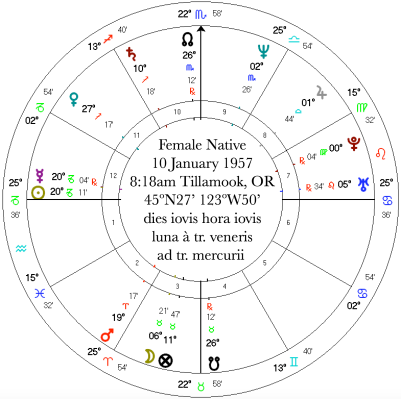
spirituality chart 8This chart belongs to a native who reported that, in the summer of 2018 while traveling abroad, they had a near death experience that resulted in something of a spiritual transformation, by which the native meant that they had a newfound sense of identity and purpose as a result of undergoing this trial. The native’s narrative reminded me of the phenomenon of “shaman sickness,” wherein those who are undergoing some form of shamanic initiation go through a debilitating physiological and spiritual illness en route to their awakening as someone who has a foot in either world.
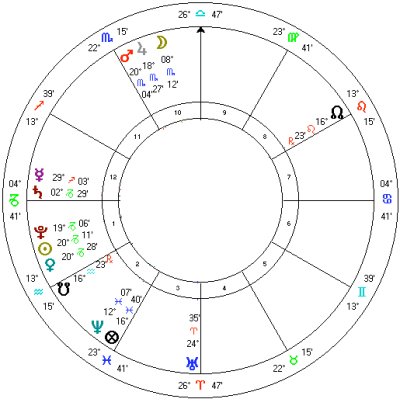
We see first the prominently placed Sun/Mercury cazimi. It’s just over five degrees above the ascendant, but I am going to lean on Lilly and call this a first-house Sun/Mercury cazimi. This is the inferior cazimi as well, as Mercury is retrograde, and therefore is at the very beginning of his cycle and is being symbolically reborn in the heart of the Sun. I imagine there’s something of Mercury cazimi in Capricorn that is richly iconographic of Mercury’s role as psychopomp, since here he is, being reborn in the house of the dead (Capricorn) and closely connected to the focal point of the native’s chart. We also need to note that the Moon’s very next aspect, beyond crossing the Part of Fortune, is her application to the trine of Mercury, having separated from the trine of Venus prior to entering Taurus. Yet there’s quite a bit of distance between the Moon and her perfection of Mercury—when she closes that gap, she’ll be just a few degrees shy of the 4th house cusp.

Mercury also rules the fifth and eighth houses in this chart, and Jupiter is placed in the eighth. Jupiter himself is in Libra, not terrifically dignified but strengthened mightily by his mutual sign reception with Venus, who rules the fourth (the ancestors and the grave) as well as our main house under consideration, the 9th. Jupiter and Venus support each other in accomplishing what it is they desire to make happen. Likewise, Jupiter applies to Saturn by sextile, which is also received (in this instance by exaltation), so this eighth house Jupiter has quite a bit of support both from his exchange with Venus and the willingness Saturn has to listen to him—and as a planet placed in the eighth house, Jupiter needs all the help he can get.

Yet we must consider that Venus, our 9th ruler here, is placed at the cusp of the 12th house. It’s likely that the native will experience their spirituality as needing to go beyond the everyday and will find that particular path as isolating as it is beautifully fulfilling. Added on to Jupiter’s placement in the house associated with death and debt, it’s a fair guess that death will be something significant in this native’s experience of spirituality. I’m not saying that the native necessarily needs to be a funeral director or get used to being around death, but their relationship with mortality is certainly going to be a direct route into spiritual growth for them.

With all that in view, let’s look at the fact that the native had a near death experience in the summer of 2018 that resulted in a newfound spiritual awakening. I’m interested in seeing whether we might have been able to predict that from the nativity, or whether it was a result of ever-present chaos. So! Let’s look at the solar return, the profection year, the transits, and the secondary progressions to determine if there’s any signification that might have clued us into what manifested for this individual.

Example 8.a: Solar Return & Profection

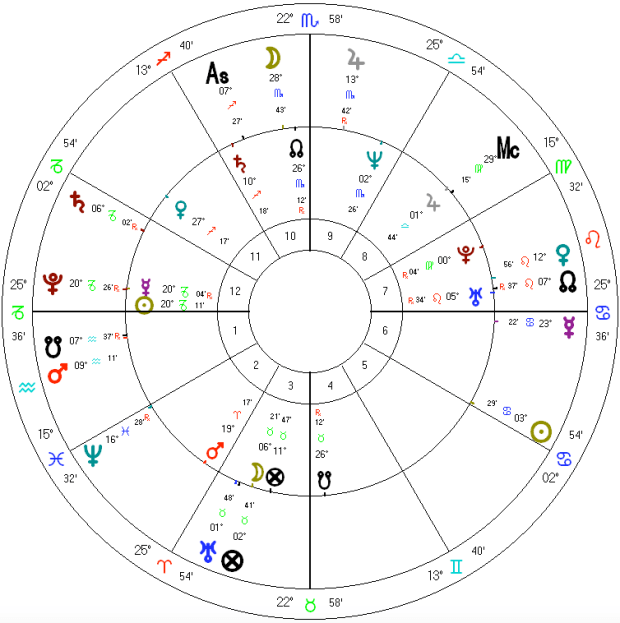
Example 8.a. Solar return chart for January 2018The native turned 61 years old on 10 January 2018. The near-death experience occurred around Sunday, June 24th, 2018 while the native was on a trip in the Mediterranean. This means that the native was in a 2nd house profection year, which in the native’s case means that it is a Jupiter year. In the Solar return, Jupiter is in Scorpio near the 11th house cusp, with the Moon applying to the conjunction to Jupiter (by way of the trine of Neptune). Of course, one of the major transits in 2018 was Jupiter’s retrogression and trine to Neptune prior to stationing direct and applying to the sextile of Pluto. Right off the bat, we’ve got a lot of Jupiter-type things happening, and Jupiter’s natal position in the eighth house is going to draw eighth house significations into the native’s subjective experience of the unfolding year, inclusive of the transits to Neptune and Pluto.
Example 8.b: Transits at time of NDE

Screenshot 2018-10-15 17.25.48

At the time of the native’s near-death experience, a number of things were happening: first, we see that Neptune had, at this point, crossed over the natal 2nd cusp, which, because it’s a 2nd house profection year, is functioning symbolically as the native’s ascendant. Let’s begin by considering that Venus in Leo as the natal 9th ruler is applying to the square of time lord Jupiter in the 9th by transit. Again: Venus is the natal 4th ruler. Because this aspect is between benefics, we wouldn’t expect it to be as deathly as we might otherwise surmise. But is a square between Venus and Jupiter enough to presage a brush with death? I’m not convinced.

Those of us who practice traditional astrology tend to treat all three outer planets as functional malefics if we use them at all, and Neptune is no different. Likewise, we have Pluto, who has been floating back and forth over the natal Sun and Mercury cazimi for several years now, applying to the conjunction of that same cazimi.

We also have Jupiter separating from the trine of Neptune by transit, himself also retrograde and in the 9th. With Neptune dissolving the symbolic ascendant for the year and the time lord engaging with that outer malefic by trine while Pluto is throwing gasoline on the fire of the natal Sun/Mercury cazimi, this looks like a pileup that will signify some kind of spiritual engagement with dissolution of the body and energetic intensity (which, frankly, describes what we might expect a classic NDE to look like). But I’m still not sure if the stack of testimonies we have now would lead us to be able to predict something like what the native endured. So, let’s look at the secondary progressions as well, just for kicks.

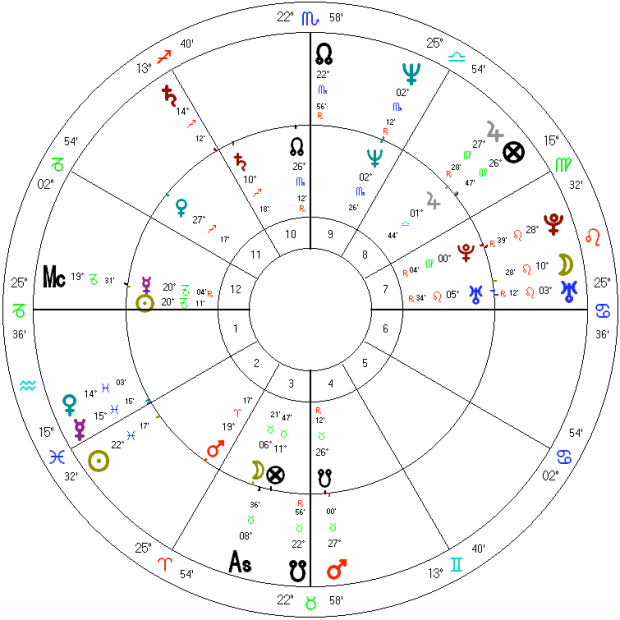
Example 8.c: Secondary Progressions at time of NDE

Screenshot 2018-10-15 17.25.15

The main thing that draws my attention in the secondary progression chart is the secondary progression of the natal eighth ruler Mercury to the cusp of the 2nd house, which, of course, is functioning symbolically as the ascendant during this year of the native’s life. Mercury in Pisces is… not so great. (“O Death, be not proud!”) A brush with death seems symbolically apt here, but to be frank I’m not actually sure if there’s a precedent for using profections and secondary progressions simultaneously in delineating a single testimony to an event that’s happening in the native’s life. Big if true, in other words.

We also see that the Midheaven degree is coming up quickly on the natal Mercury/Sun cazimi, and since the MC is in a sign of short ascension at the time of this event by secondary progression, this will conjoin and complete within the year, I imagine. The native’s public persona is being significantly colored by importing the significations of the Mercury/Sun cazimi by secondary progression—that is, what I spoke to before, viz. Mercury’s moment of rebirth, becomes part of how this individual’s life story impacts the world around them and how they are seen by others. I would also note that the Moon’s relationship to Saturn in the secondary progressed chart is significant insofar as Saturn is the ruler of the native’s 12th and 1st houses; there’s something here that we might want to put a pin in for further exploration, but I don’t think it’s as significant in terms of the present conversation.

So what?

What this exploration has shown is that deeply transformative spiritual or transpersonal experiences can be demonstrated through predictive techniques applied to the natal chart, and the astute practitioner will be able to look at such factors and say, “oh, hey, keep an eye out in June.” I’m not confident that a practioner would be able to say that the form of such an experience would necessarily be a near-death experience, and frankly, I would like to have seen more support for such an event through transits involving the fourth and eighth rulers more clearly, but the secondary progression remains significant.

I’m honestly interested, too, if the practice of looking at progressions to the profected ascendant is a defensible practice—there remains work yet to be done, as ever. I’ll be back soon with another judgment of a similar experience to continue to build out the factors we might consider in order to arrive at predictions of Damascus Road experiences such as the one this native underwent. That said, I’m content leaving a certain amount of agency to the wiles of chaos—and, I suppose, to the Divine itself. The bigger purpose here, I think, is to be able to see something like this coming down the pipe and grease the cogs so that the native doesn’t get completely blown away by it. Some of us are better equipped to handle these kinds of events than others, and I suppose that we’d employ a judgment on similar astrological factors to determine how well a person might be able to adapt to the wisdom such crises render.

Featured image by Viviana Rishe via Unsplash

My Favorite Psychopomp: Virgo, Mercury, and the BVM

I’m undergoing something of a spiritual key change.

I’m playing variations on the same material I always have, but as my understanding has deepened and broadened (and as Jupiter has been transiting my 9th house in Scorpio), I find that these days I’m playing this material at a new pitch level that’s requiring any number of adjustments to compensate for the untold variety of different harmonics and intonations that my life’s song is generating at this new pitch. In fact, it’s almost as though there needs to be a pause for re-instrumentation, because some instruments can’t play in A major as easily as they can play in B-flat major, if you’ll allow my overblowing of the metaphor.

The Blessed Virgin has a hold on the scruff of my neck that doesn’t seem to let up, regardless of how my spiritual schemata continue to shift and grow and change under Jupiter’s enervating influence. She’s been in my corner for quite a while, as far as I can tell. Which is why this particular Virgo season has me thinking more deeply about the connection between the sign of the Virgin and the person of the Virgin, both as an archetypical reality and as a means of interpreting things going on in Mercury’s nocturnal home.

The association between Virgo and the BVM is a facile one, and I’m well aware that there are any number of myths undergirding both the sign and the constellation of the same name—most notably Astraea and her Eagle—but, for me, the connection to the BVM mythos is doubly strong because of my particular religio-cultural context. I’m also a Virgo Sun, so, I have lived the bulk of my life growing into an understanding that a fundamental ego purpose of my existence is to adapt and to perfect within the material realm.

While listening to commentary on Virgo placements during an episode of my friend Melanie’s podcast, I suddenly found myself thinking once again about this connection between Virgo and the BVM not because of any sacred baggage we might attach to “virginity” but rather because of the idea of “adapting to material learning” that Demetra George uses as a byword for Mercury’s purposes in Virgo.

Virgo is, when you’ve gotten down to the heart of its significations, primarily about making things real. This is why Jupiter struggles so hard here, and most Virgo Jupiters I know skew towards a particular kind of over-examined rigidity whether in faith or in skepticism. Mercury, however, rejoices to make things real, taking ethereal concepts like words and meaning and value and transmuting them into material things that we can pick up and share and carry around with us and distribute and hoard—things like money, or books, or words, or even ideas themselves. Mercury transforms the extraordinary things of our hopes and dreams and wildest imaginations into the ordinary stuff of everyday life, but in the most extraordinary of ways.

With this movement towards reality in mind, I want to look again at what I consider one of the peak moments of the story of Mary in the New Testament, namely, her song of exultation after having shared with her relative Elizabeth what has happened to her, viz., being told by the angel Gabriel that she is to give birth to a messiah:

My soul doth magnify the Lord,
And my spirit hath rejoiced in God my Saviour.
For he hath regarded the low estate of his handmaiden: for, behold, from henceforth all generations shall call me blessed.
For he that is mighty hath done to me great things; and holy is his name.
And his mercy is on them that fear him from generation to generation.
He hath shewed strength with his arm; he hath scattered the proud in the imagination of their hearts.
He hath put down the mighty from their seats, and exalted them of low degree.
He hath filled the hungry with good things; and the rich he hath sent empty away.
He hath helped his servant Israel, in remembrance of his mercy;
As he spake to our fathers, to Abraham, and to his seed for ever.
(Luke 1.46-55, KJV)

There is a lot that could be said here, but I want us to think about this: the story of Mary, a peasant girl from a nowhere town with no social prospects, who has become pregnant out of wedlock and has an unbelievable story about precisely how that happened, who is part of a people group who live under the thumb of oppression, has every reason to expect that her wildest dreams will never come to fruition and to linger in Piscean/Jovian dissolution. To wit, she is easily the first candidate for someone we would imagine would have no recourse in this world but to escape into flights of fancy.

But if we notice how the writer of Luke’s gospel has recorded Mary’s words, we notice one thing: nothing is in the subjunctive. All of her declarations are in the perfect tense; they have been accomplished, and there’s nothing left to wait for or to let remain the purview of dreams. Notice too that Mary’s Mercurial song of transmutation and magnification takes an easy potshot at everything Jupiterian or Piscean: “[God] hath scattered the proud in the imagination of their hearts.” After all, magnification is the very process by which the small becomes visible.

Mercury has transmuted what we would expect to be Piscean idealism and dissolution into the here and now, and not just the spiritual here and now, but the real socio-political right here, right now—what Mary sings of is not “salvation” as in being removed to some far away place, but rather the kind of salvation that manifests in corrupt governments being overthrown and the last and the least being given, at last, justice and equity in their plight. Adaptation to material knowledge, indeed.

Virgo scatters imaginations and flights of fancy to magnify the utterly real day-to-day stuff; Mary’s song draws the reader’s attention to that which is most on the minds of this oppressed and colonized people group and states, in no uncertain terms, that what was once the exclusive purview of dreams and prophecies has become as matter of fact as the sky’s being blue. That seems to be what it is that Virgo does, and likewise what the BVM does with all of us who have a connection with her ancient and archetypical image: she magnifies and realizes, leaving us unable to let that which is most important to us remain the exclusive purview of some far-off hope.

I’d also add briefly that Mary serves an important role as psychopomp and intercessor between humanity and the divine. Considering the overlapping function of Mercury within Greco-Roman mythology, this is not something to overlook. I surmise that this is one of the reasons that the BVM-as-Virgo archetypical notion serves to reinforce the idea of the priorities of Virgo being servile and helpful. If Mercury in Gemini is a fleet-footed go-between, Mercury in Virgo is much more strongly connected to the idea of advocacy and assistance—an “in” with the divine, so to speak, which is precisely the BVM’s function in non-Protestant religiosity.

Perhaps this is another one of the reasons that I have such a devotion to her. Because I was socialized believing that God is fundamentally “male” (even though that’s not a defensible position theologically) and, after all, I’m afraid to talk to men. But I can talk to Mary any time with the ease and facility of talking to an old friend’s mom at the dinner table. This ease and facility is another one of Virgo’s key significations, for Mercury here can adapt immediately to any incoming information or material and get it precisely to where it needs to go in order to be most effective, just as Mary and other such psychopomp figures can route incoming souls, prayers, magics, etc. to precisely where they will be most effective.

It’s with all this in mind that both my spirituality and my astrological practice continue to grow and reorganize as I draw close to my next solar return—which will ensconce the perfecting Mars/Uranus square as thematic of the next twelve months, and Mars rules my 9th. All that to say, what key this life-music will end up in by next September is anyone’s guess, but at the very least my Virgo sun will know what to do with all of that information when I get there.

Featured image by Jochen Rehm | Alamy Stock Photo

The Astrology of Spirituality, Part 2

In my last entry in this series, I laid out some ground rules for the way we might approach and understand the way a person’s approach to spirituality is coded in their natal chart so that we astrologers, as persons engaged in spiritual care and “pastoral counseling,” can best target our own approach to these matters with our clients. I put out an all-call on Twitter for people who might be interested in having me delineate their charts for them in this matter, and the following three charts are the first set of those who graciously volunteered their data for this project.

In each case I’ve delineated the chart first and then gone back to the individual to determine what they have to say about their own spirituality. Let’s recall what the basic significations are which we’ll be taking under consideration:

  • First, we look to any planets placed in the 9th house or the 3rd house (the spirituality/religion axis), and their dignities and fortitudes. Since these houses are by nature cadent, we’re not going to consider cadency by placement as much of an accidental enfeeblement as we would otherwise.
  • If there are no planets there, we then look to Jupiter as well as the 9th ruler, specifically to their natural significations and placement, as well as to their dignities and fortitudes, including planetary motion, phasis, etc.
  • In doing some additional research, I discovered some references made by Anthony at Seven Stars Astrology citing Mercury as the natural significator of rationality and critical thought, as well as Saturn as the natural significator of doubt, fear, challenge, and rot—so I shall be considering them as well from here out (briefly).
  • We’ll also keep the ascendant and its ruler in mind as the general significator of the native themselves.

As we saw from the examples shared last time, essential dignity is not the only factor we need to take into consideration when judging an individual’s propensity to religiosity, as all three of the individuals judged in the last set had Jupiter in debility but strongly placed and ruling significant places in the chart. Wade made the comment that planets in debility, especially angular ones, sometimes tend to attract the attention of the native in such a way that they become major life foci, and I found this to be true in the three previous examples.

This time around, all but one of the charts have Jupiter in one of his signs, whether Sagittarius or Pisces; the remaining example has Jupiter in Aries in a day chart (though in this case the Sun is within 5º of the Descendant, so we may surmise that the chart could, in some ways, behave as a night chart). As a reminder, I’m using Placidus houses, Dorothean triplicities, Chaldean decans, and Egyptian terms.

CHART FOUR

spirituality chart 4.pngRight off, we see that we have Pluto in the 3rd, but we’ll hold off on judging that for now. The 3rd/9th axis for this individual lies across Sagittarius and Gemini, so we are going to be looking first off at Jupiter and Mercury, as well as the Moon, and at Saturn. We might as well bring Venus into the mix too as we’re looking at the ascendant and its ruler, but let’s focus on Mercury and Jupiter for now.

As ninth ruler, Mercury happens to be in a mutual sign reception with Mars and is empowered because of that reception. Mercury is also in an angular house and further supported by the sextile from Jupiter which is still active yet separating at this moment.

This would be a passable Mercury on its own, but we also see that Mercury is co-present in the sign with restrictive Saturn, who rules the 4th (home and ancestry) and the 5th (creative work and self-propagation). Mercury likewise is under the beams—but not combust! Mercury is two degrees shy of making a phasis, emerging from the Sun’s beams presently—and will in fact do so within a few days of this native’s birth. I’m not content calling this a phasis yet but it will be presently.

Remember too that Aries is a cardinal fire sign, so we might adjudge that the native will approach matters of spirituality in a way that demonstrates motion towards initiating one’s own identity knowledge. I very specifically use the word “initiating” there for its specific overtones of religious initiation—this person will need to undergo some kind of initiatory experience to make their spirituality truly their own and to emerge from the influence of their upbringing.

Meanwhile, Jupiter rules the 3rd, the “religion” house as well as that of neighbors, etc. and is placed in Aquarius in the 5th house, a fixed air sign, supporting Mercury by sextile. Jupiter in Aquarius knows what it is that it believes and will nary be convinced otherwise (fixity of ideas is thematic), but because of Aquarius’ humane nature, and even moreso because of Jupiter’s rulership of the 3rd as well as the 6th, this individual’s neighborhood religiosity may aptly be described as a sense of familial obligation to tradition. If this works for the native, great, but if they feel they need to move forward in a different direction (as I imagine they would because of their Mercury placement), they must do so in conversation with the tradition whence they came.

My judgment would be that the spiritual practice of this individual is Mercurial in nature, investigatory by virtue of the 9th cusp’s placement in Gemini and has as one of its major themes the sense of emergence from patriarchal influence, even though it will be bolstered by this native’s ability to remain connected to their communal traditions in some meaningful way (3rd house ruled by Jupiter, who supports Mercury via sextile). That said, the obsession with which they might pursue those connections could cause them to overcorrect in one direction or the other, especially if they try to separate themselves from the influence of older and more powerful men (Pluto on the 3rd cusp, Mercury is combust while the Sun is the sect light, Saturn co-present with Mercury in 7).

The native responded:

“ ‘The native’s story of religiosity and spirituality is going to be about emerging from underneath the influence of tradition and ancestry to come to a spiritual horizon of their own discovery.’ I just want to say that I strongly resonate with this quote and this is basically a very small sum of my spiritual journey.” The native’s parents raised her in Christianity, but later in life, the native proceeded to find her own spirituality through philosophy. She notes, “my solar return for 2017 really brought the notion for the self-discovery to come up. It was a 9th house profection year for me and I had a stellium in that house. That year, I changed to a philosophy major.)”

The native also wrote that “the native will approach matters of spirituality in a way that demonstrates motion towards initiating one’s own identity knowledge” was an accurate statement, reporting, “a topic that I am very strongly interested in is the philosophy of identity and how to go about creating and sustaining one. It’s interesting that you said an initiatory experience, because that most definitely happened. The wheels on creating on my spirituality remained dormant until I discovered astrology.” The native also confirmed that I don’t quite she indeed experienced obligation to follow the spirituality of the people surrounding her, saying, “I do have a very strong need to overcorrect myself to connect myself to communal settings.”

CHART FIVE

spirituality chart 5.pngHere, the 3rd/9th axis lies across Libra (11º48’ on the 3rd) and Aries on the 9th, with the Sun placed in the 9th in his exaltation and ruling the ascendant. Right off the bat, we have a notable portent that the question of spirituality and religiosity will factor in prominently not just in the native’s life but in the very way the native lives in and moves through the world. As we saw with the previous native, their will is oriented towards initiating identity learning, that is, establishing who it is they are in the world, and moreover in this instance, the realm of life where that plays out is the field of spirituality and religion.

Lilly writes that the Sun in the 9th “shewes much piety in the Native, gives religious Preferments, and makes admirable Preachers” (Christian Astrology 612). The Sun is exalted and joined with the North Node—to which point Lilly also writes, “if Jupiter, Venus, or North Node possesse the 9th… the Native proves a good Christian, and a lover of Religion wherein trained up” (612). That the Sun is exalted and “dialed up” due to the North Node’s proximity is an important factor in this native’s story of faith.

If we look at the 9th ruler, we see an exalted Mars in the 5th in Capricorn. This native engages their religiosity through the mode of creative expression and I wouldn’t be surprised at all if they have a tendency towards the ancient and eldritch in their practice, as is apparent with Mars’ placement in this Saturn-ruled sign. I’d also note that Fortuna’s placement in the 3rd suggests the significance of incisive writing, communication, or networking to this person’s livelihood—but a more important indication of the same is the 3rd ruler being Venus, who also rules the 10th and is placed in her domicile conjunct the MC.

Let’s look at Jupiter, while we’re here: Jupiter is one of the chart’s final dispositors (the Moon and Venus are the other two, but neither of those have planets answering to them). If we follow the chain of dispositors, the Sun answers to Mars, who answers to Saturn, who answers to Jupiter. Mercury answers to Jupiter as well. So whatever skepticising or limiting factors may be present within the native’s life are beholden to this more prominent spiritual principle. Jupiter lies on the 8th house cusp in Pisces, where he has rulership. This is a religiosity that would rather dissolve into a cloud of prayer than have anything resembling a systematic theology (Mercury is in fall and detriment in 8th), and any attempts to systematize a conception of belief will not work for this native.

I also notice Mars’ application to Jupiter by sextile from the sign of Jupiter’s fall, suggesting a kind of creative tension that might emerge when the native’s roots and religion (4 and 9) butt up against the native’s creative self-propagation and their experience of death and the demands placed on them by other people (5 and 8). In fact I wonder whether the native’s roots and religion might become prominent fodder for the material the engage with in their creative endeavors, if they choose to do so.

Also of note here is the Moon’s application, from the 11th house, to the opposition of 9th ruler Mars from Mars’ sign of fall after having opposed Neptune. The sign of the 11th house is double-bodied and mutable, We see too that Mercury rules the 11th, and is placed in a double-bodied mutable sign as well (again, Mercury’s detriment and fall), suggesting that particular affiliations with societal groups, denominations, or other such entities will not be a comfortable one, despite the native’s desire to seek out emotional security through their attachment to group affiliation—and this will engender no small amount of change in the native’s life.

The native has reported that he is a musician and writer and works a day job while engaging in any number of creative venues with his free time. He was raised in a conservative Christian tradition and became an Episcopalian later in his life. He also spent some time in discernment for holy orders in the Episcopal Church (Sun in 9th!), though did not ultimately move forward in that process and instead began practicing Zen Buddhism while maintaining his connection to the Episcopal Church. He jokes that, at his funeral mass, he would like the Berlioz requiem to be played, the celebrant to say the mass in a hushed and terrified whisper, and the homily to be a Zen roshi screaming once and then sitting in silence while the congregation waits, bewildered, for what’s going to happen next.

CHART SIX

spirituality chart 6.pngHere, the 3rd cusp lies in Capricorn and the 9th in Cancer (the cusp of each being at 5º50’). We have no planets in the 9th, and in the 3rd, we have the Sun, who is just shy of the 5º mark of being on the cusp of the 4th. For all intents and purposes then, I’ll read the Sun in the 3rd, which Lilly says “doth increase the signification of goodness,” suggesting a natural inclination toward some sort of neighborhood practice.

The 9th is ruled by the Moon, who is placed in Sagittarius in the 2nd house. She separates from the square of Saturn and is actively applying to the conjunction of a peregrine Venus: we would expect this native’s approach toward spirituality is one of seeking out expansive and aesthetic expressions of beauty. Venus herself applies to the sextile of Mercury in Aquarius, and she applies from the sign of Mercury’s detriment. Neither Venus or the Moon are received by Mercury, and as the Moon will reinforce this connection by crossing Venus and immediately pushing her virtue to Mercury, I would suppose that that her significations will be regularly challenged by a searching scrutiny that invites the native to consider the social and societal impact of their spiritual dalliances.

Because Jupiter is well-placed by sign and in an effective house (though not as effective as one of the angles would be), we further expect Jupiter’s natural significations to be able to shine forth, especially in the native’s relationship to their finances or in their self-propagating work. The fly in the ointment here, however, is the presence of both Mercury and Saturn in an angular house (4th), where both of them have extensive opportunity to act but will have to rely on their dispositors to accomplish anything. Jupiter applies to Saturn from an overcoming square, pressing his agenda onto Saturn doubly since Saturn is ruled by Jupiter here (and Jupiter is the only final dispositor of the chart), yet Saturn regards the 9th cusp with a trine, suggesting that he almost has one hand stabilizing what could be an over-emotional, nigh charismatic spiritual temperament.

This individual will encounter barriers and restrictions anywhere they are making attempts to expand their horizons to include religiosity, and particularly as far as finance and fun are concerned. Given Saturn’s rulership of the 3rd and 4th house we would expect these constricting influences to emerge from the native’s neighborhood, siblings, parents, and upbringing. In particular, their dalliances with their concept of the divine will be watered down by incisive rhetoric from the groups they have found themselves allied to as well throughout their upbringing, almost as though their expanding and optimistic vision for what the world could be will be under constant scrutiny and will meet constructive resistance that ultimately yields and serves to provide them with a structure that allows their expanding beliefs to flourish.

The native responded:

“The sentiment that connects with me the most in your write up is the presence of an expansive religious influence mitigated by scrutiny. Despite being very receptive to a whole array of possibilities concerning invisible influence on human life, I feel obligated to filter these interests, somewhat, when presenting myself and my ideas. I think scientific materialism is short sighted, but I also think it’s reasonable for people to be weary of religion, and spirituality, for being exploitative, or heavy handed, in a lot of cases. I practice magic and have always felt there’s something deeper to the experience of life than just surface humanity, but I also remain agnostic, sensing that I won’t prove anything to my family and my community by religion alone. It feels like a charge to translate an internal optimism into material results that directly improve the lives of others.”

CHART SEVEN

spirituality chart 7.pngIf we’re going to talk about charts with dignified Jupiter, this would be a chart for the ages, considering Jupiter’s rulership of both the ascendant degree and the midheaven, his elevated placement in the chart, and his strong essential dignity. It should be no surprise that spirituality, religiosity, and values are of tremendous import to this individual. Jupiter is, however, retrograde, and the Sun-Jupiter opposition for this cycle is coming very close to perfecting while the Sun is in one of the signs of Jupiter’s detriment, highlighting a tension between ego identity and spirituality that may become emblematic of the native’s life—and this tension emerges most strongly in regard to the native’s experience of their parents or upbringing and their partners, where they may in fact feel confined by the tension. Their sense of duty or obligation is at direct odds with their very nature.

Moreover, Mars applies mutually to Jupiter by an overcoming square from the other sign of Jupiter’s detriment and ruling the 9th, almost as though the native’s experiences with a deep, searching, and exacting spirituality (Mars in Virgo angular) serve as a snare that presents the native with challenges throughout their life in the realm of coming to terms with themself as well as in their professional and vocational identity. Moreover, I suppose it would be difficult for this native to date or form collaborative partnerships with individuals whose beliefs or values differ from theirs.

At the same time, the Moon separates from the sextile of 9th ruler Mars, where she offended Mars with her sensibilities and application from the sign of Mars’ fall, and applies now to Venus, who doesn’t necessarily receive her but is amenable to her presence. Venus is situated directly on the 3rd house cusp suggesting that this individual’s experience of commonplace religiosity, so long as it remains unchallenged (which is unlikely due to Mars’ prominence and overcoming square towards Jupiter), will sit fairly well with them.

It’s also worth mentioning that the 11th ruler, Saturn, is in the 1st house, in Pisces, mollified somewhat by the sextile of Venus. Once again, Saturn attempts to structure, and he can’t do that very well in Pisces—this native’s relationship to structures and containers of faith will be difficult for them to navigate and they would likely do best with older traditions to have some sort of solid footing underneath the extreme expressiveness and forward-driving particularity they might otherwise pursue to their detriment.

This native, an artist (dignified Moon in 5 applying to the sextile of Venus in the 3rd) was raised in a conservative protestant environment and was involved with a number of evangelical campus ministries, but upon leaving college began studying Judaism out of a need to find an expression of faith that enabled them to be fully present to their sexual and gender identity. This person has a strong sense of values and has little qualm engaging with people with whom they disagree in sometimes spectacular fashion, but they care deeply about social justice and creating a more just world for all (Venus on the 3rd cusp, as well as opposing the 9th cusp, in Taurus). During their recent 11th and 12th house profection years, this native converted to Reform Judaism and is already exploring a possible career as a rabbi.

For kicks, I’ve included this native’s current solar return; they converted to Judaism about two and a half months after their birthday. This is a 12th house profection year, so the year ruler is Saturn. We see the telling mutual application of the Moon to Saturn right at the 4th cusp, which is the natal 11th cusp, while Mercury and the Sun gathered around the 9th house cusp—this is the natal 4th cusp. The Sun here, of course, rules the solar return 11th house. We might describe, briefly, this collection of significations as “entering into a new spiritual foundation.”

So what?

We see from the preceding examples that having a dignified Jupiter does not quite necessarily mean that the native will make religion or spirituality a major component of their life process, though it certainly can go in that direction. What I sense with this particular placement is that a dignified Jupiter demands authenticity in spirituality and will not suffer being sequestered to anything resembling “going along to get along,” unless, I suppose, said Jupiter had dominion over the 11th. Yet more research remains to be done regarding dignified Jupiter placements, and I’m especially interested in Jupiters that rule the 11th. The reason for this is because there’s a difference between pursuing an authentic spirituality as an individual, which is the case with each of the individuals above, and pursuing an authentic spirituality for you that happens to be the spiritual tradition in which you were raised.

Still more, we have seen here instances where malefics rule the 3rd or 9th house, and those malefic rulerships have almost served as factors to propel the native forward in their “spiritual journeys,” to use a hackneyed phrase of convenience. None of these individuals has necessarily found “ease” in their pursuit of an authentic spiritual position and praxis, but they have found what they sought (to my knowledge).

The next set of entries will look at arrangements that involve Jupiter in his exaltation and his fall (so, Cancer or Capricorn Jupiter placements) as thematic of that individual’s essential religious temperament, contrasted with the other considerations that Lilly and others have raised when judging a native’s propensity toward or away from spirituality. What I’d really like to do is look at the charts of a number of skeptics or hard-line atheists, though I don’t believe many of those will be lining up to volunteer their birth data. Such is the nature of the art, I suppose!

If you’d like to participate in my study, please get in touch! I’m extending a 10% discount on any of my services to participants.